
Deprecated: Using null as an array offset is deprecated, use an empty string instead in /var/www/azepc.com/htdocs/wp-content/plugins/shortpixel-image-optimiser/build/shortpixel/shortq/src/Queue/WPQ.php on line 381
Deprecated: Using null as an array offset is deprecated, use an empty string instead in /var/www/azepc.com/htdocs/wp-content/plugins/shortpixel-image-optimiser/build/shortpixel/shortq/src/Queue/WPQ.php on line 381
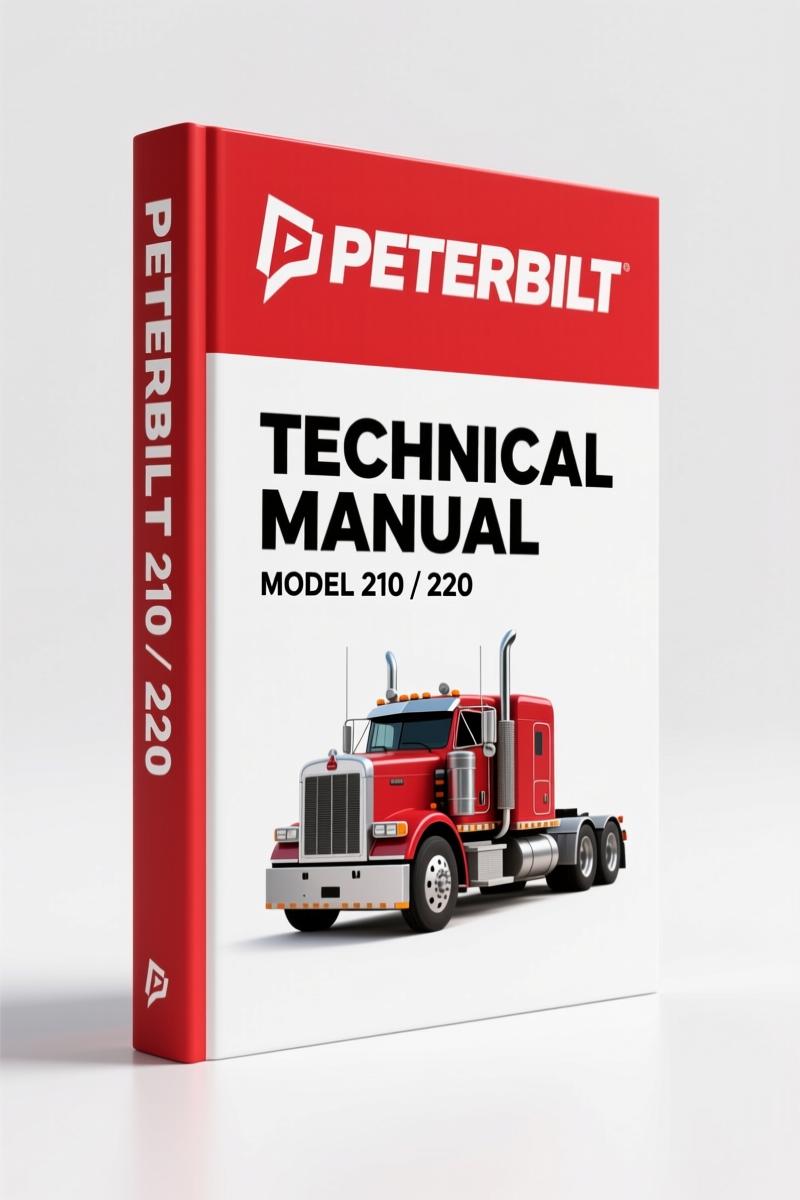
Peterbilt 210, 220 Technical Manual – OEM Factory Specs for 96 Pages
Original price was: $32.50.$25.00Current price is: $25.00.
Factory-certified 96-page technical manual for Peterbilt 210 and 220. Exact dimensions, cab tilt, frame layouts, and emissions compliance data.
Description
Peterbilt 210, 220 Technical Manual – Factory Body Builder Specs
If you are planning to mount a body on a Peterbilt 210 or 220, you need the factory specs before you drill a single hole. I’ve seen too many frame failures from guys who guessed at crossmember locations or used aftermarket dimensions that were off by half an inch. That’s why this Peterbilt 210, 220 Technical Manual sits in my toolbox. 96 pages of direct-from-Peterbilt data, not some third-party reprint with fuzzy numbers. You want turning radius? Cab tilt angles? It’s all in Section 3. You want DEF system routing? Section 4. Spend an hour with this before you touch a wrench.
Dimensions, Turning Radius, and Cab Tilt (Section 3)
Section 3 is where you live if you’re building a body or installing equipment. Every dimension is listed for both the 210 (19.5 tires) and the 220. Side views, front and rear views, chassis heights – all with OEM tolerances. Turning radius data is on page 3-2. Cab tilt specs for the 210 with 19.5 tires on page 3-3. If you need to know where the DPF and SCR sit, page 3-23 gives you exact locations.
Frame rail configurations, crossmember locations, battery box and fuel tank positions – it’s all drawn out with measurements. I’ve had body shops call me asking why their new dump body won’t clear the DEF tank. They didn’t have this manual. Don’t be that guy.
Safety & Compliance: Not Optional
Section 2 covers Federal Motor Vehicle Safety Standards compliance and incomplete vehicle certification. That’s lawyer-speak for “if you alter this chassis, you need to know what’s still legal.” Noise and emissions requirements are spelled out. The safety signal definitions are there so you don’t mistake a warning for a note. Ignoring this section can land you with a vehicle that won’t pass inspection or, worse, a liability issue after an accident. Read it.
You’ll also find the incomplete vehicle certification details on page 2-2. That’s the document that says what Peterbilt certified and what you, as the body builder, are responsible for. Keep a copy with the truck.
Exhaust & Aftertreatment – DEF System Routing (Section 4)
Section 4 is critical for anyone adding a body near the exhaust or DEF system. General guidelines for DEF system installation start on page 4-3. Measurement reference points on page 4-4. PTO clearances are in Section 3, page 3-25, but the exhaust routing and aftertreatment dimensions live here. If you’re adding a PTO-driven pump or hydraulic system, you need to check these clearances against your body design. The manual gives you the minimum distances to avoid heat damage and DEF contamination.
For details on manual transmission interfaces, refer to Manual Transmission documentation. The PTO clearances on page 3-25 also affect Manual Transmission installations.
Frame Layouts and Body Mounting (Section 5)
Section 5 is where the chassis gets real. Frame layouts with visual index and acronym index. Critical clearances for body mounting. This is where you translate the dimensions from Section 3 into actual holes and brackets. The manual shows you frame rail configurations and crossmember locations so you don’t drill through a wiring harness or air line. I’ve seen guys mount a service body and punch a hole straight into the fuel tank. That’s a $2,000 mistake. This manual prevents it.
You’ll also get the critical clearance callouts for specific rear axle suspensions like the Reyco 79KB and Hendrickson HAS. Those are listed on page 3-24 with the tire data.
96 Pages: Why Factory Specs Beat Aftermarket Copies
Aftermarket “technical manuals” often miss the mark on torque specs, frame rail thickness, or wiring routing. This is a direct Peterbilt production. The paper, the table of contents, the indexing – it’s what the factory engineers use. When you order Peterbilt 210, 220 Technical Manual – Factory Shop Specs, you get the real thing. Not a scanned reprint with missing pages. 96 pages of verified data.
For suspension and air bag specs, you might also need the Peterbilt FLEX Air Suspension Service Manual. And if you work on heavier models, the Peterbilt 320 Body Builder Manual covers similar territory for the 320 chassis.
Does This Manual Cover the PACCAR Engine?
Yes. All engine interface dimensions are included in the frame layouts and exhaust sections. The manual isn’t an engine service guide – it’s a body builder’s manual – so it focuses on clearances, mount points, and aftertreatment routing.
Get the Fluid Capacities and Torque Sequences
Fluid capacities for the DEF system and fuel tanks are in Section 4. Torque specs for body mounting bolts? They’re referenced throughout the frame sections – but this is a body builder manual, not a service manual. You get the critical torque sequences for frame rail crossmembers and suspension connections. For engine and transmission internal work, you need a separate powertrain manual.
Access the Factory Manual. I don’t say that lightly. I’ve been wrenching for 28 years, and the number of jobs I’ve saved by having the OEM book in my hand is in the hundreds. This Peterbilt 210, 220 Technical Manual is the difference between a clean install and a comeback. Get it.
- Does this manual cover the PACCAR PX-7 engine?
- Yes. All engine interface specs are included.
- Why do I need the body builder manual instead of a generic chassis guide?
- Because a generic guide won’t tell you the exact DEF tank location on a 210 with 19.5 tires, or the specific crossmember spacing for a 220 frame. This manual gives you Peterbilt’s own measurements, safety compliance details, and aftertreatment routing. Generic guides leave out the critical clearances that cause expensive mistakes. I’ve seen body shops weld brackets right through an air line because they used a generic diagram. This manual prevents that with factory OEM data.
Additional information
| Brand | Peterbilt |
|---|---|
| Language | English |
4 reviews for Peterbilt 210, 220 Technical Manual – OEM Factory Specs for 96 Pages
You may also like…
-
Sale!

Peterbilt 379 Electrical Schematic – OEM Wiring Diagram (98 Pages)
Original price was: $48.00.$40.00Current price is: $40.00. -
Sale!
Peterbilt 389 Electrical Schematic – 67-Page OEM Wiring Diagram
Original price was: $58.40.$40.00Current price is: $40.00. -
Sale!

Peterbilt 387 Wiring Diagram – 73 Pages of Factory Circuit Mapping
Original price was: $56.25.$45.00Current price is: $45.00. -
Sale!
Peterbilt 387 Wiring Diagram – Factory Electrical Schematics
Original price was: $54.00.$40.00Current price is: $40.00.
Related products
-
Sale!

International 1000-3000 Series Operators Manual – 132 Pages of OEM Specs
Original price was: $14.40.$10.99Current price is: $10.99. -
Sale!

1991 Operators Manual – International Truck OEM Specs (108 Pages)
Original price was: $13.63.$10.99Current price is: $10.99. -
Sale!

2011 Parts Catalog – International Truck OE Parts Documentation (1786 Pages)
Original price was: $34.50.$25.00Current price is: $25.00. -
Sale!
1994 Troubleshooting Manual – International 1000-4000 FBC
Original price was: $60.00.$50.00Current price is: $50.00.
Michael T. –
Great factory service manual. The file looks clean. A must-have for any Peterbilt 210, owner doing repairs. I will recommend this shop to others.
pro_mechanic –
Excellent OEM spec sheet. It is easily zoomable on my iPad without blur. It assisted me to fix my Peterbilt 210, electrical system. Saves me hundreds of money.
gearhead88 –
This is just what I required. It is easily zoomable on my iPad without blur. A must-have for any Peterbilt 210, mechanic doing maintenance. Saves me hundreds of time.
William H. –
Five stars! Immediate link after checkout. It helped me to troubleshoot my Peterbilt 210, transmission. Great value for money.