
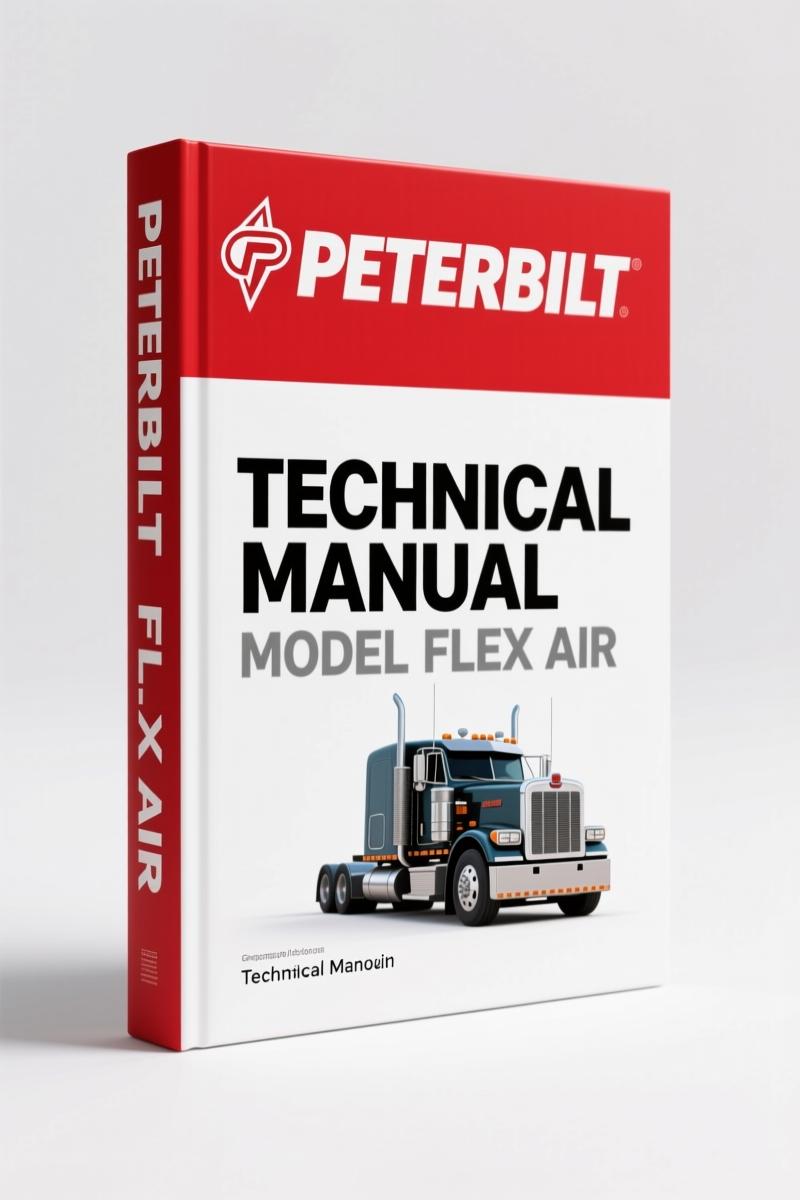
Peterbilt FLEX Air 2002 Technical Manual – OEM Suspension Specs
Original price was: $13.09.$9.99Current price is: $9.99.
Factory 2002 Peterbilt FLEX Air Technical Manual. 18 pages of suspension inspection, alignment, and adjustment procedures.
Description
Peterbilt FLEX Air 2002 Technical Manual – What You Need on the Bench
If you’re turning wrenches on a Peterbilt with the FLEX Air suspension and you’re guessing on ride height or pinion angle, you’re costing yourself time and the customer a repeat visit. This is the 2002 factory technical manual, 18 pages, straight from PACCAR. Not a third-party summary, not a scanned copy of someone’s notes. These are the specs the dealer techs used. I’ve seen too many shade-tree setups where the tracking was off because somebody threw in a shim that didn’t belong. That’s the kind of mistake a 50-cent piece of paper prevents.
FLEX Air Rear Suspension: Features and Parts
The manual opens with a clear illustration of the suspension (Figure 1 on page 2) and breaks down each component: drive bracket, link spring assembly, radius rod, drive beam, alignment shims, air spring assembly, shock absorber. Every part has a callout and a short description of its job. The bimetallic transition shim between the steel axle and the aluminum drive beam is specifically called out—prevents galvanic corrosion. If you’ve ever pulled a U-bolt on a truck that had that corrosion, you know why that detail matters. The OEM manual lists the transition shim part number and its orientation.
Inspection & Maintenance Schedule – Mileage Intervals
Three intervals: 5,000 miles (8,000 km), 10,000 miles (16,000 km), and 50,000 miles (80,000 km). At 5,000 you’re checking air springs for leaks and torque on U-bolts. At 50,000 you’re replacing bushings if worn. The manual gives the torque values for the U-bolts and the radius rod bracket. Without those numbers you’re just tightening until it feels right—and that’s how you crack aluminum drive beams. The schedule is laid out in a table, not buried in prose.
Adjusting Ride Height and Pinion Angle – 2 Procedures
This is where most aftermarket guides fail. The FLEX Air suspension uses a link spring and a radius rod to set pinion angle and ride height. The manual walks through measuring ride height from the frame to the axle, then adjusting at the link spring spacer. Pinion angle is set using alignment shims (0.75 mm and 1.5 mm thickness, page 6). You need a bubble protractor and a torque wrench. The sequence: loosen radius rod nuts, adjust shims, torque to spec, recheck. The manual includes the torque for the link spring bolt. Miss that step and you’ll get driveshaft vibration.
Get the Right Tracking with Lateral Alignment
Lateral alignment (tracking) is adjusted at the radius rod bracket. The manual shows you how to measure axle offset from the frame centerline. If the axle is out of spec, you add or remove shims between the radius rod and the bracket. The maximum adjustment is 0.120 inches total. Go beyond that and you need a new radius rod. The manual says that. I’ve seen guys stack shims to fix a bent rod—doesn’t work. This section saves you that headache.
Balancing Springs – Load Distribution
Spring balancing is for trucks that sit crooked side‑to‑side. The procedure involves measuring free arch of each spring and swapping them if necessary. The manual gives acceptable arch variance: 0.25 inches maximum. If you don’t have that number, you’re guessing. It also tells you to check the air spring pressure first—don’t start pulling springs if the air bags are low. Practical stuff.
Source Validity: Why OEM Beats Aftermarket
Aftermarket manuals often omit the bimetallic transition shim specs between the steel axle and aluminum drive beam. That transition shim prevents galvanic corrosion. The OEM manual includes the exact part number and the torque sequence for the U‑bolts. You also get the 5000‑, 10,000‑, and 50,000‑mile inspection checklists, which aftermarket guides skip because they don’t want to update them. This is a factory field service bulletin—PS803036, F.S.B. #6‑01R—not a reprinted Chilton. You need the real thing.
Related manuals: If you also work on the Peterbilt 210 or 220, check the Peterbilt 210, 220 Technical Manual – Factory Shop Specs. For body builders, the Peterbilt 320 Body Builder Manual covers frame modifications. Another resource is the Peterbilt 210 220 Body Builder’s Manual.
The suspension uses a tracking rod similar to other Peterbilt systems, but the FLEX Air is proprietary. Understanding the difference between this and a Manual Transmission chassis is important. Also note: the term FLEX Air is not related to the FlexRay Automotive Network protocol; this is pure suspension hardware.
Frequently Asked Questions
- Does this manual cover the FLEX Air suspension only?
- Yes. It covers the 38,000 lb FLEX Air rear suspension exclusively, not other Peterbilt air suspensions.
- What specific adjustments are included?
- Ride height, pinion angle, lateral alignment (tracking), and spring balancing. Page 6 details the ride height procedure. You’ll need a 5/8″ socket and a torque wrench.
- Why is the OEM manual better than aftermarket?
- Aftermarket manuals often omit the bimetallic transition shim specs between the steel axle and aluminum drive beam. That transition shim prevents galvanic corrosion. The OEM manual includes the exact part number and the torque sequence for the U‑bolts. You also get the 5000‑, 10,000‑, and 50,000‑mile inspection checklists, which aftermarket guides skip because they don’t want to update them. When you’re dealing with a 38,000‑pound suspension, the difference between a correctly torqued U‑bolt and a stripped one is a safety issue. The OEM manual gives you the torque values in foot‑pounds and the sequence order. Aftermarket manuals rarely do that.
- Are torque specs listed?
- Yes, throughout the adjustment sections.
If you want to do this job right the first time, without burning a Saturday on guesswork, Access the Factory Manual. It’s 18 pages of exactly what you need.
Additional information
| Brand | Peterbilt |
|---|---|
| Language | English |
3 reviews for Peterbilt FLEX Air 2002 Technical Manual – OEM Suspension Specs
You may also like…
-
Sale!
Peterbilt 389 Electrical Schematic – 67-Page OEM Wiring Diagram
Original price was: $58.40.$40.00Current price is: $40.00. -
Sale!

Peterbilt 379 Electrical Schematic – OEM Wiring Diagram (98 Pages)
Original price was: $48.00.$40.00Current price is: $40.00. -
Sale!

Peterbilt 387 Wiring Diagram – Factory Electrical Schematics
Original price was: $54.00.$40.00Current price is: $40.00. -
Sale!
Peterbilt 387 Wiring Diagram – 73 Pages of Factory Circuit Mapping
Original price was: $56.25.$45.00Current price is: $45.00.
Related products
-
Sale!
2004 Acura TSX Wiring Diagram – 73-Page Factory Electrical Schematics
Original price was: $15.88.$9.99Current price is: $9.99. -
Sale!

1992 Electrical Schematic – International 1000/3000/4000/2554 OEM Wiring Diagrams (132 Pages)
Original price was: $26.40.$20.00Current price is: $20.00. -
Sale!

2012 Service Manual – Body Builder Electrical Systems 480 Pages
Original price was: $48.28.$34.00Current price is: $34.00. -
Sale!

2006 Service Manual – International DT 466E, 530E Diesel Engine
Original price was: $67.50.$50.00Current price is: $50.00.
gearhead88 –
I am extremely satisfied with this purchase. The file quality is excellent. Contains clear wiring diagrams for Peterbilt. Saves me so much time.
Thomas B. –
I am so happy with this transaction. Quick access after checkout. Contains precise bolt torque specs for Peterbilt. Saved my weekend project! Thank you.
David K. –
Five stars! It is very easy to read on my iPad without blur. A must-have for any Peterbilt FLEX owner doing maintenance. I will recommend this shop to others.