
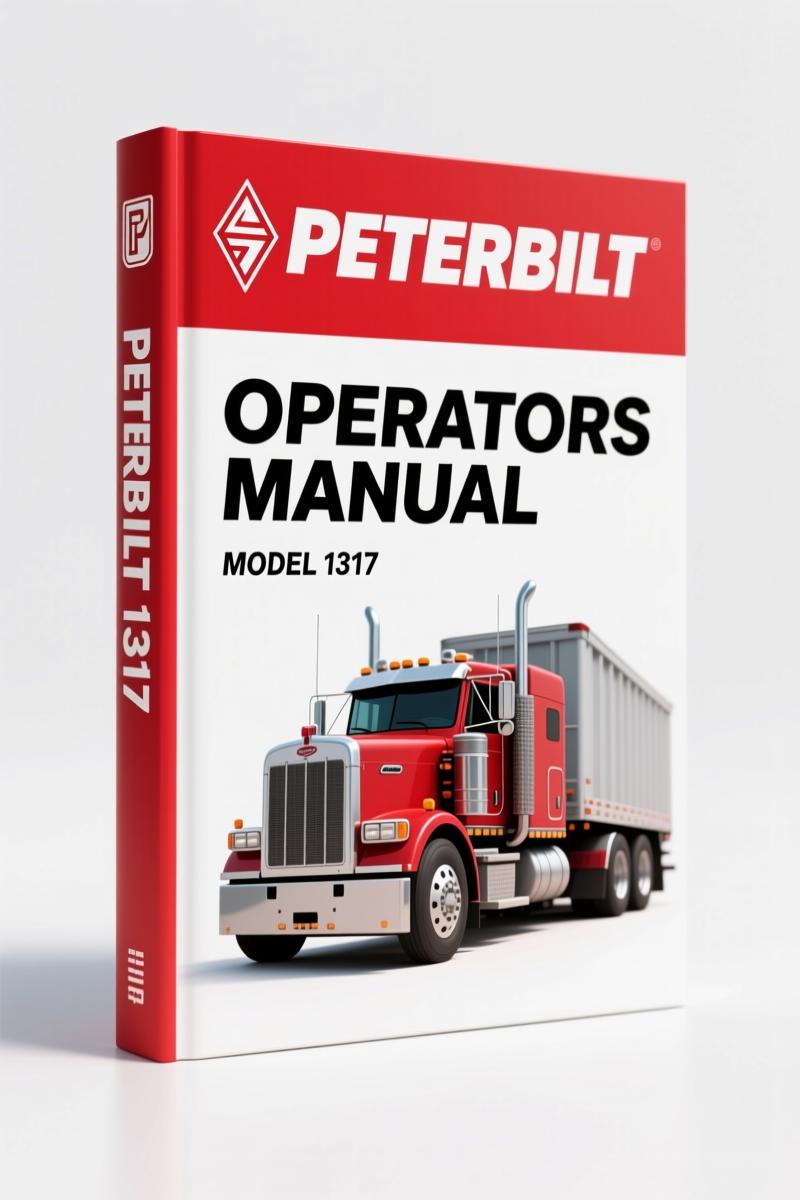
Peterbilt 1317 Operators Manual – 196-Page OEM Operator Guide
Original price was: $15.72.$10.99Current price is: $10.99.
OEM operator manual for Peterbilt 1317. 196 pages of factory controls, dash features, pre-operation checks, and preventive maintenance schedules.
Description
Peterbilt 1317 Operators Manual
If you’re running a Peterbilt 1317 Operators Manual in your hand, you already know the difference between a factory manual and a reprint. This is the real deal – 196 pages of OEM documentation straight from Peterbilt. I’ve been turning wrenches for 28 years, and I can tell you: the driver who reads this before turning the key is the driver who doesn’t come back with a fried starter or a cab that won’t tilt. Skip the aftermarket junk. This is what the engineers wrote for the guys who drive these trucks every day.
What This Operator’s Manual Covers
This isn’t a service manual. It won’t tell you how to rebuild the rear axle or pull a head. What it does is give you the exact procedures for starting, driving, and maintaining your Peterbilt 1317 safely. The Table of Contents starts with the Quick Table of Contents on page 2, then breaks into 10 parts: Introduction, Cab and Frame Access, Controls and Displays, Seat and Restraint Systems, Driver’s Checklists, Starting and Operating, Maintenance and Service, Vehicle Identification, Consumer Information, and a Subject Index. Every section has cross-references so you can jump straight to the cold start procedure or the airbag system warning without flipping through the whole booklet.
Page 76: Driver’s Checklists – Don’t Skip This
Page 76 lays out the Driver’s Checklists. I’ve seen guys blow a turbo because they didn’t check the air filter restriction indicator before pulling a loaded trailer. This manual walks you through what to look at before you start: tire condition, fluid levels, belt tension, brake system pressures. It also includes an in-cab checklist that covers the warning lights and buzzers. If you’re buying a used Peterbilt 1317, these checklists are the first thing you should read. They’ll save you a tow bill.
Cold Weather Starting and Warmup Procedures
Starting a diesel in freezing weather without the right procedure will kill your batteries and your starter. This operator’s manual gives you two cold-start methods: ether metering equipment and preheater with glow plug. It tells you exactly how long to wait, when to engage the starter, and what the engine oil pressure gauge should read before you put it in gear. The warmup procedure on page 80 (in the Starting and Operating section) includes the transmission warmup for COE cabs. Follow that, and you won’t be asking why your shift forks are binding.
Peterbilt 1317 Operators Manual: Built for the Driver, Not the Mechanic
This manual was written for the person behind the wheel. It covers the Jacobs Engine Brake and Cummins “C” Brake switch, the interaxle differential lock, the two-speed rear axle range switch, and the fifth wheel lock slider adjustment. It also explains the Brakesaver manual and automatic control, the bobtail brake proportioning system, and the ABS warning lamps for both tractor and trailer. If you’re a fleet owner, you should be handing this to every new hire. It’s the difference between a driver who knows his dash and one who calls you at 3 a.m. because a light came on.
OEM Documentation vs. Aftermarket Reprints
I hate aftermarket manuals. They copy the text but leave out torque specs, skip the safety warnings, and reprint blurry wiring diagrams that don’t match. This is an original OEM print from Peterbilt – the same manual that came with the truck when it left the factory. The California Proposition 65 warning on page 2 is intact. The safety cable instructions for the COE cab tilt system are there. The airbag system/SRS description includes the sensor/control unit location and the airbag electrical components. You won’t find that in a $20 PDF from some third-party site. Don’t risk your life or your career on a reprint.
Maintenance Schedule and Service Intervals
The Maintenance and Service part begins on page 112. It covers preventive maintenance inspections, fluid checks, filter replacement intervals, and basic adjustments you can do without pulling into a shop. The manual also tells you what to do if your vehicle must be towed – including the procedure for returning a towed vehicle to service. If you have a Peterbilt 579 Operator’s Manual for your other truck, or a Peterbilt Model 320 Operator’s Manual for a vocational rig, the structure is similar, but each model has its own specific controls. The Peterbilt Model 330 Operator’s Manual is also available if you run a mixed fleet.
How to Use the Quick Table of Contents
Right after the title page, there’s a Quick Table of Contents that lists the main parts with page numbers. If you need the starting procedure, it’s Part 7 starting on page 80. If you need the caution about hood tilt safety cables, it’s in Part 2, Cab and Frame Access. The manual even has external cross-references like “For information on how to operate your two-speed rear axle properly and safely, see PART 7: START…” That kind of linking saves you time. For external info on how manual gearboxes work, the manual references the Manual Transmission section. And when you’re shifting gears, you’ll want to double-check the Manual Transmission procedures to avoid grinding synchros.
- Can I use this manual for repairs?
- No. This operator’s manual covers operation, not repairs. Use the Peterbilt service manual for that.
- What is the cold start procedure for the Peterbilt 1317?
- It depends on whether your truck has ether metering equipment or glow plugs. The manual spells out both methods in the Starting and Operating section. For ether systems: set the hand throttle, engage the starter while injecting ether per the equipment instructions. For glow plugs: turn the ignition to the preheat position and wait for the indicator light to go out (typically 10–30 seconds depending on ambient temperature). Then crank the engine. Do not use ether with glow plugs – you will damage the engine. The warmup after start requires running at 600–800 rpm until the water temperature reaches at least 120°F before driving. This prevents cylinder wall damage and turbo bearing failure.
- Does this manual include wiring diagrams?
- No. It includes warning lights and gauge descriptions but no electrical schematics. You need the Service Manual for wiring diagrams.
- How do I find the maintenance schedule?
- Go to page 112, the start of the Maintenance and Service section. It lists daily, weekly, and monthly inspections plus oil and filter change intervals based on engine hours.
You’ve got the truck, you need the facts. Access the Factory Manual and keep it in the cab where it belongs. Your Peterbilt 1317 will run longer, and you’ll sleep better knowing you’ve got the OEM guide within reach.
Additional information
| Brand | Peterbilt |
|---|---|
| Language | English |
3 reviews for Peterbilt 1317 Operators Manual – 196-Page OEM Operator Guide
You may also like…
-
Sale!

Peterbilt 387 Wiring Diagram – Factory Electrical Schematics
Original price was: $54.00.$40.00Current price is: $40.00. -
Sale!

Peterbilt 389 Electrical Schematic – 67-Page OEM Wiring Diagram
Original price was: $58.40.$40.00Current price is: $40.00. -
Sale!
Peterbilt 387 Wiring Diagram – 73 Pages of Factory Circuit Mapping
Original price was: $56.25.$45.00Current price is: $45.00. -
Sale!

Peterbilt 379 Electrical Schematic – OEM Wiring Diagram (98 Pages)
Original price was: $48.00.$40.00Current price is: $40.00.
Related products
-
Sale!

1995 Operators Manual – International 1000-4000 Series | OEM Documentation
Original price was: $12.49.$9.99Current price is: $9.99. -
Sale!
2004 Acura TSX Wiring Diagram – 73-Page Factory Electrical Schematics
Original price was: $15.88.$9.99Current price is: $9.99. -
Sale!
Acura NSX 1991 Service Manual – 1420 Pages OEM
Original price was: $102.05.$65.00Current price is: $65.00. -
Sale!

1989 Service Manual – International 2000-8000 Electrical Systems
Original price was: $72.00.$50.00Current price is: $50.00.
Richard G. –
I am very pleased with this purchase. The scan is high-quality and easy to navigate. Every torque spec is included for Peterbilt 1317. Highly recommended for mechanics.
Robert M. –
Perfect factory service manual. The file quality is excellent. It assisted me to fix my Peterbilt 1317 transmission. I will definitely buy again.
James L. –
I am very pleased with this purchase. The PDF is high resolution. Contains precise wiring diagrams for Peterbilt. Worth every penny.