
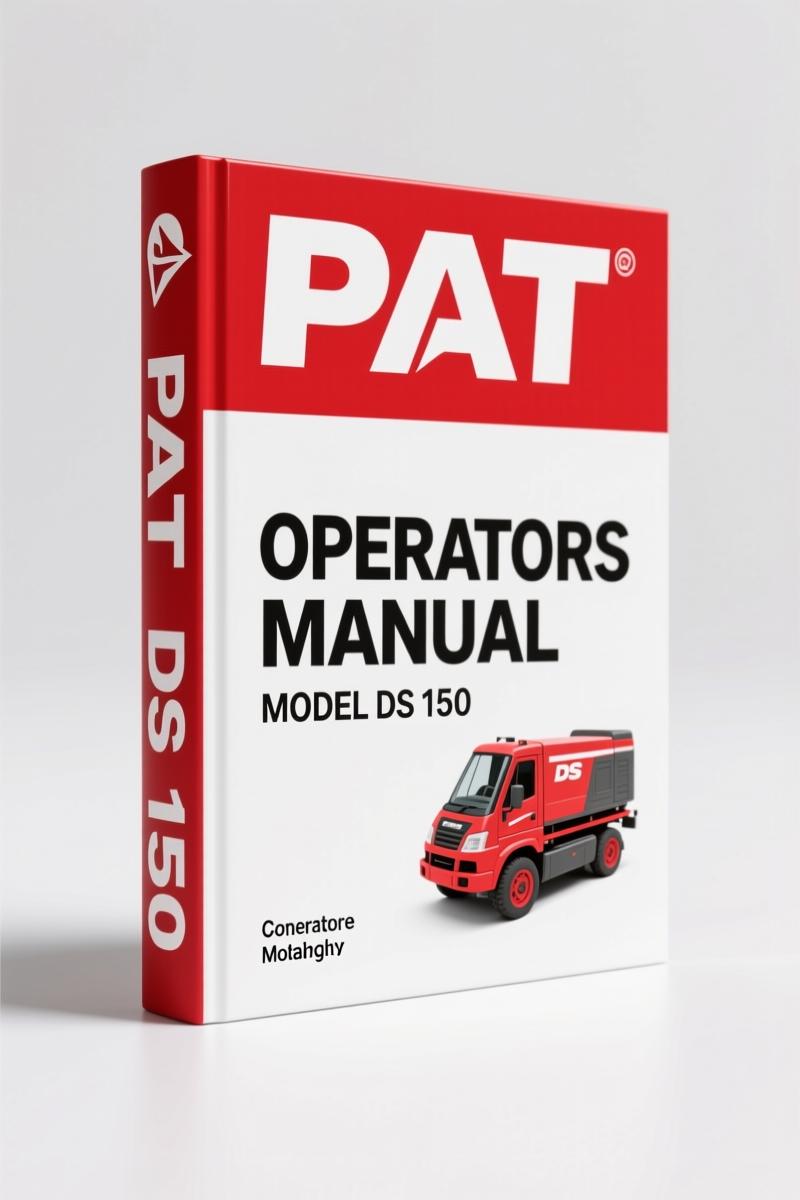
PAT DS 150 2001 Operators Manual – OEM Load Moment Indicator
Original price was: $63.45.$45.00Current price is: $45.00.
OEM operator manual for PAT DS 150 load moment indicator – 16 pages covering pre-operation inspection, calibration, and troubleshooting.
Description
PAT DS 150 2001 Operators Manual – Factory Specs for Load Moment Indicator
If you’ve ever had a crane alarm go off without knowing why, or had to guess whether the load moment was right, you’ve already lost time and risked a job-site violation. A load moment indicator (LMI) isn’t a suggestion box – it’s a safety device. Guessing the calibration, the reeving setting, or the override procedure is how accidents happen. That’s why the PAT DS 150 2001 Operators Manual exists. This is the original factory document, 16 pages, printed by PAT America in 2001. Not a third-party rewrite. Not a scan of a scan. The real thing.
Pre-Operation Inspection and Calibration Verification
Page 7 of this manual walks you through the inspection and calibration check you are supposed to run before every lift. Not an optional read. You start by powering the console, checking the display, and running the zeroing procedure. The manual calls out what to look for on the load moment display and how to confirm the force transducer is sending a clean signal. Miss this step and you are flying blind. I’ve seen guys skip it because they “knew the machine.” That’s how you bend a boom.
Console Operation: Load Moment Display and Mode Selector
The DS 150 console has a load moment display with a numeric readout and a set of indicator lights. Section 4.1 breaks down each control: the operating mode selector, the reeving and man-basket switch, and the constant monitoring function. If your crane has a fixed jib, retracted jib, telescopic jib, or a man basket, you set the mode selector accordingly. Get it wrong and the LMI calculates the wrong allowable load. That’s not a software glitch – that’s a physics problem.
Warnings Section – Not Optional Reading
Page 1 and 2 are all warnings. PAT America spells out the liability clearly: this manual is for trained operators. If you don’t understand the terms, stop and get qualified. The warnings cover electrical shock from the console, mechanical crush hazards from boom movement, and the fact that the LMI is an aid, not a substitute for sound judgment. I know reading warnings feels like a chore, but every lawyer and safety officer will point to this page if something goes wrong.
16 Pages of Critical Info – What You Actually Get
Sixteen pages sounds small until you realize each page carries a specific procedure. The table of contents lists: General Information, Warnings, System Description, System Components (including Console Operation subsections), Control Lockout Override Key Switch (optional), Pre-Operation Inspection and Calibration Verification, Service and Maintenance, and Troubleshooting. That’s the whole LMI system, from power-up to fault diagnosis. No filler. No ads. No “tips from the field” from some guy who once fixed one. It’s the original factory content.
Control Lockout Override – When It’s Safe to Use
Section 4.2 describes the optional control lockout override key switch. This is not a “do whatever you want” bypass. It’s a specific override for load moment limit situations – usually to retract a boom or lower a load to a safe position. The manual tells you exactly when you are allowed to use it and what conditions must be met. If you use it outside those conditions, you void liability and safety protection. Page 6 covers the location and operation of the switch.
Troubleshooting: Factory-Level Diagnostic Steps
Page 9 lists troubleshooting steps. The manual doesn’t just say “check the connections.” It tells you what readings to expect on the load moment display for specific fault conditions. If the display stays blank, check the power indicator on the console (section 4.1.4). If the alarm sounds continuously, it might be a misadjusted reeving setting or a faulty transducer. The troubleshooting table is straight from PAT’s engineering department – not a forum post.
- Does this manual cover calibration procedures?
- Yes, page 7 covers the pre-operation calibration verification. It includes the zeroing force transducer check and display validation steps.
- What is the Control Lockout Override Key Switch and when should I use it?
- The override key switch (section 4.2) allows manual control when the LMI has engaged a full lockout – typically during emergency retraction or lowering of a load. You must follow the factory conditions: ensure no personnel are in the danger zone, verify the boom path is clear, and only use the override to move the load to a safe position. The manual explicitly warns that improper use can cause boom collapse or tip-over. Page 6 shows the switch location and the exact operational sequence. Do not rely on memory; follow the printed steps every time.
- PAT DS150C DS 150 2002 Service Manual”>PAT DS150C DS 150 2002 Service Manual
- PAT DS 150 Load Moment Indicator Operators Manual”>PAT DS 150 Load Moment Indicator Operators Manual
- PAT DS 350 DS 1334 2000 Operators Manual – Load Moment Indicator”>PAT DS 350 DS 1334 2000 Operators Manual – Load Moment Indicator
For operators more familiar with a Manual Transmission than an LMI console, this manual fills the gap. Unlike a Manual Transmission, the DS 150 uses electronic sensors that need correct calibration – guesswork is not an option. Access the factory manual and get the real procedures, not a third-party summary. Access the Factory Manual now and keep it in the cab where it belongs.
Additional information
| Brand | PAT |
|---|---|
| Language | English |
3 reviews for PAT DS 150 2001 Operators Manual – OEM Load Moment Indicator
You may also like…
-
Sale!
PAT DS 350G, DS 350GW 2001 Service Manual – OEM LMI Diagnostics
Original price was: $59.40.$45.00Current price is: $45.00. -
Sale!
PAT iFLEX5, DS 350 2003 Operators Manual – Factory Spec Data
Original price was: $68.85.$45.00Current price is: $45.00. -
Sale!
PAT DS 160 2003 Technical Manual – Calibration Guide for LMI Systems
Original price was: $54.45.$45.00Current price is: $45.00. -
Sale!
PAT DS 350GM RT875CC 2002 Service Manual – OEM LMI Diagnostics
Original price was: $66.60.$45.00Current price is: $45.00.
Related products
-
Sale!

1989 Service Manual – International 1000-4000, 7000, 8000 Instruments
Original price was: $58.80.$40.00Current price is: $40.00. -
Sale!

2011 Parts Catalog – International Truck OE Parts Documentation (1786 Pages)
Original price was: $34.50.$25.00Current price is: $25.00. -
Sale!
1992 Electrical Schematic – International 1000/3000/4000/2554 OEM Wiring Diagrams (132 Pages)
Original price was: $26.40.$20.00Current price is: $20.00. -
Sale!

2006 Service Manual – International DT 466E, 530E Diesel Engine
Original price was: $67.50.$50.00Current price is: $50.00.
gearhead88 –
I am extremely satisfied with this purchase. The scan is high-quality and easy to navigate. It assisted me to repair my PAT DS electrical system. I will definitely buy again.
Michael T. –
Excellent quality! It is easily zoomable on my laptop without blur. Contains detailed bolt torque specs for PAT. Saved my weekend project! Thank you.
William H. –
This is just what I required. The text is searchable and well indexed. A must-have for any PAT DS owner doing repairs. Saves me hundreds of time.