
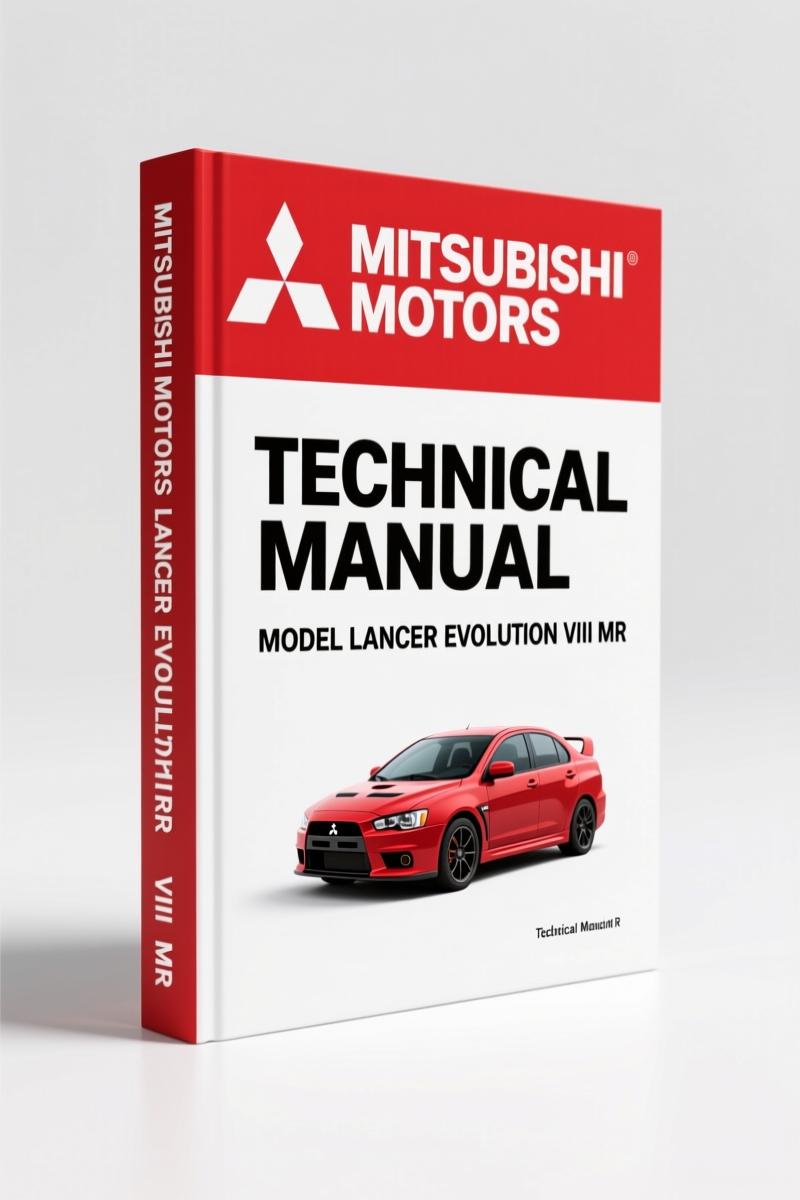
Mitsubishi Motors LANCER EVOLUTION VIII MR 2004 Technical Manual – OEM Engineering Data
Original price was: $29.90.$23.00Current price is: $23.00.
OEM technical review featuring engine cooling, vortex generators, and weight reduction research for the 2004 LANCER EVOLUTION VIII MR. 127 pages.
Description
You’re looking at a genuine Mitsubishi Motors Technical Review from 2004, number 16. This is not a reprint, not a scan, not some aftermarket binder job. It’s the factory’s own engineering digest for the Mitsubishi Motors LANCER EVOLUTION VIII MR 2004 Technical Manual that covers the cooling system, weight reduction, aerodynamics, and drivetrain development. If you’re working on one of these cars, you need the actual specs that Mitsubishi engineers used, not something a third-party publisher pulled off a forum.
Engine Cooling and Knock Suppression: Page 17
One of the technical papers in this manual is titled Study of Engine Cooling Technologies for Knock Suppression in Spark Ignition Engines. That’s not a generic overview—that’s a deep dive into how Mitsubishi engineers managed heat rejection to prevent detonation on high-boost applications. If you’ve ever had an EVO VIII MR that pinged under load after a radiator swap, this paper tells you the coolant flow rates and temperature gradients the factory validated. Page 17 gives you the methodology, not a guess.
Weight Reduction Technology for Improved Handling Performance
This chapter (page 79) covers how Mitsubishi shaved mass without sacrificing structural rigidity. The LANCER EVOLUTION VIII MR benefited from aluminum hood, suspension links, and a lighter rear subframe. The manual includes the actual engineering targets—bending stiffness, torsional rigidity values—not just marketing fluff. If you’re planning a weight-reduction build, this is the blueprint.
Research on Aerodynamic Drag Reduction by Vortex Generators
The cover photo shows the pressure distribution with and without vortex generators. The paper on page 11 explains the computational fluid dynamics (CFD) work that led to the roof-mounted VGs. Drag coefficient reduction, rear lift changes—all documented with pressure maps. This isn’t a sticky-on part instructions; it’s the engineering reasoning behind the shape.
Does This Manual Cover the 4G63 Engine Specs?
Yes and no. This is a Technical Review, not a service manual. It does not give you step-by-step timing belt replacement or head bolt torque sequences. What it gives you is the why behind the engineering decisions. For example, the engine cooling paper directly relates to the 4G63’s knock margin. If you’re diagnosing a chronic overheating issue or trying to understand the limits of the stock intercooler, this manual provides the research data the factory used. But if you need torque values for the cylinder head, you’ll want the Mitsubishi Motors 3000GT 1992 Technical Manual – 216-Page Factory Specs or the Mitsubishi Motors 4G63, 4G64 1998 Technical Manual – 122-Page Factory Specs for engine-specific specs. Also check the Mitsubishi Motors F1C1A 2001 Technical Manual – CVT Factory Specs if you’re on a different platform.
127 Pages of Factory Engineering Data
Seven technical papers, seven new technology developments, five technical topics, and a full new products section. Everything from fuel cell vehicle trends to occupant classification for airbags. The manual was printed in Tokyo on recycled paper with soy ink—that’s how authentic it is. You want to understand the evolution of Mitsubishi’s core technologies? This is your source. And if you need broader context on automotive engineering practices, Automotive Industry Overview provides a parallel perspective. Automotive Industry Overview also covers regulatory trends that influence design.
Who Needs This Manual
If you’re a home garage enthusiast with an EVO VIII MR who wants to move beyond swapping parts and actually understand the vehicle dynamics, this manual is for you. If you’re a professional mechanic who gets tired of chasing cooling issues on modified cars, the research here will save you hours of trial and error. Beginners? This might be heavy—but if you’re willing to read engineering papers, you’ll learn faster than any internet forum.
Source Authenticity: OEM vs Aftermarket
This is a genuine Mitsubishi Motors publication, ISSN 0915-3802. It’s not a third-party compilation. The pages are direct from the factory editorial committee. I’ve seen aftermarket manuals that claim to cover the EVO but use generic diagrams. This one has the actual CFD results, gear whine analysis, and chassis development data. No shortcuts.
Frequently Asked Questions
- Is this a repair manual or a technical review?
- Technical review. It covers engineering development, not step-by-step repair procedures like a service manual.
- Does it include torque specs for head bolts?
- Not in the traditional sense. The manual focuses on research papers. For specific torque specs, you need the factory service manual.
- Will this help me fix my EVO VIII MR?
- Yes, if you want to understand why the engineers did what they did. For example, the engine cooling research on page 17 directly applies to knock suppression. If you’re building a high-horsepower car, knowing the exact coolant flow targets and knock limits from the factory gives you a solid baseline. But if you’re looking for a parts replacement guide, this isn’t it. It supplements, not replaces, a service manual.
- How many pages?
- 127 pages.
Related Manuals
- Mitsubishi Motors 3000GT 1992 Technical Manual – 216-Page Factory Specs
- Mitsubishi Motors 4G63, 4G64 1998 Technical Manual – 122-Page Factory Specs
- Mitsubishi Motors F1C1A 2001 Technical Manual – CVT Factory Specs
Stop guessing on your EVO VIII MR build. Get the actual factory engineering data. Access the Factory Manual now and start working with specifications that Mitsubishi engineers signed off on.
Additional information
| Brand | Mitsubishi Motors |
|---|---|
| Language | English |
3 reviews for Mitsubishi Motors LANCER EVOLUTION VIII MR 2004 Technical Manual – OEM Engineering Data
You may also like…
-
Sale!
Mitsubishi Motors F4A33 W4A32 W4A33 1994 Service Manual – 148 Pages
Original price was: $43.50.$30.00Current price is: $30.00. -
Sale!
Mitsubishi Motors F3A21 F3A22 F4A21 F4A22 F4A23 1989 Service Manual
Original price was: $62.00.$40.00Current price is: $40.00. -
Sale!
Mitsubishi Motors F4A41, F4A42, F4A51 2002 Service Manual – 135 Pages Factory Specs
Original price was: $41.70.$30.00Current price is: $30.00. -
Sale!
Mitsubishi F4M21-F5M33 1995 Service Manual
Original price was: $41.70.$30.00Current price is: $30.00.
Related products
-
Sale!

1993 Electrical Schematic – International 1000/3000/4000 Bus Chassis OEM Wiring Diagrams
Original price was: $29.26.$22.00Current price is: $22.00. -
Sale!

Service Manual – International HS 2.8L Engine – 130 Pages of Factory Specs
Original price was: $56.40.$40.00Current price is: $40.00. -
Sale!

2006 Service Manual – International DT 466E, 530E Diesel Engine
Original price was: $67.50.$50.00Current price is: $50.00. -
Sale!
Acura NSX 1991 Service Manual – 1420 Pages OEM
Original price was: $102.05.$65.00Current price is: $65.00.
William H. –
Excellent OEM spec sheet. The text is searchable and well indexed. A must-have for any Mitsubishi Motors Motors DIYer doing maintenance. Highly recommended for mechanics.
Charles W. –
I am so happy with this purchase. The pages are clean and well indexed. A must-have for any Mitsubishi Motors Motors DIYer doing repairs. I will recommend this shop to others.
John S. –
I am very pleased with this manual. Quick access after checkout process. It guided me to rebuild my Mitsubishi Motors Motors electrical system. Worth every penny.