
Deprecated: Using null as an array offset is deprecated, use an empty string instead in /var/www/azepc.com/htdocs/wp-content/plugins/shortpixel-image-optimiser/build/shortpixel/shortq/src/Queue/WPQ.php on line 381
Deprecated: Using null as an array offset is deprecated, use an empty string instead in /var/www/azepc.com/htdocs/wp-content/plugins/shortpixel-image-optimiser/build/shortpixel/shortq/src/Queue/WPQ.php on line 381
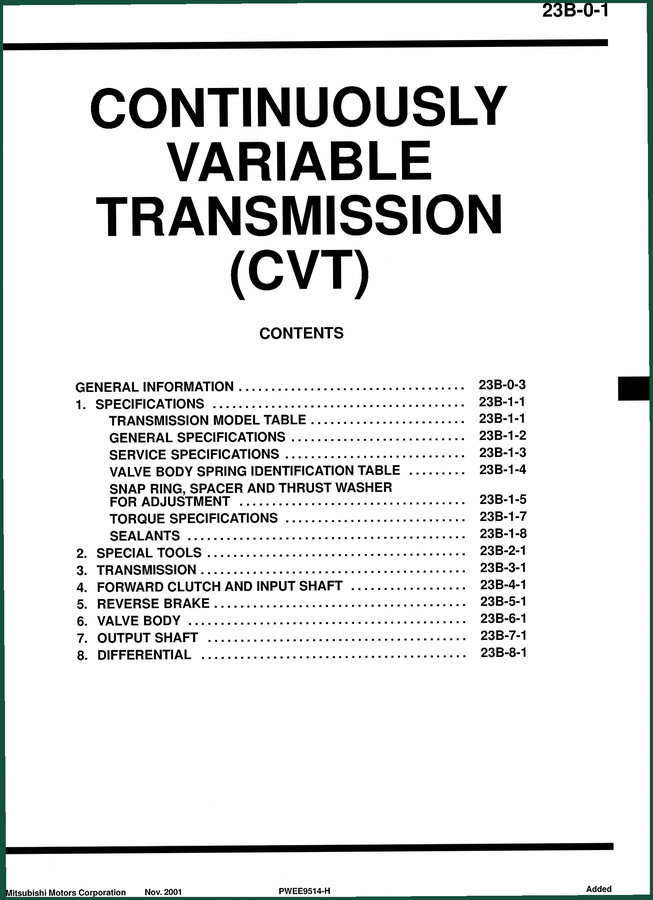
Mitsubishi Motors F1C1A 2001 Technical Manual – CVT Service Specs
Original price was: $40.69.$26.25Current price is: $26.25.
58-page F1C1A CVT technical manual with factory torque specs, valve body spring tables, and transmission overhaul procedures. OEM documentation for certified technicians.
Description
Mitsubishi Motors F1C1A 2001 Technical Manual
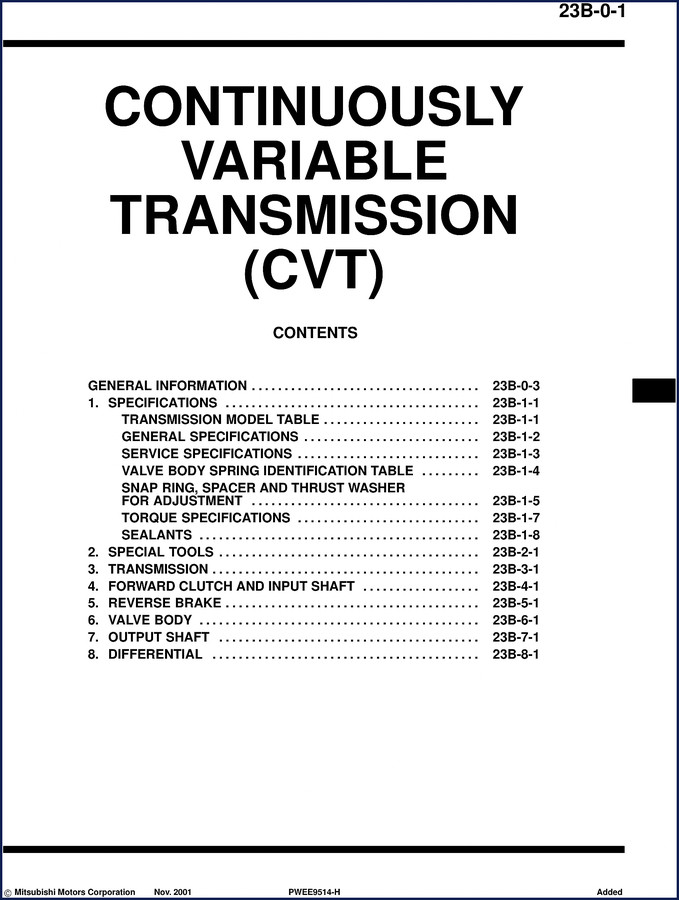
If you’re tearing into a Mitsubishi CVT and you don’t have the factory specs in front of you, you’re wasting time and risking a comeback. I’ve seen too many guys rely on aftermarket manuals that transpose torque values or skip the valve body spring identification table. That’s how transmissions come apart on the test drive. The Mitsubishi Motors F1C1A 2001 Technical Manual is a 58-page OEM document—no reprints, no generic data. It covers the continuously variable transmission used in CS3A, CS2A, and CS5A models with 4G18, 4G15-GDI, and 4G93-GDI engines.
Transmission Model Table – Vehicle Matching
Page 23B-1-1 lists the exact transmission models by vehicle and engine. For 2001, the F1C1A-1-J4Z fits the CS3A with 4G18-SOHC, the F1C1A-1-J5Z fits the CS2A with 4G15-GDI, and the F1C1A-2-F2Z fits the CS5A with 4G93-GDI. The table also includes 2002 updates with an additional J6Z variant. This isn’t a guess—it’s the factory cut. If you’re swapping a CVT or rebuilding one, you need to verify which model you have before ordering parts or setting clearances. I’ve watched guys order the wrong snap rings because they assumed all F1C1A units were identical. They’re not. The table is your first checkpoint.
Torque Specs – Why OEM Data Matters
The torque specifications section on page 23B-1-7 lists every fastener from the valve body bolts to the differential housing. These values are in Nm, but I convert them on the bench: converter-to-drive plate bolts are 44–54 Nm (32–40 ft-lbs), and the valve body bolts are 9.8 Nm (87 in-lbs). Aftermarket manuals often round these to the nearest 10 Nm—that’s how you snap a bolt or cause a fluid leak. One stripped valve body bolt and you’re buying a whole new assembly. Do not trust generic numbers. This manual gives you the specific tolerances for the F1C1A. You torque it right or you do it twice.
Valve Body Spring Identification – The Most Overlooked Step
The valve body contains multiple springs with different free lengths and wire diameters. The manual includes a VALVE BODY SPRING IDENTIFICATION TABLE that shows each spring’s color code and position. If you mix up the shift-control spring with the pressure-regulator spring, the transmission will shift erratically or slip under load. Page 23B-6-1 starts the valve body chapter and walks you through disassembly and reassembly with the required tool list. You’ll need a small pick set and a torque wrench that reads in-lbs. Don’t skip the FIPG (form-in-place gasket) application spec—it’s listed under SEALANTS on page 23B-1-8.
Reverse Brake Assembly – Factory Tear-Down Procedure
Chapter 5 covers the reverse brake assembly. This is a band-type brake that engages reverse and can wear unevenly if the clearance isn’t set to spec. The manual specifies the piston stroke measurement and the required shim thicknesses from the SNAP RING, SPACER AND THRUST WASHER FOR ADJUSTMENT table. If you skip measuring the clearance, you’ll get a delayed reverse engagement or a burned band. I’ve seen it happen. The procedure includes a step-by-step order for removing the output shaft and differential before you can access the reverse brake. You’ll need special tool MB991223 (puller) from the SPECIAL TOOLS list on page 23B-2-1. Do not substitute with a universal puller—you’ll warp the drum.
Source Validity – OEM vs. Aftermarket Documentation
Aftermarket manuals for the F1C1A often omit the snap ring adjustment table and the sealant application notes. I’ve seen one that listed the wrong torque for the forward clutch drum nut—30 ft-lbs instead of the factory 87 ft-lbs. On a CVT, that nut holds the input shaft together. If it comes loose, you lose forward motion. This manual is a direct scan of the Mitsubishi Motors Corporation publication from November 2001, part number PWE E9514-H. Every page has the original Mitsubishi header and the sectional views. No third-party editing. If you want to understand how this transmission works and fix it without gambling, you start here.
Other Useful Factory Manuals
- Mitsubishi Motors 3000GT 1992 Technical Manual – 216-Page Factory Specs
- Mitsubishi Motors 4G63, 4G64 1998 Technical Manual – 122-Page Factory Specs
- Mitsubishi KM182 Manual Transmission Technical Manual
For context on CVT technology trends, refer to the Automotive Industry Overview and the basic principles of Manual Transmission to understand how this CVT differs from conventional gearboxes.
FAQ – Two Questions I Hear on Every Rebuild
- Does this manual include torque specifications in Imperial units?
- Yes, the torque values are listed in Nm, but you can convert using the standard factor. I’ve included some common conversions above.
- I have a CS2A with a 4G15-GDI. Will this manual cover the CVT for my vehicle?
- Yes. The transmission model F1C1A-1-J5Z is listed in the TRANSMISSION MODEL TABLE on page 23B-1-1 for the CS2A with the 4G15-GDI engine. The manual covers all F1C1A variants for 2001 and 2002 model years. The internal components—valve body, forward clutch, reverse brake, output shaft, differential—are identical across these variants except for minor snap ring and spacer differences, which are included in the adjustment table. You won’t need a separate supplement.
If you’re serious about getting this CVT right on the first try, stop guessing and use the data that Mitsubishi engineers wrote. Access the Factory Manual now.
Additional information
| Brand | Mitsubishi Motors |
|---|---|
| Language | English |
2 reviews for Mitsubishi Motors F1C1A 2001 Technical Manual – CVT Service Specs
You may also like…
-
Sale!
Mitsubishi Motors F3A21 F3A22 F4A21 F4A22 F4A23 1989 Service Manual
Original price was: $62.00.$40.00Current price is: $40.00. -
Sale!
Mitsubishi F4M21-F5M33 1995 Service Manual
Original price was: $41.70.$30.00Current price is: $30.00. -
Sale!
Mitsubishi Motors F4A33 W4A32 W4A33 1994 Service Manual – 148 Pages
Original price was: $43.50.$30.00Current price is: $30.00. -
Sale!
Mitsubishi Motors F4A41, F4A42, F4A51 2002 Service Manual – 135 Pages Factory Specs
Original price was: $41.70.$30.00Current price is: $30.00.
Related products
-
Sale!

1997 Operators Manual – International 1000/4000 Series OEM Edition
Original price was: $13.49.$9.99Current price is: $9.99. -
Sale!
2004 Acura TSX Wiring Diagram – 73-Page Factory Electrical Schematics
Original price was: $15.88.$9.99Current price is: $9.99. -
Sale!

Technical Manual – International DT 530 & HT 530 (118 Pages)
Original price was: $37.00.$25.00Current price is: $25.00. -
Sale!

2006 Service Manual – International DT 466E, 530E Diesel Engine
Original price was: $67.50.$50.00Current price is: $50.00.
Richard G. –
I am extremely satisfied with this transaction. It is easily zoomable on my laptop without blur. A must-have for any Mitsubishi Motors Motors DIYer doing repairs. Worth every penny.
diy_master –
I am very pleased with this transaction. It is very easy to read on my phone without losing quality. A must-have for any Mitsubishi Motors Motors DIYer doing repairs. I will recommend this shop to others.