
Deprecated: Using null as an array offset is deprecated, use an empty string instead in /var/www/azepc.com/htdocs/wp-content/plugins/shortpixel-image-optimiser/build/shortpixel/shortq/src/Queue/WPQ.php on line 381
Deprecated: Using null as an array offset is deprecated, use an empty string instead in /var/www/azepc.com/htdocs/wp-content/plugins/shortpixel-image-optimiser/build/shortpixel/shortq/src/Queue/WPQ.php on line 381
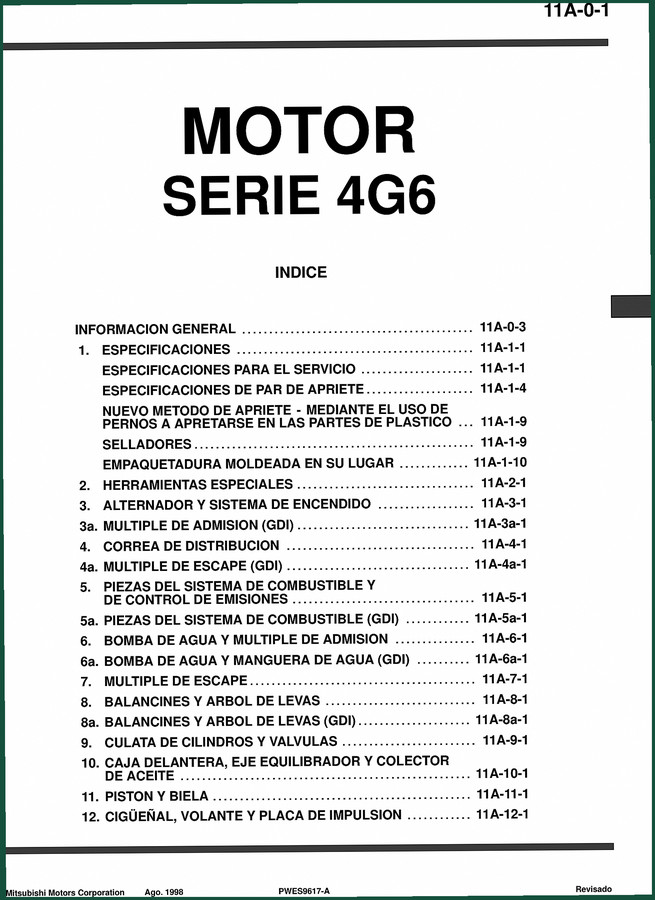
Mitsubishi Motors 4G63, 4G64 1998 Technical Manual – 122 Pages
Original price was: $28.80.$22.50Current price is: $22.50.
Factory 1998 Technical Manual for Mitsubishi 4G63 and 4G64 engines. 122 pages of torque specs, timing, and GDI variants.
Description
You pull the head on a 4G64 and you’re staring at a pile of bolts. Aftermarket manual says 58 lb-ft. Factory manual says 67 lb-ft plus an additional 90-degree turn. Which one is right? The factory spec. That’s why this Mitsubishi Motors 4G63, 4G64 1998 Technical Manual exists. It’s a 122-page OEM binder from Mitsubishi Motors Corporation, printed August 1998, and it’s the only document I trust when I’m on the line.
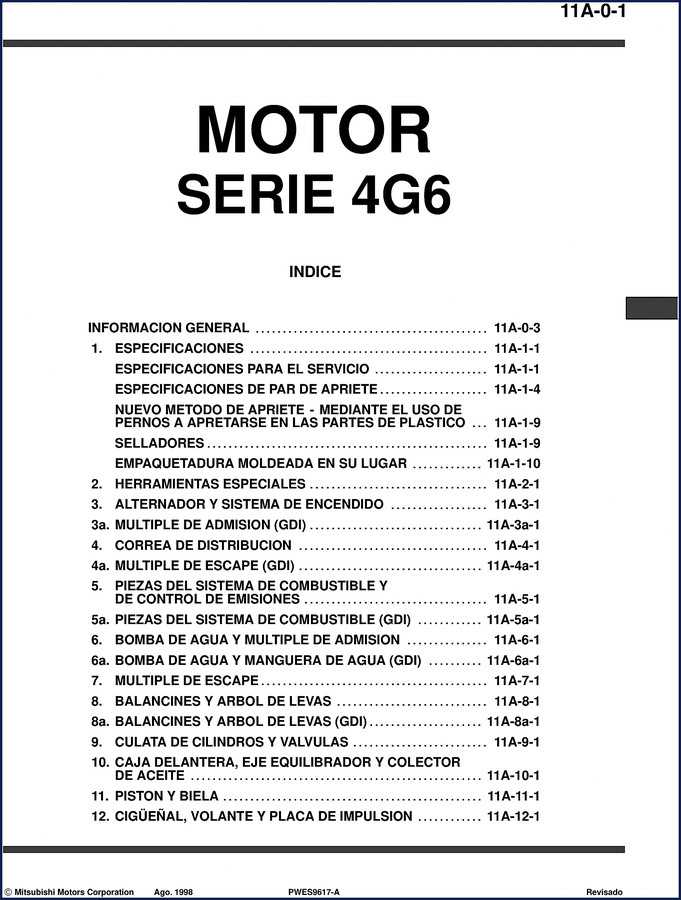
12 Chapters of Factory Procedure
The manual splits the 4G6 engine series into 12 numbered chapters, plus GDI-specific sub-chapters. You get the full breakdown: Alternator and Ignition System (chapter 3), Timing Belt (4), Fuel and Emission Control (5), Water Pump and Intake Manifold (6), Exhaust Manifold (7), Rocker Arms and Camshaft (8), Cylinder Head and Valves (9), Front Case and Balance Shaft (10), Piston and Connecting Rod (11), and Crankshaft, Flywheel, and Drive Plate (12). Each chapter starts with the factory service specifications and ends with torque values. The GDI sections – 3a, 4a, 5a, 6a, 8a – cover the direct injection variants. If you’ve ever tried to use a generic manual that lumps all variants together, you know the difference.
Torque Specs and the New Tightening Method
One of the things I see most often – DIY guys using generic torque charts. That’s a mistake. This manual has its own ESPECIFICACIONES DE PAR DE APRIETE section, and it includes the “Nuevo Metodo de Apriete” – a new tightening method for plastic parts. This isn’t in any Haynes or Chilton. You get the exact sequence and angles for the cylinder head bolts, main bearing cap bolts, and the balance shaft chain. If you skip that method, you’re asking for a leak or a snapped bolt. The torque specs are listed in the original factory units (Nm and lb-ft). I’ve seen too many engines come back with a blown head gasket because someone used the wrong value. Don’t be that guy.
Why the GDI Sections Matter
If you’re working on a 4G63 or 4G64 with GDI (Gasoline Direct Injection), you need the separate sections. The intake manifold, exhaust manifold, fuel system, and water pump all have different configurations. The manual labels them clearly: section 3a, 4a, etc. Don’t use the non-GDI data on a GDI engine – the injector timing is different, and the ECU will throw codes. This manual spells out the differences. For example, the intake manifold on the GDI engine has a different bolt pattern and torque spec. You’ll find that in section 3a. The fuel system section (5a) covers the high-pressure pump and injector service. If you’ve ever tried to rebuild a GDI injector without the factory procedure, you know it’s not happening.
Use the Correct Special Tools
Another pain point – you don’t have the right tool. The manual lists the special tools needed for each job in the HERRAMIENTAS ESPECIALES section (chapter 2). For example, the timing belt tension adjustment requires a specific tool. If you try to use a pry bar, you’ll overstress the tensioner. The part numbers are right there. Look up the tool, buy it or rent it, and do the job right. I keep a copy of this manual in my toolbox for exactly that reason – I can call the dealer and order the tool by part number.
Who Should Buy This Manual?
Home garage guys who are overhauling a 4G63 or 4G64 in an Eclipse, Galant, or Montero. Also shop owners who want a reference for their techs. If you’ve rebuilt one of these engines before, you still need the specs – Mitsubishi updated the torque methods in 1998. This is the latest OEM data. For other Mitsubishi engines, you might want the Mitsubishi Motors 3000GT 1992 Technical Manual – 216-Page Factory Specs if you’re working on a 3000GT. Transmission work? The Mitsubishi Continuously Variable Transmission (CVT) Manual covers the CVT and the Mitsubishi KM182 Manual Transmission Technical Manual covers the manual box. For a general picture of how these specs fit into the wider industry, the Automotive Industry Overview gives context on torque-to-yield standards. And if you want to understand the gearbox theory, the Manual Transmission page explains the basics.
- Does this manual cover both 4G63 and 4G64 engines?
- Yes. It covers both SOHC variants with all specifications.
- What about the GDI versions?
- The manual includes separate sections for GDI engines. Sections 3a, 4a, 5a, 6a, and 8a cover the intake manifold, exhaust manifold, fuel system, water pump, and rocker arms/camshaft specifically for GDI. If your engine is a GDI, use those sections exclusively for those components – the non-GDI data won’t match.
- Is this the same as a Haynes manual?
- No. This is an OEM technical manual from Mitsubishi Motors. It has the factory-approved torque values, wear limits, and diagnostic flow charts. Haynes is a summary.
- Can I use this manual for a 1997 or 1999 engine?
- The manual is dated 1998. It should cover 1997-1999 model years, but verify the engine variant. Some 1999 models may have updates not reflected. Cross-check with your vehicle’s VIN.
Access the Factory Manual from AutoRepairManuals – it’s the only OEM source you should have on your workbench.
Additional information
| Brand | Mitsubishi Motors |
|---|---|
| Language | English |
2 reviews for Mitsubishi Motors 4G63, 4G64 1998 Technical Manual – 122 Pages
You may also like…
-
Sale!

Mitsubishi Motors F3A21 F3A22 F4A21 F4A22 F4A23 1989 Service Manual
Original price was: $62.00.$40.00Current price is: $40.00. -
Sale!
Mitsubishi F4M21-F5M33 1995 Service Manual
Original price was: $41.70.$30.00Current price is: $30.00. -
Sale!

Mitsubishi Motors F4A41, F4A42, F4A51 2002 Service Manual – 135 Pages Factory Specs
Original price was: $41.70.$30.00Current price is: $30.00. -
Sale!
Mitsubishi Motors F4A33 W4A32 W4A33 1994 Service Manual – 148 Pages
Original price was: $43.50.$30.00Current price is: $30.00.
Related products
-
Sale!

Technical Manual – International DT 530 & HT 530 (118 Pages)
Original price was: $37.00.$25.00Current price is: $25.00. -
Sale!

1991 Operators Manual – International Truck OEM Specs (108 Pages)
Original price was: $13.63.$10.99Current price is: $10.99. -
Sale!

2012 Service Manual – Body Builder Electrical Systems 480 Pages
Original price was: $48.28.$34.00Current price is: $34.00. -
Sale!

International 1000-3000 Series Operators Manual – 132 Pages of OEM Specs
Original price was: $14.40.$10.99Current price is: $10.99.
gearhead88 –
I am extremely satisfied with this manual. It is very easy to read on my iPad without losing quality. It guided me to rebuild my Mitsubishi Motors Motors transmission. Saved my repair job! Thanks.
workshop_guy –
I am very pleased with this purchase. The file looks clean. A must-have for any Mitsubishi Motors Motors owner doing repairs. I will definitely buy again.