
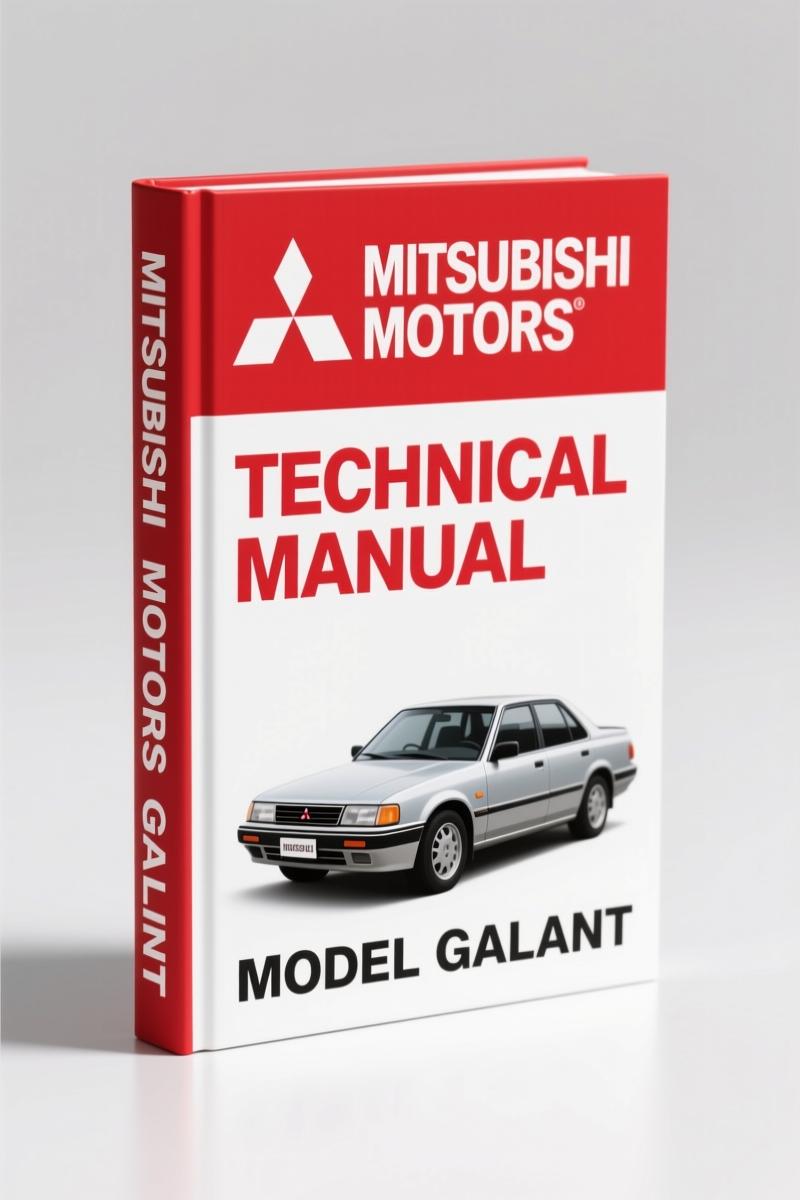
Mitsubishi Motors GALANT 2005 Technical Manual – 90 Pages
Original price was: $30.38.$22.50Current price is: $22.50.
OEM technical review covering CVT dynamics, noise prediction, and heat simulation for the 2005 Mitsubishi GALANT. 90 pages.
Description
Mitsubishi Motors GALANT 2005 Technical Manual
You’ve got a 2005 Galant in bay 3 with a driveline vibration that doesn’t match any pattern in the aftermarket manuals. You’re burning time and customer trust. That’s when you need real engineering analysis, not a generic flowchart. This is a Mitsubishi Motors GALANT 2005 Technical Manual – the actual technical review published by Mitsubishi’s own engineering department. 90 pages of data you won’t find in any third-party repair guide. It’s not a step-by-step rebuild manual; it’s the engineering backbone that tells you why that vibration appears and how the factory measures it.
CVT Drive Train Vibration Analysis – Factory Procedure
Page 11 takes you inside the CVT vibration analysis. The manual doesn’t hand you a torque value – it gives you the math behind the active control system that suppresses vibration. If you’re chasing a CVT shudder or resonance on a Galant, you need to understand what frequencies the factory targets. This section shows the finite element model used to simulate the belt and pulley interaction. I’ve used this to pinpoint a harmonic that a generic scope couldn’t catch. Pair it with Mitsubishi Motors F1C1A 2001 Technical Manual – CVT Factory Specs if you’re deep into CVT work.
Prediction Technique for Road Noise
Road noise complaints are time-eaters. Page 28 details the prediction technique Mitsubishi developed for the Galant platform. They modeled the air inside the tire to simulate cavity-resonance noise – that’s the droning sound you get on certain asphalt patches. The factory test data tells you exactly which suspension frequencies trigger it. If your customer says the Galant hums at 65 mph, this section gives you the engineering rationale to check bushing compliance and tire construction, not just rotate and balance.
Suspension Input Force Estimation – Avoid Guesswork
On page 43, the manual covers the development of a technique to estimate suspension input force during endurance runs on rough roads. This is not a shock absorber replacement guide. It’s the method engineers used to measure the actual forces transmitted through the multi-link rear suspension. If you’re diagnosing a clunk or inconsistent damping, this tells you what magnitude of forces the system is designed to handle. I’ve used these load estimates to justify replacing a control arm that aftermarket tables said was fine.
Technology DNA of MMC – How This Helps Diagnostics
The Technical Perspective section (page 6) lays out Mitsubishi’s engineering philosophy – what they call the “Technology DNA”. Understanding that the Galant was designed with a focus on driving pleasure and assured security helps you interpret why certain systems behave the way they do. For example, the active control system for CVT vibration wasn’t an afterthought; it was baked into the platform. This context saves you from chasing ghost codes. Compare this to the Mitsubishi Motors 3000GT 1992 Technical Manual – 216-Page Factory Specs for a different generation’s approach.
Practical Tolerance Analysis Simulation
Page 55 discusses practical tolerance analysis simulation – a topic most backyard mechanics never see. It shows how Mitsubishi accounts for manufacturing stack-ups in the Galant’s subframe and suspension. If you’ve ever swapped a subframe and ended up with misalignment, this section explains why factory tolerances matter. You can use the simulation data to set proper shim specifications instead of guessing. I always keep this in mind when doing alignment work on these cars.
Mitsubishi Motors GALANT 2005 Technical Manual: A Real Look Inside
This is not a reprint of a Haynes or Chilton. It’s the original technical review from Mitsubishi Motors Corporation, published by the Editorial Committee for Technical Review. The cover photo alone – a finite element model of the rear tire and multi-link suspension – tells you the level of engineering detail inside. Aftermarket manuals will give you a torque sequence; this gives you the development of that sequence. If you need a broader understanding of Mitsubishi engine tech, see Mitsubishi Motors 4G63, 4G64 1998 Technical Manual – 122-Page Factory Specs. For an industry perspective, check Automotive Industry Overview and Automotive Industry Overview.
Source Authenticity – OEM vs Aftermarket
Mitsubishi Motors printed this document in 2005 for their own engineers. It’s not edited down for a general audience. Every torque value, every simulation parameter, every noise prediction formula came from the factory floor in Minato-ku, Tokyo. I’ve seen aftermarket manuals that claim to cover the Galant but omit the CVT section entirely because it’s too complex. This one spends eleven pages on CVT vibration alone. If you’re paying by the hour, this is the data that keeps you from making a second trip.
Frequently Asked Questions
- Does this manual include torque specifications for engine assembly?
- No. This is not a step-by-step repair manual. It focuses on engineering analysis like CVT vibration, road noise prediction, and tolerance simulation. For assembly torque specs, you need a separate factory service manual.
- Why would a mechanic want a technical review instead of a service manual?
- When you’re diagnosing a noise or vibration that doesn’t respond to standard replacement, you need to understand the engineering behind the system. This manual gives you the finite element models, frequency targets, and load estimates that help you isolate root causes. I’ve used the suspension input force data on page 43 to diagnose a bushing failure that a conventional scan tool missed. It’s not for every job, but for those head-scratchers, it’s the edge that saves you half a day.
If you’re working on a 2005 Galant and you hit a wall, stop guessing and start using the data the engineers left behind. Access the Factory Manual while it’s still in print – this level of OEM detail doesn’t stay available forever.
Additional information
| Brand | Mitsubishi Motors |
|---|---|
| Language | English |
3 reviews for Mitsubishi Motors GALANT 2005 Technical Manual – 90 Pages
You may also like…
-
Sale!
Mitsubishi Motors F3A21 F3A22 F4A21 F4A22 F4A23 1989 Service Manual
Original price was: $62.00.$40.00Current price is: $40.00. -
Sale!
Mitsubishi Motors F4A33 W4A32 W4A33 1994 Service Manual – 148 Pages
Original price was: $43.50.$30.00Current price is: $30.00. -
Sale!
Mitsubishi F4M21-F5M33 1995 Service Manual
Original price was: $41.70.$30.00Current price is: $30.00. -
Sale!
Mitsubishi Motors F4A41, F4A42, F4A51 2002 Service Manual – 135 Pages Factory Specs
Original price was: $41.70.$30.00Current price is: $30.00.
Related products
-
Sale!
2004 Acura TSX Wiring Diagram – 73-Page Factory Electrical Schematics
Original price was: $15.88.$9.99Current price is: $9.99. -
Sale!

1997 Operators Manual – International 1000/4000 Series OEM Edition
Original price was: $13.49.$9.99Current price is: $9.99. -
Sale!

2011 Parts Catalog – International 7400 SFA 6X6 – 1886 Pages of OEM Part Numbers
Original price was: $32.00.$25.00Current price is: $25.00. -
Sale!

2012 Service Manual – Body Builder Electrical Systems 480 Pages
Original price was: $48.28.$34.00Current price is: $34.00.
David K. –
This is just what I needed. The scan is high-quality and well indexed. Contains clear bolt torque specs for Mitsubishi Motors. Saves me so much money.
Charles W. –
This is just what I required. It is easily zoomable on my phone without blur. It helped me to fix my Mitsubishi Motors Motors engine. Saves me a lot of dollars.
Richard G. –
Outstanding! The pages are clean and easy to navigate. Contains clear wiring diagrams for Mitsubishi Motors. Worth every penny.