
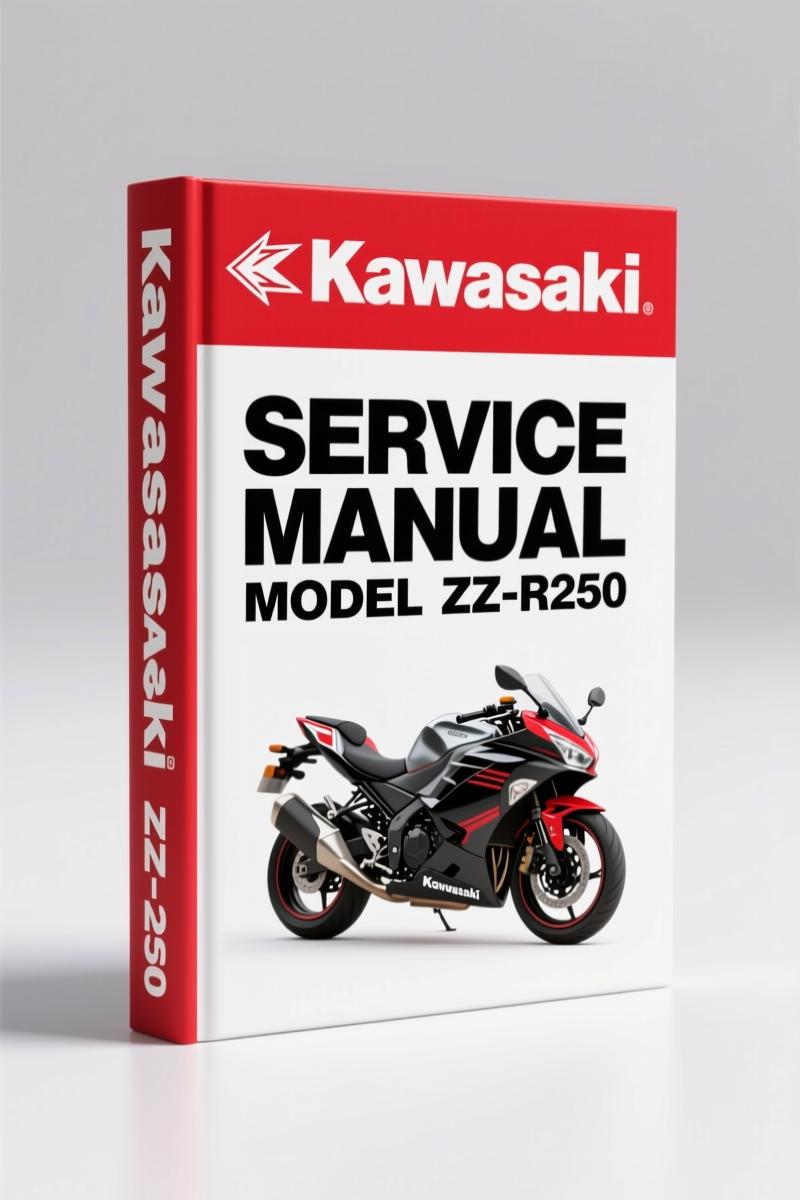
Kawasaki ZZ-R250 1997 Service Manual – OEM Factory Specs
Original price was: $36.00.$25.00Current price is: $25.00.
Factory-certified 125-page service manual for the Kawasaki ZZ-R250 (1990-1996). Crankshaft specs, torque values, emissions data.
Description
Kawasaki ZZ-R250 1997 Service Manual – Factory Specs for the Twin Cam 8-Valve
If you’re wrenching on a Kawasaki ZZ-R250 1997 Service Manual supplement and don’t have the factory data, you’re gambling with your engine. I’ve seen too many guys strip head bolts because they used a generic torque chart. This is the actual supplement Kawasaki released in August 1997 (Part No. 99924-1129-54). 125 pages of OEM specs for the EX250-H7 and earlier models back to 1990. No guesswork – just the numbers that came off the assembly line.
Engine Top End: Valve Clearance and Camshaft Specs
The Engine Top End chapter (4) is where most DIY guys get into trouble. This manual gives you the exact valve clearance specs for intake and exhaust, and the camshaft removal procedure. You’ll find the tightening sequence for the cylinder head bolts – and yes, it matters. Use a torque wrench, not your arm. The supplement notes any changes from the 1990 base manual, so check your frame number on page 2 to see if you need the updated specs.
Does This Manual Cover the Clutch and Transmission?
It does. Chapter 5 is the clutch section – including clutch plate thickness limits and spring free length. Chapter 8 covers the crankshaft and transmission. If you’re splitting the cases, you need the bearing clearance specs from this manual. The crankshaft section includes the runout inspection limits and the torque values for the connecting rod bolts. Don’t rely on a YouTube video – use the factory manual.
7 Systems from Fuel to Electrical
The manual covers Fuel System (2), Cooling System (3), Engine Lubrication (6), Wheels/Tires (9), Final Drive (10), Brakes (11), and Suspension (12). Each section has repair procedures, required tool lists, and safety warnings. For example, the fuel system chapter warns about pressure relief before disconnecting lines and specifies the correct fuel line routing to prevent pinching. The cooling system chapter gives the exact coolant capacity and bleeding procedure; it also warns about opening the radiator cap when hot. The brake section specifies the correct DOT fluid, pad wear limits, and the proper bleeding sequence using a vacuum bleeder or the two-person method. The suspension chapter includes fork oil weight and volume, as well as the air pressure setting for the rear shock. These details are not found in aftermarket manuals – they are the same specs used by Kawasaki dealers. Overlooking a single value like fork oil level can ruin the handling. That is why I keep this supplement within arm’s reach on my workbench.
Get the Right Torque Data for the Crankshaft
When you’re reassembling the bottom end, the torque specs for the crankshaft components are critical. The manual provides the tightening torque for the crankshaft nut, main bearing cap bolts, and the connecting rod bolts. It also includes the angular tightening method where required. You’ll find the exact values in foot-pounds and Newton-meters. Using this data prevents bearing failure and oil leaks. I’ve seen engines grenade because someone used a generic spec from a forum. Don’t be that guy.
Source Validity: Why a Factory Supplement Beats Aftermarket
This is an original Kawasaki publication, printed in Japan. Part number 99924-1129-54. It’s a supplement to the base service manual, so if you have the earlier version, this updates it for the 1997 model year. The Model Application chart on page 2 lists every frame number from 1990 through 1996. Compare your frame number to confirm coverage. Aftermarket manuals often skip the supplement updates or reproduce faded photocopies. This is a clean digital file – no missing pages, no blurred torque charts.
Trust the factory data.
FAQ
- Is this manual specific to the 1997 model?
- It covers 1990–1996 models with 1997 supplement updates.
- Does it include wiring diagrams?
- Yes, the Electrical System chapter (15) includes schematics. As a supplement, it may only show changes from the base manual – you’ll want the base 1990 manual for the full diagram. Check the appendix for revisions.
- Will this manual help me remove the engine?
- Chapter 7 gives you the removal and installation procedure with torque values for engine mount bolts and lifting points.
- What torque specs are provided for the crankshaft?
- The Crankshaft/Transmission chapter (8) includes all torque values for the connecting rod bolts (with a two-stage tightening sequence – first stage torque then angle), main bearing cap bolts, and the crankshaft nut. It also specifies inspection limits for bearing clearance and shaft runout. You get the values in ft-lb and Nm, along with the exact angle where required. This level of detail is why factory manuals are essential – you get the procedure Kawasaki used at the factory, not a generic approximation. The supplement also notes any changes from the base manual, so if your bike is a later model, you have the latest specs.
If you’re serious about keeping your ZZ-R250 on the road and not on a lift with a blown motor, get the factory data. I’ve used these supplements for years in my shop, and they save time and parts. Kawasaki Ninja 250R Service Manual – 428 Pages of Factory Specs is another option if you have the Ninja variant. For the KLX, check Kawasaki KLX250 D-TRACKER X Service Manual – 558 Pages. And if you’re into sportbikes, Kawasaki ZX-6R Service Manual – 597 Pages of Factory Specs covers the 600 class. For more on manual transmissions, see Manual Transmission and Manual Transmission for general theory. Now stop reading and access the Factory Manual – your engine will thank you.
Additional information
| Brand | Kawasaki |
|---|---|
| Language | English |
2 reviews for Kawasaki ZZ-R250 1997 Service Manual – OEM Factory Specs
You may also like…
-
Sale!
Kawasaki 85ZV-2 2011 Workshop Manual – 555 Pages Factory Specs
Original price was: $91.00.$65.00Current price is: $65.00. -
Sale!
Kawasaki KLF 250, BAYOU 250 Service Manual – 322 Pages Factory Specs
Original price was: $63.00.$45.00Current price is: $45.00. -
Sale!
Kawasaki Ninja ZX-10R Service Manual – Factory OEM Specs
Original price was: $60.75.$45.00Current price is: $45.00. -
Sale!
Kawasaki 92ZV-2 2011 Workshop Manual – 541 Pages Factory Specs
Original price was: $83.20.$65.00Current price is: $65.00.
Related products
-
Sale!

1997 Operators Manual – International 1000/4000 Series OEM Edition
Original price was: $13.49.$9.99Current price is: $9.99. -
Sale!

Technical Manual – International DT 530 & HT 530 (118 Pages)
Original price was: $37.00.$25.00Current price is: $25.00. -
Sale!
1991 Electrical Schematic – 112-Page OEM Wiring Diagram for International 1000-3000 Series
Original price was: $22.75.$17.50Current price is: $17.50. -
Sale!
Acura NSX 1991 Service Manual – 1420 Pages OEM
Original price was: $102.05.$65.00Current price is: $65.00.
William H. –
Great buy! It is easily zoomable on my phone without blur. Every spec sheet is provided for Kawasaki ZZR250. Highly recommended for mechanics.
James L. –
Great OEM spec sheet. The scan is high-quality and easy to navigate. It helped me to troubleshoot my Kawasaki ZZR250 transmission. Worth every penny.