
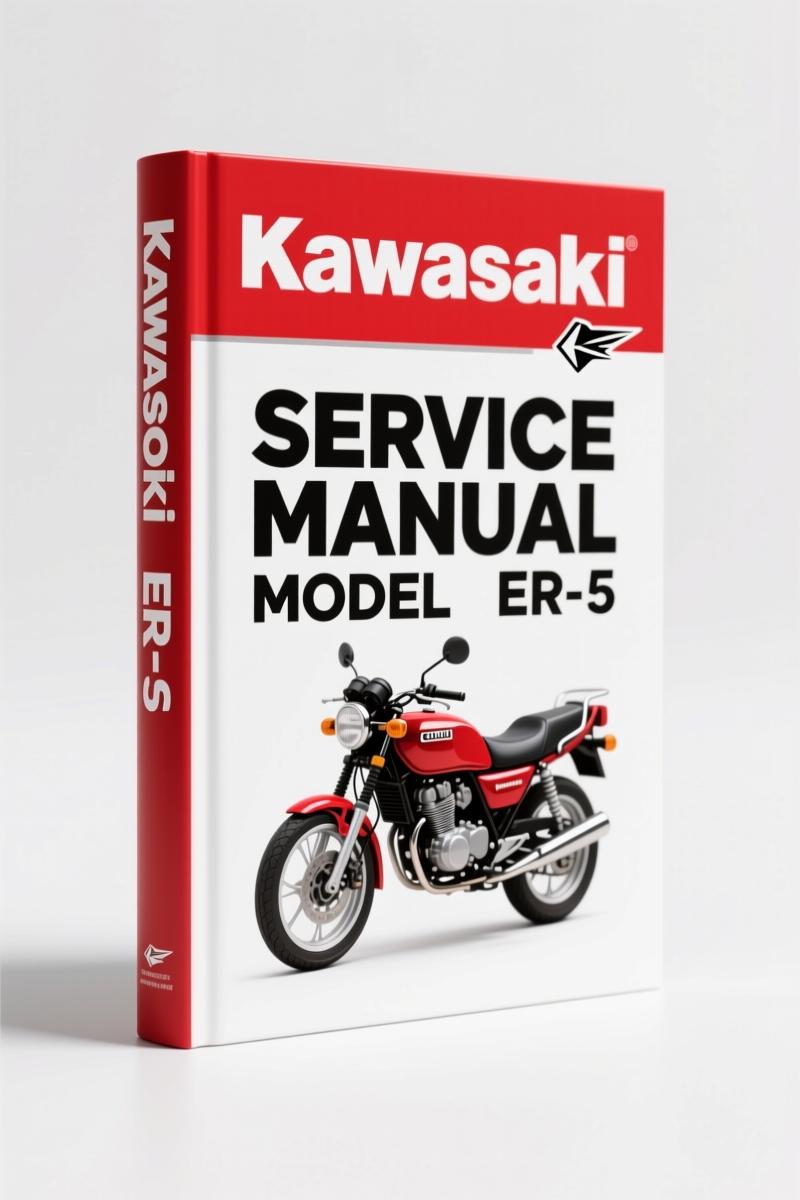
Kawasaki ER-5 Service Manual – 334 Pages of Factory Specs
Original price was: $37.75.$25.00Current price is: $25.00.
Factory-certified Kawasaki ER-5 service manual: 334 pages, torque tables, valve specs, fuel system data. No generic reprints.
Description
I’ve seen more than one ER-5 come into the shop with a stripped spark-plug hole or a bent valve because somebody grabbed a generic manual off the internet. That stuff gets you close enough to break something. If you’re wrenching on a parallel-twin with a chain-driven balancer, you need the Kawasaki ER-5 Service Manual – the 334-page factory book that Kawasaki printed for their own dealerships. No guesswork on fuel level, no estimating camshaft clearance, no faking a torque wrench click.
334 Pages of Factory Data – What You Get
This manual is laid out the same way Kawasaki organizes every service procedure since the 90s. The Table of Contents starts with Basic Torque for General Fasteners and runs through every adjustment point on the bike. You get the Camshaft Journal, Camshaft Cap Clearance table, the Cylinder Compression (Usable Range) specs, and the Valve Clearance Measuring Position – both pages for the intake and exhaust sides. The Valve Closing Temperature and Thermostat Valve Opening Temperature are in the same section, so you don’t have to flip between chapters to figure out why your engine won’t reach operating temp. That’s the kind of organization that saves a Saturday.
Fuel System Specs: Don’t Guess the Float Height
The ER-5 uses a CV carburetor that gets finicky with ethanol-blend fuels. This manual gives you the factory Float Height measurement – not a range, not a “approximately” – an exact number. It also covers Fuel Level and Idle Speed adjustments with the proper tool numbers listed under Special Tools. If you’ve ever had a bike that stumbles off idle after a carb rebuild, it’s because you didn’t set the Vacuum Switch Valve Closing Pressure within spec. Page 73? That’s where you’ll find the pressure numbers. I don’t say that lightly – I’ve pulled that page out of the binder more times than I can count.
Valve Clearance: Cold Measurement Procedure
Valve clearance on the ER-5 is checked cold, and this manual lists the Valve Clearance (when cold) table with both intake and exhaust gaps. It also includes the Valve Seating Surface Outside Diameter and Valve Seating Surface Width – data you need before you lap a valve or order new ones. The Cylinder Head Warp limit is there, too. If that surface is warped beyond spec, you’ll chase a head-gasket leak forever. The manual tells you the maximum allowable warp and the bolt-tightening sequence for the cylinder head. That sequence is not optional – skip a step and you’ll crack a casting.
Camshaft and Cylinder: Bearing Clearance and Compression
The Camshaft Journal, Camshaft Cap Clearance table gives you the oil clearance limits. That’s critical because the ER-5’s cam journals ride directly in the cap – no bearings. Wrong clearance means oil pressure drop or cam seizure. The Cylinder Compression (Usable Range) tells you what to expect with a healthy engine. If you’re below that number, you need to dig into the rings or valves. The manual also covers Piston Ring/Groove Clearance, Piston Ring End Gap, and Piston Diameter. That’s the kind of detail you’d pay a machinist to look up. It’s all here.
Torque Values: Why OEM Specs Matter
I’ve watched a tech snap an 8 mm bolt on a clutch cover because he used a generic torque chart. This manual lists Torque Value for 8 mm Bolts – specific to the ER-5’s fasteners. It also includes Basic Torque for General Fasteners for the rest of the bike. Every fastener on the engine, frame, and suspension has a torque spec. The rear axle nut, the camshaft cap bolts, the connecting rod nuts – it’s all in there. If you skip the Connecting Rod Big End Bearing Insert/Crankpin Clearance check and just torque the rod bolts, you’re gambling with a rod failure. This manual tells you the clearance range and how to select the right bearing insert using the Crankpin Diameter Marks and Connecting Rod Big End Bore Diameter Marks. That’s factory-level stuff you won’t find in aftermarket paperbacks.
Source Authenticity: Kawasaki Heavy Industries, Ltd.
The copyright page says “© 2000 Kawasaki Heavy Industries, Ltd. 4th Edition (1): Aug. 5, 2004 (K).” That’s the OEM print, not a re-scanned copy with missing pages. The Foreword includes General Information with safety notes about battery acid, fuel vapor, and hot surfaces – standard factory warnings that aftermarket reprints often drop to save paper. The manual also contains the original Emission Control Information and Tampering With Noise Control System Prohibited notices. If you need a manual that covers the entire Final Drive chapter, the Electrical System with Regulator/Rectifier Output Voltage and Pickup Coil Peak Voltage tests, this is the one. Related: check the Kawasaki Ninja 250R Service Manual – 428 Pages of Factory Specs for a smaller twin, or the Kawasaki KLX250 D-TRACKER X Service Manual – 558 Pages for a dirt-biased platform. For a supersport engine, the Kawasaki ZX-6R Service Manual – 597 Pages of Factory Specs covers similar torque procedures from the same era. For broader motorcycle theory, see the Manual Transmission or Manual Transmission article for clutch and gearbox fundamentals.
FAQ
- Does the manual include wiring diagrams?
- Yes. Chapter 15 (Electrical System) covers ignition coil peak voltage, pickup coil resistance, and regulator/rectifier output tests.
- Can I use this for a 2005 ER-5?
- The manual says 4th edition from 2004. It applies to the ER500-C1 and D1 models. If your bike has 2005+ updates like a different paint scheme or minor electrical changes, you might need a supplement. But the engine, frame, and suspension specs are the same through the model run. I’ve used this manual on 2001 through 2006 bikes without running into a spec that didn’t match. The fuel system section covers the 34 mm CV carb that Kawasaki used for years. If you’ve swapped the carb or installed an aftermarket ignition box, you’re on your own – the manual only covers factory parts. Check the VIN against the model codes in the front matter to be certain.
Access the Factory Manual and put it on your shop tablet or print the pages you need for the job. I keep a binder with the fuel and valve sections tabbed because those are the two areas where most guys screw up. The Kawasaki ER-5 Service Manual is the same 334-page document that dealer techs use. Stop chasing torque specs on forums and start working from the source that built the bike.
Additional information
| Brand | Kawasaki |
|---|---|
| Language | English |
2 reviews for Kawasaki ER-5 Service Manual – 334 Pages of Factory Specs
You may also like…
-
Sale!
Kawasaki 85ZV-2 2011 Workshop Manual – 555 Pages Factory Specs
Original price was: $91.00.$65.00Current price is: $65.00. -
Sale!
Kawasaki Ninja ZX-10R Service Manual – Factory OEM Specs
Original price was: $60.75.$45.00Current price is: $45.00. -
Sale!
Kawasaki 92ZV-2 2011 Workshop Manual – 541 Pages Factory Specs
Original price was: $83.20.$65.00Current price is: $65.00. -
Sale!
Kawasaki KLF 250, BAYOU 250 Service Manual – 322 Pages Factory Specs
Original price was: $63.00.$45.00Current price is: $45.00.
Related products
-
Sale!

1995 Operators Manual – International 1000-4000 Series | OEM Documentation
Original price was: $12.49.$9.99Current price is: $9.99. -
Sale!
1992 Electrical Schematic – International 1000/3000/4000/2554 OEM Wiring Diagrams (132 Pages)
Original price was: $26.40.$20.00Current price is: $20.00. -
Sale!
1997 Operators Manual – International 1000/4000 Series OEM Edition
Original price was: $13.49.$9.99Current price is: $9.99. -
Sale!
1991 Electrical Schematic – 112-Page OEM Wiring Diagram for International 1000-3000 Series
Original price was: $22.75.$17.50Current price is: $17.50.
pro_mechanic –
Excellent quality! The document looks clean. Contains precise bolt torque specs for Kawasaki. Highly recommended for mechanics.
diy_master –
Great workshop guide. The pages are clean and well indexed. Contains detailed schematics for Kawasaki. Worth every penny.