
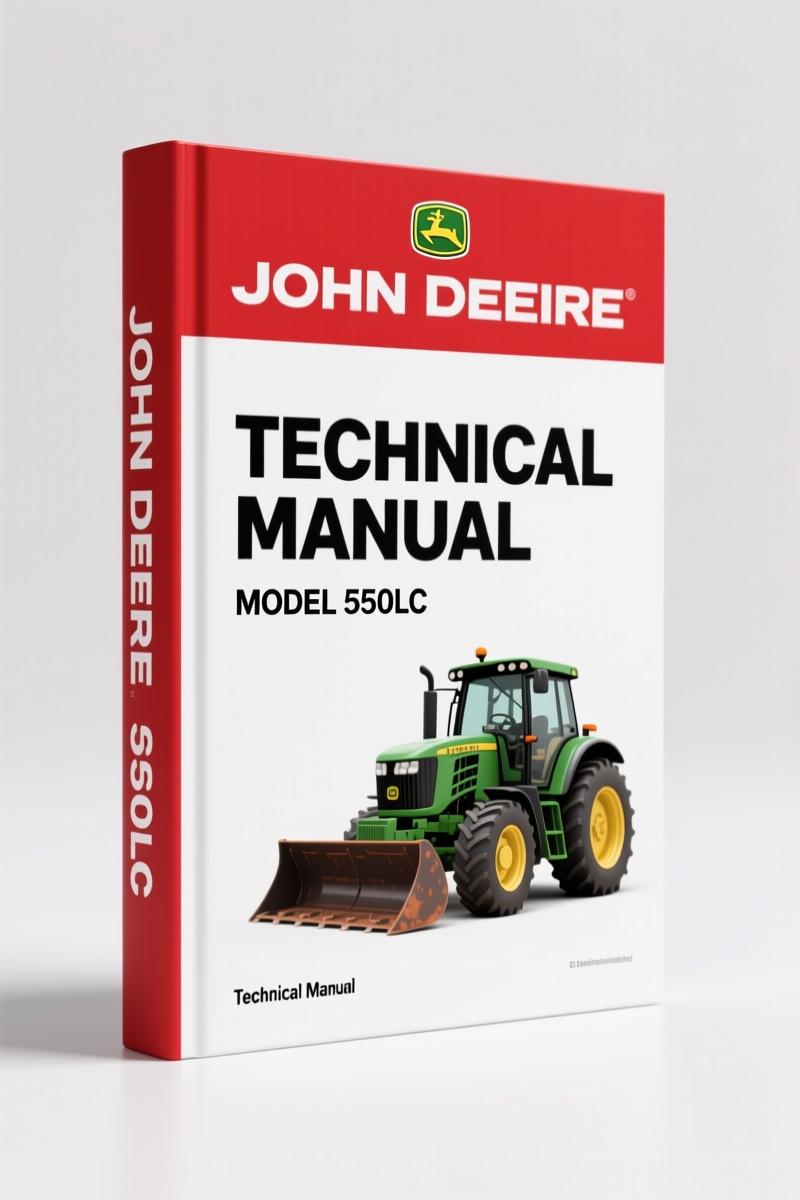
John Deere 550LC 2005 Technical Manual – 672 Pages OEM Service Specs
Original price was: $54.45.$45.00Current price is: $45.00.
John Deere 550LC 2005 Technical Manual: 672 pages of factory torque specs, fluid capacities, and track system repair procedures.
Description
John Deere 550LC 2005 Technical Manual
You’ve got a John Deere 550LC 2005 Technical Manual in your hands? Good. Because the aftermarket garbage on the internet won’t tell you the right torque for the track chain bolts. I’ve wasted an afternoon with a stripped bolt because some online forum said “tighten till it feels right.” That’s how you turn a $50 repair into a $500 headache. This manual is factory-original, 672 pages of the exact procedures John Deere engineers wrote for the 550LC excavator. It’s not a reprint. It’s the real thing.
Safety – This Section Could Save Your Life
Before you even think about pulling a wrench on this machine, read the Safety group (Section 00, Group 0001). It covers battery explosions, high-pressure fluid injection injuries, and proper machine support. John Deere didn’t write this to fill pages – they wrote it because experienced techs still get hurt. The “Avoid High-Pressure Fluids” warning is worth the price of the manual alone. Hydraulic oil at 3000 psi can pierce skin. You don’t get second chances with that.
Torque Values – Why Factory Specs Matter
The Torque Values section (Group 0003) has both Unified Inch and Metric bolt torque tables. It also gives service recommendations for O-Ring Boss fittings, flat face O-ring seals, 37° flare connectors, and four-bolt flange fittings. The TOC lists ‘Service Recommendations for 37° Flare and 30° Cone Seat Connectors’ – that’s the kind of detail you won’t find in a generic manual. You also get ‘Additional Metric Cap Screw Torque Values’ for bolts that fall outside standard ranges. And the ‘Check Oil Lines And Fittings’ section tells you how to inspect hydraulic lines before you torque them. If you skip this step, you risk a line blowout. I’ve seen it happen. If you’re reassembling the track system and you use the wrong torque on a sprocket bolt, you’ll be replacing sprockets every season. The manual gives you the numbers. Use them.
Fuels and Lubricants – Avoiding Costly Mistakes
Group 0004 tells you exactly what to put in every reservoir: diesel fuel lubricity requirements, engine oil, hydraulic oil, swing gearbox oil, track roller grease. You can’t just pour in generic 10W-30. The manual specifies the correct fluids for the 550LC. Getting it wrong means seal failure, pump cavitation, or worse. The manual also warns against using galvanized containers for fuel storage – a detail most aftermarket sources ignore.
Track System – Disassembly and Wear Measurement
This manual covers the Track System in detail. You get procedures to measure track roller wear, carrier roller wear, grouser wear, and chain pitch. It tells you the exact tools needed – John Deere part numbers included. Removal and installation steps for track shoes, chain, sprocket, and front idler. If you need to rebuild the undercarriage, this is your only reliable source. No more guessing bushing wear – the manual gives you the limits.
672 Pages – What Else Is Inside?
From General Information through Predelivery Assembly Instructions, Operator’s Station removal and installation, and even the heating and air conditioning section – this manual covers everything a technician needs. The Predelivery Assembly group (Group 0006) alone is critical if you’re putting together a machine from parts. It includes precautions for lifting, installing boom and cylinder hoses, and adjusting bucket linkage. Every step is a John Deere procedure, not a third-party interpretation.
If you’re looking for supplementary documentation, consider these related factory manuals: John Deere 220 1993 Technical Manual – 718 Pages of Factory Specs for smaller models, and John Deere 240, 250 2000 Technical Manual – Factory Specs for the 2000 series. For the 550LC, also check the John Deere 550LC 2005 Technical Manual – Section: Section 99—Dealer Fabricated T if your machine has dealer-made modifications.
For background knowledge on basic powertrain components, the Wikipedia article on Manual Transmission can help if you’re rebuilding the swing gearbox, but don’t rely on it for 550LC-specific specs. Also review Manual Transmission fundamentals if needed.
Now, about the tech writing in this manual: It’s dense. It’s for experienced technicians, as the foreword states. But if you can read a torque wrench and follow steps, you can use this manual. Essential tools are listed at the start of each group. You’ll need a press for track roller work, a bushing tool, and standard sockets. No special dealer-only tools required for most jobs – but when they are, the manual calls them out.
- Does this manual cover the engine?
- Yes, engine specifications and drain/refill capacities are included.
- What is the difference between this Technical Manual and the Operation and Tests manual?
- The Technical Manual (TM1808) is for repair: disassembly, assembly, and component replacement. The Operation and Tests manual (TM1807) is for diagnosing failures through operational tests and test procedures. Both are useful, but if you need to fix a broken track or replace a hydraulic cylinder, this is the manual you need.
Don’t trust your $50,000 excavator to a photocopied PDF from a sketchy site. Get the real factory document. Access the Factory Manual from AutoRepairManuals and have it on your tablet or printed in your toolbox. You’ll save more than the cost in the first repair you get right the first time.
Additional information
| Brand | John Deere |
|---|---|
| Language | English |
3 reviews for John Deere 550LC 2005 Technical Manual – 672 Pages OEM Service Specs
You may also like…
-
Sale!
John Deere JD450 1987 Service Manual – OEM Factory Specifications
Original price was: $79.95.$65.00Current price is: $65.00. -
Sale!
John Deere JD450 1987 Service Manual – OEM Factory Specs
Original price was: $97.50.$65.00Current price is: $65.00. -
Sale!
John Deere 325J 2011 Repair Manual — Factory Specs for Backhoe Loader
Original price was: $109.60.$80.00Current price is: $80.00. -
Sale!
John Deere 400 1974 Service Manual – Factory Specs for Technicians
Original price was: $92.30.$65.00Current price is: $65.00.
Related products
-
Sale!

Technical Manual – International 6.0L Power Stroke FICM Diagnostics
Original price was: $29.80.$20.00Current price is: $20.00. -
Sale!

2012 Service Manual – Body Builder Electrical Systems 480 Pages
Original price was: $48.28.$34.00Current price is: $34.00. -
Sale!

1995 Operators Manual – International 1000-4000 Series | OEM Documentation
Original price was: $12.49.$9.99Current price is: $9.99. -
Sale!
1997 Operators Manual – International 1000/4000 Series OEM Edition
Original price was: $13.49.$9.99Current price is: $9.99.
pro_mechanic –
I am very pleased with this purchase. The PDF looks clean. A must-have for any John Deere Deere owner doing maintenance. Saves me hundreds of money.
David K. –
This is exactly what I needed. Immediate link after payment. Contains precise bolt torque specs for John Deere. Saves me a lot of money.
Robert M. –
Perfect workshop guide. The document is high resolution. It assisted me to fix my John Deere Deere electrical system. Saved my weekend project! Thank you.