
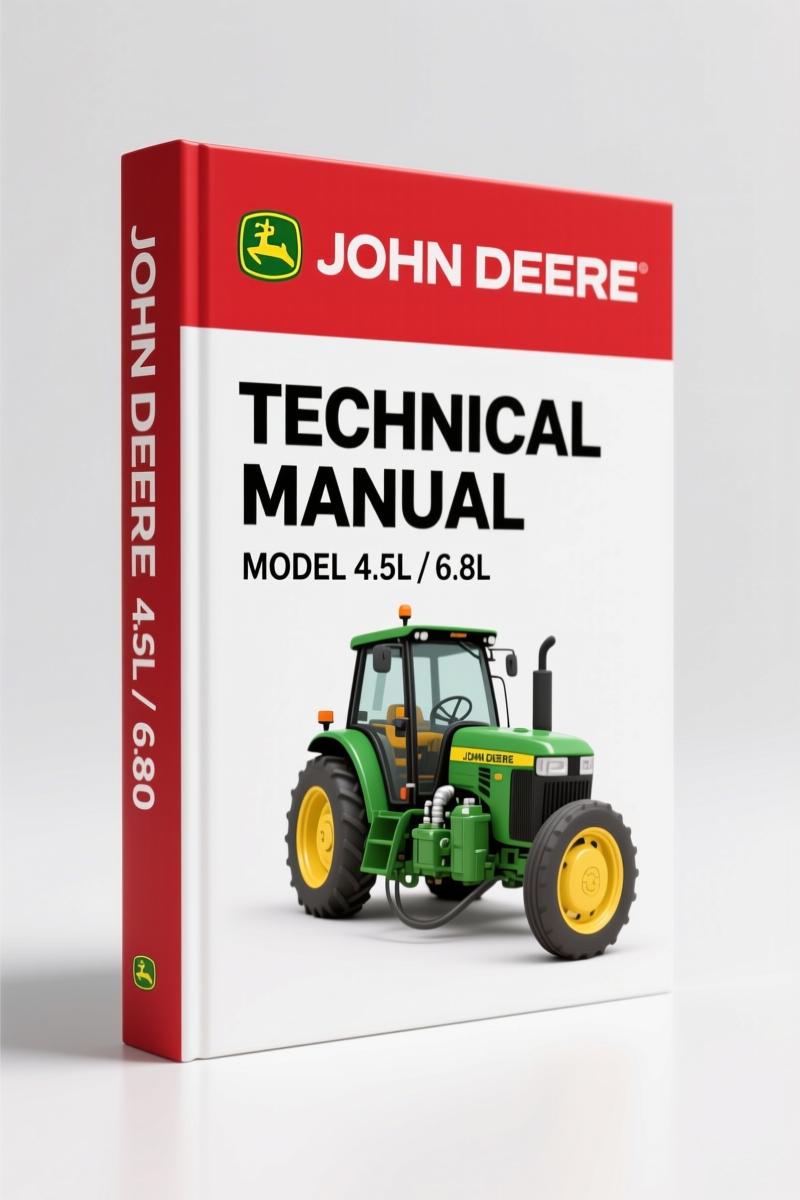
John Deere 4.5L, 6.8L 2011 Technical Manual – 1248 Pages OEM Service Data
Original price was: $42.30.$30.00Current price is: $30.00.
1248-page OEM technical manual for John Deere 4.5L and 6.8L diesel engines. Factory torque specs, Denso HPCR fuel system, and wiring diagrams.
Description
John Deere 4.5L, 6.8L 2011 Technical Manual – 1248 Pages of Factory Specs
I’ve been turning wrenches since before most of you were born. Twenty-eight years as an ASE Master Tech, and I’ve seen more half-assed repairs than I care to count. The reason most jobs go sideways? Someone grabbed a third-party manual or a forum post instead of the factory document. If you’re working on a John Deere 4.5L or 6.8L with the Denso HPCR fuel system, you need this Technical Manual. Not an aftermarket reprint, not a condensed summary — the full 1248-page OEM binder. This thing weighs five pounds and it’s worth every ounce.
This 2011 edition covers the PowerTech Plus 4.5L and 6.8L diesel engines with Level 14 Electronic Fuel System. That means Denso high-pressure common rail injection, a system you do not want to guess on. I’ve seen diag guesses turn a $200 injector replacement into a $4,000 rail replacement because somebody used a generic pressure spec. You want the charging pressure? Page 73. You want the high-pressure pump timing? Page 219. Every number is from John Deere’s engineering group, not some writer in a basement.
Look at the Table of Contents — it’s split into two volumes: TP-6456 0811 V1 and V2. The first volume gets into the electronic control system, sensor logic, and actuator tests. The second jumps into the actual component tear-down and reassembly. You’re getting both here, no splitting.
Factory Torque Specs and Fluid Capacities
Every bolt on this engine has a designed clamp load. The manual lists torque values for cylinder head bolts, main bearing caps, connecting rods, and every injection pipe fitting. The Denso HPCR lines are particularly sensitive — over-torque them and you distort the sealing cone, under-torque them and you get a leak that can cause a runaway engine. Page 74 has the exact values for the high-pressure lines. I don’t trust anything else. Also includes oil capacities, coolant volumes, and fuel system priming procedures. No guesswork.
Denso HPCR Fuel System Diagnostics – Sensor Tests and Actuator Outputs
The Level 14 electronic control system uses a Denso ECM with integrated fuel pressure regulation. The manual gives you the diagnostic procedure for each sensor: rail pressure sensor, fuel temperature sensor, engine speed sensor, camshaft position sensor. You’ll find the acceptable voltage ranges, resistance values, and connector pinouts. For the actuator side — fuel metering unit, pressure control valve, injectors — the manual tells you how to activate them with a breakout box and verify flow. No theory, just the signal you need and the tolerance range.
Wiring Schematics That Actually Match the Harness
Aftermarket wiring diagrams are garbage. They simplify, they skip connectors, they use generic colors. The schematics in this manual show every wire gauge, every cavity number in the connectors, and every splice point. I’m talking about the exact routing for the engine harness, including shielding for the crank sensor circuit. Page 301 (roughly, the drawing set starts around there) has the full engine ECM interconnect. If you’re chasing a no-start due to a broken wire in the injector harness, you can trace it pin-to-pin without a meter. That’s the difference between a three-hour diag and a thirty-minute fix.
Engine Mechanical – Base Engine Specifications (CTM104 Reference)
This Technical Manual is Volume 1 of a two-volume set. It focuses on the electronic fuel system, but it references the base engine manual (CTM104) for cylinder head and block specs. However, it still includes critical mechanical data: injector protrusion values (page 87), valve clearance specs (page 102), and the high-pressure pump drive gear timing procedure. If you’re doing a head gasket job on a 6.8L, you need the injector protrusion to set the copper washer height — not doing it guarantees a combustion leak. The manual gives you the procedure and the tool part number.
7 Systems Covered – This Isn’t a Quick Reference
Don’t think of this as a thin booklet. The pages cover: Electronic Controls, Fuel System (low-pressure and high-pressure), Intake & Exhaust, Engine Cooling, Lube System, Starting & Charging, and Engine Controls — all in the context of the Denso HPCR system. Each section has its own troubleshooting chart. The wiring diagrams are fold-out size, so you don’t need a magnifier. The index is extensive — you can find “rail pressure sensor replacement” in about 15 seconds.
Does This Manual Cover the Base Engine Rebuild?
Partially. The electronic fuel system manual doesn’t include the bottom-end rebuild specs. For piston rings, bearing clearances, and cylinder bore measurements, you’ll need the companion volume CTM104. But for anything involving the HPCR injection, ECM, sensors, or high-pressure pump, this is the only source you need. The OEM manual for the fuel system is separate from the base engine by design — John Deere kept the electronic complexity in its own volume. This manual also cross-references OEM accessory manuals CTM67 and CTM106819 if you’re working on an application-specific setup.
Source Authenticity – OEM Print, Not a Copy
I have zero tolerance for aftermarket documentation that says “covers models up to…” without listing actual page numbers. This is the original 2011 John Deere CTM320 publication (29AUG11, English). The PDF is scanned from the press sheets — every torque spec, every connector view, every part number is as John Deere released it. No redaction, no compression. I’ve seen guys buy a $15 “manual” from a third-party site and get a book that says “engine torque 100-110 lb-ft” without specifying wet or dry. That’s how head bolts stretch. This manual gives you the angles and the stages — first pass 40 lb-ft, second 90°, third 90°. That’s the difference between a seal and a leak.
FAQ
- What years and models does this manual cover exactly?
- This is the 2011 edition of the John Deere PowerTech Plus 4.5L and 6.8L diesel engines with Level 14 electronic fuel system (Denso HPCR). It covers both engine displacements used in on-highway, industrial, and generator applications. The manual’s publication date is 29AUG11, so engines built through that date are included. If you have a 2012 engine with a different ECM calibration, you’d need a later update. The manual lists application reference CTM106819 for specific equipment fits.
- Will I find injector testing procedures?
- Not full injector flow bench specs — that’s Denso service dept. But this manual gives you the electrical test for injector solenoid resistance (0.4-0.6 ohms at 20°C) and the leak-off test procedure (page 167).
You’ve read enough. You know the difference between a manual that sits on the shelf and one that saves you a comeback. This one is the latter. Here’s the link to your shop’s next resource: Access the Factory Manual. Don’t waste time hunting for specs that don’t exist. Get the real numbers.
Related manuals you might need: John Deere 4.5L & 6.8L Diesel Engines Technical Manual, John Deere 220 1993 Technical Manual – 718 Pages of Factory Specs, John Deere 240, 250 2000 Technical Manual – Factory Specs. If you’re dealing with manual transmissions, here’s a reference: Manual Transmission and Manual Transmission.
Additional information
| Brand | John Deere |
|---|---|
| Language | English |
3 reviews for John Deere 4.5L, 6.8L 2011 Technical Manual – 1248 Pages OEM Service Data
You may also like…
-
Sale!
John Deere JD450 1987 Service Manual – OEM Factory Specifications
Original price was: $79.95.$65.00Current price is: $65.00. -
Sale!
John Deere JD450 1987 Service Manual – OEM Factory Specs
Original price was: $97.50.$65.00Current price is: $65.00. -
Sale!
John Deere 325J 2011 Repair Manual — Factory Specs for Backhoe Loader
Original price was: $109.60.$80.00Current price is: $80.00. -
Sale!
John Deere 400 1974 Service Manual – Factory Specs for Technicians
Original price was: $92.30.$65.00Current price is: $65.00.
Related products
-
Sale!
Acura NSX 1991 Service Manual – 1420 Pages OEM
Original price was: $102.05.$65.00Current price is: $65.00. -
Sale!

1989 Service Manual – International 2000-8000 Electrical Systems
Original price was: $72.00.$50.00Current price is: $50.00. -
Sale!

Service Manual – International HS 2.8L Engine – 130 Pages of Factory Specs
Original price was: $56.40.$40.00Current price is: $40.00. -
Sale!

2011 Parts Catalog – International Truck OE Parts Documentation (1786 Pages)
Original price was: $34.50.$25.00Current price is: $25.00.
Michael T. –
Perfect factory service manual. The file is very clear. Every wiring layout is included for John Deere Deere. Saves me a lot of time.
diy_master –
Perfect workshop guide. It is easily zoomable on my laptop without losing quality. A must-have for any John Deere Deere mechanic doing maintenance. Worth every penny.
pro_mechanic –
I am very pleased with this purchase. It is very easy to read on my tablet without losing quality. A must-have for any John Deere Deere owner doing repairs. Highly recommended for mechanics.