
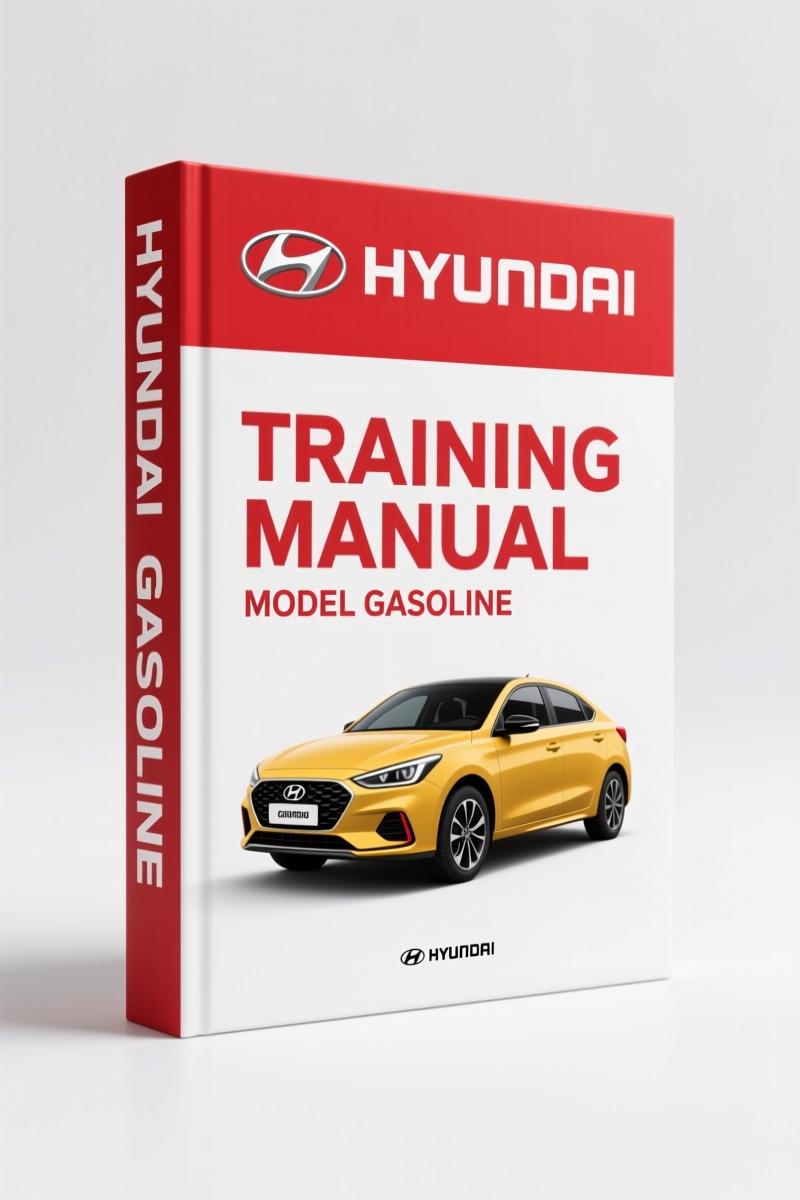
Hyundai Gasoline 2009 Training Manual – Factory Engine Management Specs
Original price was: $44.40.$30.00Current price is: $30.00.
Factory-authorized training manual for Hyundai gasoline engine management systems. 49 pages covering ECM, fuel delivery, ignition, CVVT, and diagnostics.
Description
Hyundai Gasoline 2009 Training Manual
I’ve seen too many guys throw parts at a P0300 because they don’t understand how the ECM decides dwell angle. This Hyundai Gasoline 2009 Training Manual is the OEM document that teaches you why, not just what. 49 pages of factory training material from Hyundai Motor Company, covering the entire engine management system from combustion basics to knock control. If you’re working on a Hyundai gasoline engine and you don’t have this, you’re guessing.
Using the Hyundai Gasoline 2009 Training Manual for ECM Diagnostics
Start with the development steps on page 3 – it’s not filler. Understanding how Hyundai moved from K-Jetronic to individual injector control tells you why the ECM behaves the way it does. The manual breaks down mixture control (page 7), control unit architecture (page 8), and the subsystems on page 9 before you ever touch a wrench. That sequence matters. Jump straight to diagnostic trouble codes without knowing the fuel delivery system (page 10) and you’ll miss the root cause.
Fuel Delivery and Return-less System – Sections 10 to 16
The fuel pump control logic on page 13 is different from the aftermarket diagrams you’ll find online. Hyundai uses a return-less fuel system (page 16) that requires specific pressure regulator handling – don’t guess the bleed-off procedure. The injectors section (page 17) includes spray pattern theory that affects replacement decisions. If you need the charge pressure specs, they’re buried in the training narrative, not a table, so read it all.
CVVT Control: What the Training Manual Explains
Dual CVVT operations start on page 30. This is where the manual earns its keep. The system mapping on page 28 shows you how oil pressure and solenoid duty cycle interact. I’ve watched techs replace camshaft position sensors because they didn’t understand CVVT locking at idle. The manual covers both single and dual CVVT, including the ECM correction strategies during warm-up and acceleration (page 38).
Does This Manual Cover the Ignition System?
Yes – pages 40 through 47. Essential components (page 41), advance and dwell angle control (page 42), and the spark advance strategy (page 43). The knock control and ionic current detection section (page 47) is unique to Hyundai training. If you’re diagnosing a misfire that changes with load, you need to understand basic ignition advance angle on page 44 and the timing correction tables that follow. This is not a R&R manual; it’s a theory-to-practice bridge.
3 Systems Covered: Fuel, Air, and Ignition
Fuel delivery overview (page 10) covers the pump, pressure regulator, and return-less architecture. Air induction (page 18) includes the ISC system (page 20) and the ETC throttle body block diagram on page 22. The variable intake system on page 23 affects volumetric efficiency at different RPMs. Ignition wraps it up with dwell control and knock detection. Each system has its own set of OEM test procedures, and the diagnosis functions section on page 48 gives you the framework for verifying sensor inputs and actuator outputs. You need this manual before you hook up a scan tool.
Skip the theory, and you’ll chase misfires for hours.
Diagnosis Functions: What You Need Before Scanning
Page 48 outlines self-diagnosis routines specific to Hyundai EMS. This isn’t generic OBD-II fluff – the training manual explains how the ECM monitors knock sensor rationality and ionic current integrity. If your scanner shows a weird fuel trim pattern, the acceleration and deceleration condition section (page 38) might point to an injector cut-off strategy that looks like a lean misfire. Know the control logic before you replace parts. The manual also covers injection correction (page 36) for altitude and temperature – critical for Texas heat.
For related training material, check out Hyundai HL780-9, HL730-9, HL740-9, HL757-9, HL760-9 2012 Training Manual and Hyundai 9 Excavators 2010 Training Manual – Cluster & Modes. If you’re into heavy equipment electrics, Hyundai Excavators 2011 Training Manual – Mechatronics & Electrics reinforces similar system logic. For broader industry context, read the Automotive Industry Overview and Automotive Industry Overview.
- Is this manual suitable for a 2010 Sonata?
- Yes – the 2009 training covers the engine management principles used in 2009+ GDI engines, including the Theta II family.
- What tools are required to follow this training?
- A multimeter, scan tool capable of reading Hyundai live data, and a pressure gauge for fuel rail. The manual doesn’t specify tool brands because it’s training, not a service procedure – but you’ll need the theory to apply your tools correctly.
- Can I use this to diagnose a no-start?
- Not directly. This is a training manual, not a diagnostic flowchart. It teaches you how the ECM controls fuel injection and ignition during start-up (page 37) so you can reason through a crank/no-start instead of guessing.
- Does this cover dual CVVT systems?
- Yes. Pages 30-33 explain dual CVVT operations and system mapping, including oil control valve behavior during different load conditions.
Stop working off secondhand summaries. Access the Factory Manual – the only document that carries Hyundai Motor Company’s copyright and engineering approval.
Additional information
| Brand | Hyundai |
|---|---|
| Language | English |
2 reviews for Hyundai Gasoline 2009 Training Manual – Factory Engine Management Specs
You may also like…
-
Sale!
Hyundai HDF15-5, HDF18-5 Service Manual – 227 Pages
Original price was: $61.65.$45.00Current price is: $45.00. -
Sale!
Hyundai HDF50III, HDF70III Service Manual – Factory Repair Specs
Original price was: $70.20.$45.00Current price is: $45.00. -
Sale!
Hyundai HD65, HD72, County Training Manual – A/C Diagnostics
Original price was: $65.00.$50.00Current price is: $50.00.
Related products
-
Sale!

1989 Service Manual – International 2000-8000 Electrical Systems
Original price was: $72.00.$50.00Current price is: $50.00. -
Sale!

2011 Parts Catalog – International Truck OE Parts Documentation (1786 Pages)
Original price was: $34.50.$25.00Current price is: $25.00. -
Sale!

1993 Electrical Schematic – International 1000/3000/4000 Bus Chassis OEM Wiring Diagrams
Original price was: $29.26.$22.00Current price is: $22.00. -
Sale!
1993 Operators Manual – International Bus 1000-3000 OEM Specs
Original price was: $12.30.$7.99Current price is: $7.99.
John S. –
Superb resource! It is very easy to read on my iPad without blur. Contains detailed bolt torque specs for Hyundai. Saves me a lot of money.
Richard G. –
I am extremely satisfied with this manual. It is very easy to read on my phone without losing quality. Contains detailed schematics for Hyundai. Saves me a lot of money.