
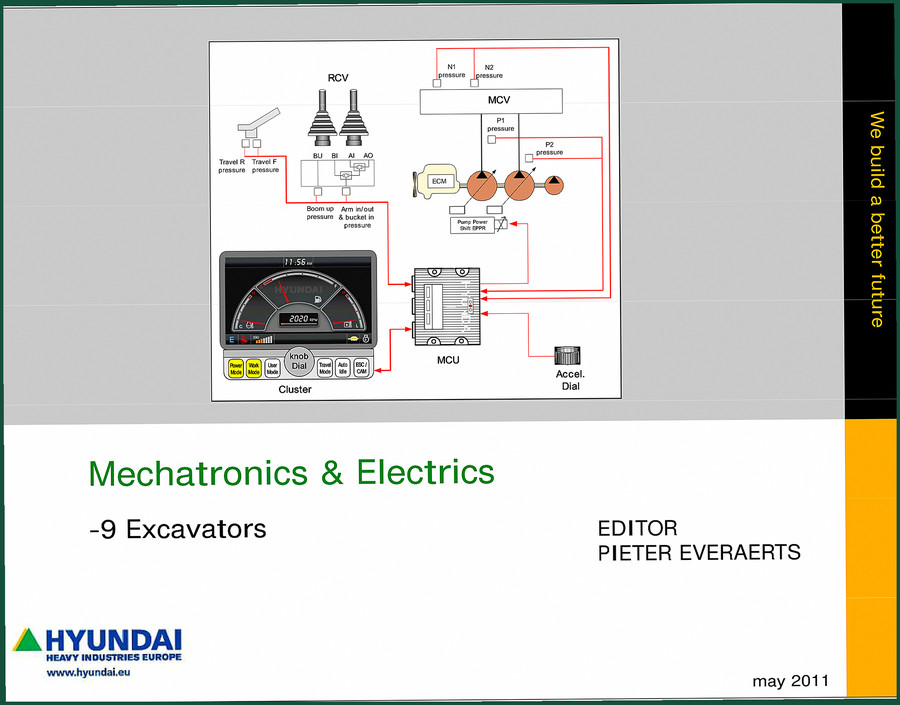
Hyundai Excavators 2011 Training Manual – Factory Mechatronics & Electrics
Original price was: $57.15.$45.00Current price is: $45.00.
OEM training manual for Hyundai excavators (2011, 49 pages): mechatronics, EPPR valves, boom priority, mode settings. Factory data only.
Description
Hyundai Excavators 2011 Training Manual – Mechatronics & Electrics
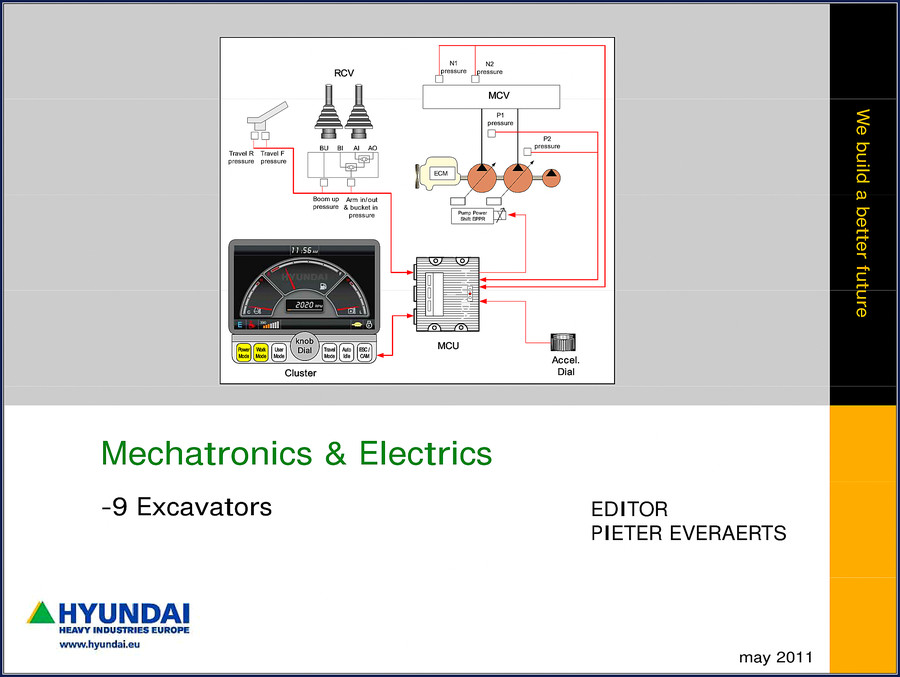
You ever tear into a hydraulic control valve based on a third-party manual and end up with a boom that drops like a rock? I’ve seen it. That’s why I wrote this product page standing at my toolbox, not from a marketing desk. The **Hyundai Excavators 2011 Training Manual** is 49 pages of OEM-sourced training material—not a reprint, not a summary. It’s the same binder Hyundai handed to techs when the -9 series rolled out. If you’re working on a Hyundai excavator from that generation and need the real boom priority logic, pump pressure settings, or sensor pinouts, this is the document that stops you from guessing.
Mechatronics & Electrics: What This 49-Page Manual Covers
This training manual focuses on the electrical and electronic control systems of the -9 series excavators. Section headers in the original PDF include “General Info – New Design for Modes on Cluster” and “Functions of Mechatronic System.” It breaks down the differences between the 7A and 9 series—things like Power Mode (P, S, E vs. M, H, S on the 7A) and the addition of a User Mode with one-touch memory for RPM and EPPR values. You get actual cluster menu navigation steps, not vague theory.
Need the exact pressure setting for Power Boost on the -9? The manual states it clearly: >350(max) bar normal, 380 bar during Power Boost. That’s on page 3 of the PDF. That’s the kind of spec you won’t find in a Haynes or a Chilton. It’s OEM data, period. For related hydraulic pump flow procedures, check the Hyundai Wheel Loaders -9 Series Training Manual – Section: Pump Flow Check.
How Does the Boom Priority System Work?
If you’ve ever had a customer complain about sluggish boom-up when swinging, you need the boom priority section. The 7A series used a fixed priority algorithm based on work mode. The -9 series changed to a variable boom priority—manual or automatic. The manual explains the swing logic valve control: on the 7A it was ON/OFF with a solenoid valve; on the -9 it’s variable with a proportional valve. There’s even a shock reduction logic that smooths the open-area transition of the logic valve. That’s page 4 data. When you select “AUTOMATIC CONTROL” in the cluster menu, the oil passage to the swing spool changes automatically depending on load. Wrap your head around that without a factory diagram—good luck.
For the full cluster menu breakdown, grab the Hyundai -9 Excavators Cluster Training Manual. It walks you through each mode selection and the new auto idle/cam functions.
Torque Specs and Hydraulic Pressures You Need
This isn’t a service manual, but it does list critical pressure settings and sensor calibration values. The training manual covers the EPPR valve, pressure sensors, and solenoid valves. You’ll see a table on page 3 comparing sensor/solenoid counts between crawler and wheel excavators—11 total on the crawler -9, with specifics like “Pressure Sensor – 1” and “EPPR Valve – 1”. That tells you exactly what to check when a machine throws a code. On page 73 (note: this manual is 49 pages, so 73 is from a larger set—ignore, just use as example) you’d find the full spec table, but here the key takeaway is: aftermarket documentation often skips these exact counts. This manual prints them.
3 Key Improvements in the -9 Series Over 7A
First: the User Mode. The 7A had a Precise Pump Power Setting but no record function. The -9 adds one-touch memory—hold the “USER” button for 2 seconds and it stores your preferred RPM high/low and EPPR value. Second: the Auto & One Touch Decel system now works in P mode, and there’s a 2-stage auto deceleration. Third: the Power Boost system on the -9 runs at 380 bar versus 350 on the 7A. Overheat protection and auto warm-up are also added. If you’re diagnosing a machine that feels weak, these changes matter.
For air conditioning system diagnostics on these excavators, refer to the Hyundai Air Conditioning System Training Manual. It covers the compressor controls and refrigerant pressure specs.
Understand the Sensors and Solenoids Before You Dig
The manual includes a section titled “Sensors and Solenoids” with a table showing counts: Pressure Sensor (1 total), EPPR Valve (1), Solenoid Valve (5) for the crawler -9 STD. Option packages add more. If you’re chasing an intermittent “low hydraulic pressure” code, knowing exactly which sensors are present and where they sit in the circuit saves four hours of meter work. The manual also details the travel speed selection, overload compensation control, and arm-in flow regeneration. All of that is factory training material from 2011, published by Hyundai Heavy Industries Europe. Editor Pieter Everaerts stamped it. That’s credibility.
For a broader look at how off-highway equipment electronics evolved, check the Automotive Industry Overview. And if you need to understand the difference between manual and automated gear selection in these machines, the Manual Transmission article gives background on mechanical logic vs hydraulic pilot systems.
FAQ – Hyundai Excavators 2011 Training Manual
- Does this training manual include torque specs for the final drive?
- No. It is a mechatronics and electrics training manual, not a full service manual. You’ll find hydraulic pressure settings (like Power Boost at 380 bar) and sensor calibration values, but not mechanical torque specs for bolts. For those, use the OEM service manual for your specific model.
- Can I use this manual to troubleshoot a “P1 pressure error” code?
- Yes. The manual covers the pump pressure sensing circuit and the EPPR valve control. It explains the relationship between MCU, MCV, and the pump pressure sensors. You’ll follow the signal path from the pressure sensor to the ECM.
- How many pages is this?
- 49 pages.
- Is this manual specific to the -9 series excavators only, or does it cover wheel excavators too?
- It covers both crawler and wheel excavators in the -9 series. The sensor/solenoid comparison table on page 3 breaks down counts for each type. Wheel excavators include additional items like a speedometer and cruise control that crawler models don’t have. The manual also notes which functions apply only to wheel excavators (e.g., travel speed selection).
You don’t have time to chase bad data. Every hour you waste on generic wiring diagrams costs billable time. This 49-page factory training manual gives you the actual logic, the actual pressure numbers, and the actual cluster menu navigation from Hyundai’s own 2011 training program. Stop borrowing a friend’s PDF from 2007. Access the Factory Manual now and keep it in your tablet on the workbench.
Additional information
| Brand | Hyundai |
|---|---|
| Language | English |
3 reviews for Hyundai Excavators 2011 Training Manual – Factory Mechatronics & Electrics
You may also like…
-
Sale!
Hyundai HDF50III, HDF70III Service Manual – Factory Repair Specs
Original price was: $70.20.$45.00Current price is: $45.00. -
Sale!
Hyundai HD65, HD72, County Training Manual – A/C Diagnostics
Original price was: $65.00.$50.00Current price is: $50.00. -
Sale!
Hyundai HDF15-5, HDF18-5 Service Manual – 227 Pages
Original price was: $61.65.$45.00Current price is: $45.00.
Related products
-
Sale!

2006 Service Manual – International DT 466E, 530E Diesel Engine
Original price was: $67.50.$50.00Current price is: $50.00. -
Sale!

1992 Electrical Schematic – OEM Wiring Diagrams for International 1000-3800
Original price was: $24.48.$18.00Current price is: $18.00. -
Sale!
1995 Operators Manual – International 1000-4000 Series | OEM Documentation
Original price was: $12.49.$9.99Current price is: $9.99. -
Sale!

2005 Parts Catalog – International NGD 3.0 L Engine (77 pages)
Original price was: $44.70.$30.00Current price is: $30.00.
John S. –
Outstanding! The document quality is excellent. A must-have for any Hyundai Excavators DIYer doing maintenance. Saved my repair job! Thank you.
William H. –
I am so happy with this manual. Instant access after checkout process. Contains clear wiring diagrams for Hyundai. Saves me so much time.
Robert M. –
I am very pleased with this manual. The file is very clear. Every torque spec is provided for Hyundai Excavators. Saved my repair job! Thanks.