
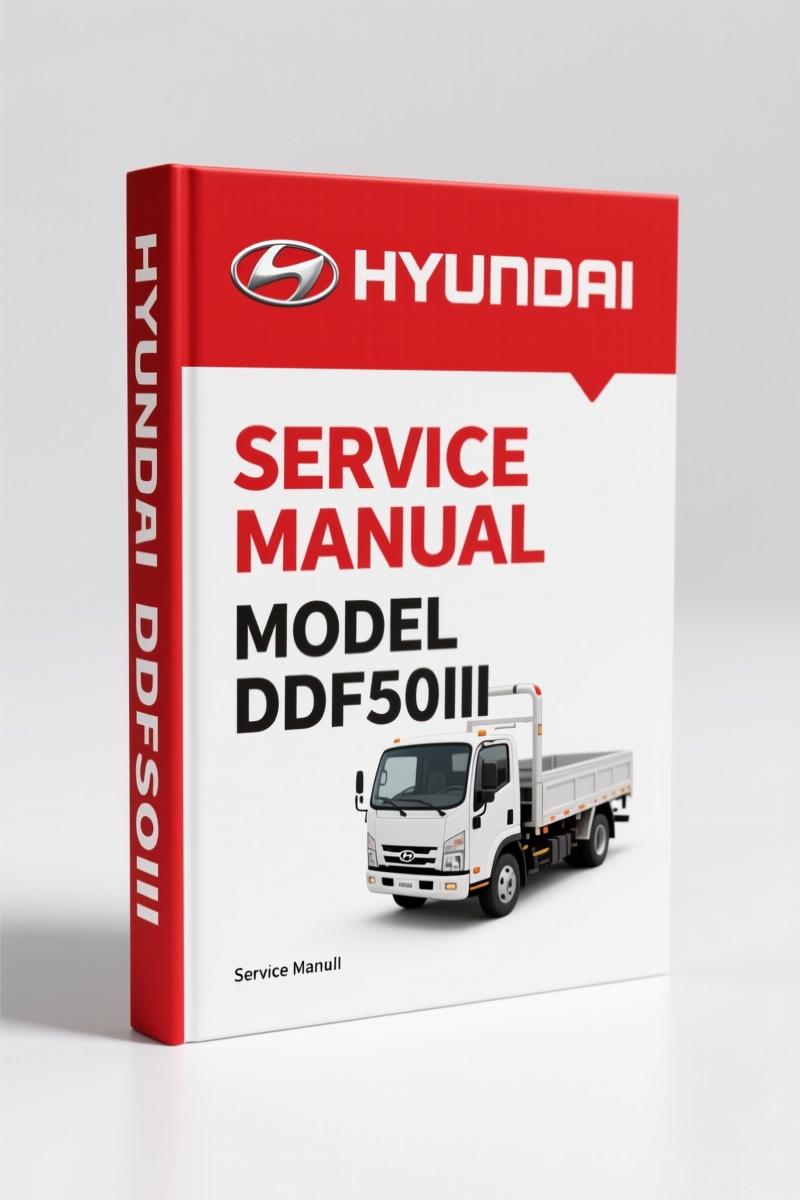
Hyundai HDF50III, HDF70III Service Manual – Factory Repair Specs
Original price was: $70.20.$45.00Current price is: $45.00.
159-page factory service manual for Hyundai HDF50III and HDF70III forklifts. Covers all major systems with OEM torque specs and diagnostic procedures.
Description
Hyundai HDF50III, HDF70III Service Manual
Hyundai HDF50III, HDF70III Service Manual — I’ve been turning wrenches for 28 years, and I can tell you right now: trying to fix a forklift with a generic manual is like trying to rebuild a transmission with a butter knife. You waste time, you break parts, and you might get hurt. I’ve seen it happen. That’s why I only trust factory documentation. This 159-page service manual is the real deal — printed from the same press Hyundai uses for their dealerships. No aftermarket reprints, no condensed versions. You get the full section breakdown, from Section 1 GENERAL safety hints to Section 8 MAST overhaul.
General Safety Hints (Section 1) – Why You Read This First
First thing I tell any green tech: read the safety section before you touch anything. Page 2 of this manual covers the foreword and safety symbols. They mark critical points with a symbol — you’ll see it next to torque specs and lifting procedures. Ignore it? Your call. But I’ve seen a mast collapse from a skipped step. The manual lays out basic precautions: proper jacking points, battery disconnect procedure, and the dangers of hydraulic oil under pressure. It’s not fluff. It’s the difference between a clean job and a hospital visit.
Removal & Installation of Unit (Section 2) – Do It Right or Don’t Do It
Section 2 walks you through pulling and reinstalling major units — engine, transmission, drive axle. Every removal sequence is listed in order. They don’t assume you know which bolt to loosen first. Need to pull the torque converter? They show you the tool list required (you’ll need a 3/4-inch drive socket set, minimum). Reinstallation? Torque values are given in both Nm and ft-lbs. No guessing. If you skip the sequence, you’ll bind the alignment. I’ve seen guys force it and crack a bell housing. This manual prevents that.
Powertrain System Breakdown (Section 3)
Here’s where the real meat is. Section 3 covers the transmission control valve, drive axle differential, and final drive. They explain the hydraulic circuit inside the transmission — how the clutch packs engage. For a DIY guy in a home garage, this section is gold: it includes exploded diagrams with part numbers. Need to replace a seal? The manual tells you which sealant to use and the cure time. Don’t use RTV when the spec calls for anaerobic. That’s how leaks start.
Brake System Piping (Section 4) – Factory Procedure
Brakes on a forklift are high-pressure systems. Section 4 gives you the entire piping layout — which line goes from the master cylinder to the wheel cylinder, and the bleed sequence. They also include the brake adjustment specs: pedal free play should be 1/8 to 3/16 inch. Aftermarket manuals often skip the bleed order. This one doesn’t. They show you a diagram of the brake circuit with check valves. Bleed the wrong wheel first and you’ll trap air. Done that. Not fun.
Hydraulic System: Gear Pump and Main Control Valve (Section 6)
Section 6 is the heart of the lift function. It covers the gear pump (flow rate and relief pressure), the main control valve spools, and the work equipment circuit. They list the O-ring sizes for every port. I’ve seen guys grab a generic O-ring that’s one size off — it cuts and dumps oil. The manual also includes a troubleshooting chart: “If mast drifts down, check spool clearance.” That kind of specific diagnostic saves hours.
Electrical System Troubleshooting (Section 7) – Before You Blow a Fuse
Section 7 has full wiring diagrams with wire colors and connector pinouts. No chasing your tail. Need to test the starter relay? They show the test points and acceptable voltage drops. They also list the fuse locations and amperage for each circuit. This is the section that prevents “mystery electrical fires.” I’ve fixed more than one forklift where someone used a generic manual and jumped the wrong pin. OEM diagrams are accurate.
Does This Manual Cover the Mast Assembly? (Section 8)
Yep. Section 8 details the mast structure, carriage, backrest, and forks. They give you the torque specs for the mast mounting bolts (page 8-15 if I recall). Also covers the lift chains — how to measure stretch and when to replace. Forks themselves have a wear limit: 10% of original thickness. This manual tells you where to measure. That info keeps you from lifting a load that snaps a fork.
Audience and Real-World Use
Who should buy this? If you work on forklifts for a living — either at a dealership or in a fleet maintenance shop — this manual is your workbench reference. Also if you’re a serious DIYer with a warehouse forklift at home. Real-world use: I had a customer bring in an HDF50III with a brake issue. Stopped half the time. Grabbed the manual, went to Brake System Piping, found the adjustment procedure on the second page. Adjusted pedal free play to the 3/16 inch spec. Problem solved in 20 minutes. Try doing that with a generic manual that says “adjust as necessary.” This is necessary.
Source Validity – OEM vs. Aftermarket
I don’t trust aftermarket documentation. Period. They copy from each other and miss details. This manual is an original Hyundai factory release — Service Manual for the HDF50III and HDF70III. It’s printed from the same file that every Hyundai dealer uses. If you’ve got a Hyundai forklift, this is the only book you need. Don’t waste money on a third-party reprint that leaves out half the wiring diagrams.
- Are torque specifications listed in both metric and imperial units?
- Yes.
- How does this manual compare to aftermarket repair books for the HDF50III and HDF70III?
- Aftermarket books often skip steps or use generic values. This factory manual gives you the exact Hyundai specs: removal sequence, sealant types, and torque values that match the assembly line. You won’t find that in a Chilton or Haynes. Plus, it covers the electrical system with full wiring diagrams. I’ve seen too many short circuits from guessing. Stick with OEM.
If you need parts identification, grab the HYUNDAI HDF50III HDF70III Parts Catalog. For another reference, HYUNDAI HDF50III HDF70III Service Manual is the same document. For lighter vehicles, check the Hyundai Santa Fe Service Manual 2001-2002 – 353 Pages OEM Factory Specs. For industry standards, see Automotive Industry Overview and Automotive Industry Overview.
Access the Factory Manual — put it on your tablet or print it out. Keep it on the bench. Every time you crack open a Hyundai forklift, you’ll thank yourself for having the right specs in hand.
Additional information
| Brand | Hyundai |
|---|---|
| Language | English |
3 reviews for Hyundai HDF50III, HDF70III Service Manual – Factory Repair Specs
You may also like…
-
Sale!

Hyundai HD65, HD72, County Training Manual – A/C Diagnostics
Original price was: $65.00.$50.00Current price is: $50.00. -
Sale!
Hyundai HDF15-5, HDF18-5 Service Manual – 227 Pages
Original price was: $61.65.$45.00Current price is: $45.00.
Related products
-
Sale!

1991 Electrical Schematic – 112-Page OEM Wiring Diagram for International 1000-3000 Series
Original price was: $22.75.$17.50Current price is: $17.50. -
Sale!
International 1000-3000 Series Operators Manual – 132 Pages of OEM Specs
Original price was: $14.40.$10.99Current price is: $10.99. -
Sale!

2012 Service Manual – Body Builder Electrical Systems 480 Pages
Original price was: $48.28.$34.00Current price is: $34.00. -
Sale!
1996 Operators Manual – International 1000-4000 Series (246 pages)
Original price was: $15.28.$9.99Current price is: $9.99.
gearhead88 –
This is just what I was looking for. The PDF is very clear. A must-have for any Hyundai HDF50III, mechanic doing repairs. Great value for money.
William H. –
This is just what I was looking for. Quick access after checkout process. A must-have for any Hyundai HDF50III, DIYer doing repairs. Great value for money.
Richard G. –
This is exactly what I required. The file looks clean. Contains clear schematics for Hyundai. Saves me hundreds of time.