
Hyundai 55W-7 Technical Manual – Factory Specs for Wheel Excavator
Original price was: $21.44.$14.99Current price is: $14.99.
Hyundai 55W-7 Technical Manual: 40 pages of factory hydraulic specs, pump data, and component function diagrams for workshop use.
Description
Hyundai 55W-7 Technical Manual – OEM Hydraulic System Specs
You ever pull a hydraulic pump apart and find yourself guessing which port is which? That’s how you blow a seal and waste a Saturday. I’ve seen too many aftermarket manuals that leave out the port size table or give you a generic drawing with no thread pitch. That’s not how you keep a loader running. The Hyundai 55W-7 Technical Manual gives you the factory documentation straight from Hyundai. 40 pages of structure and function for the hydraulic and drivetrain systems. No guesswork.
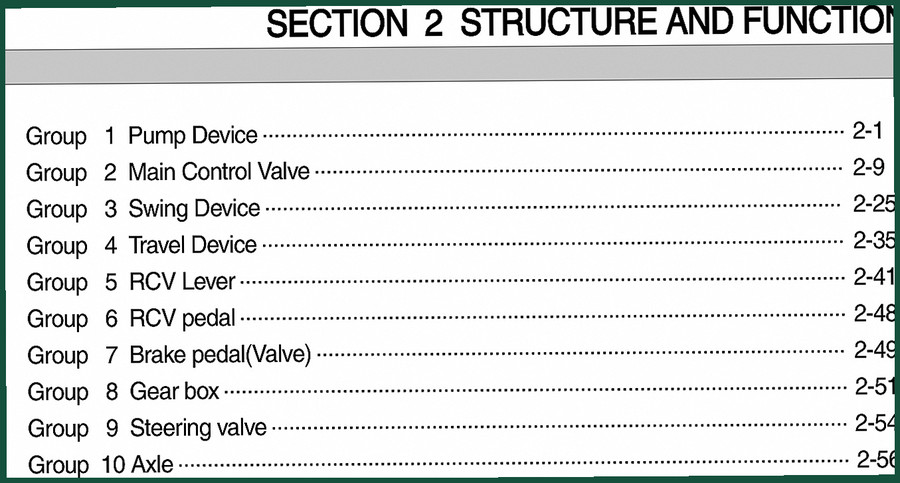
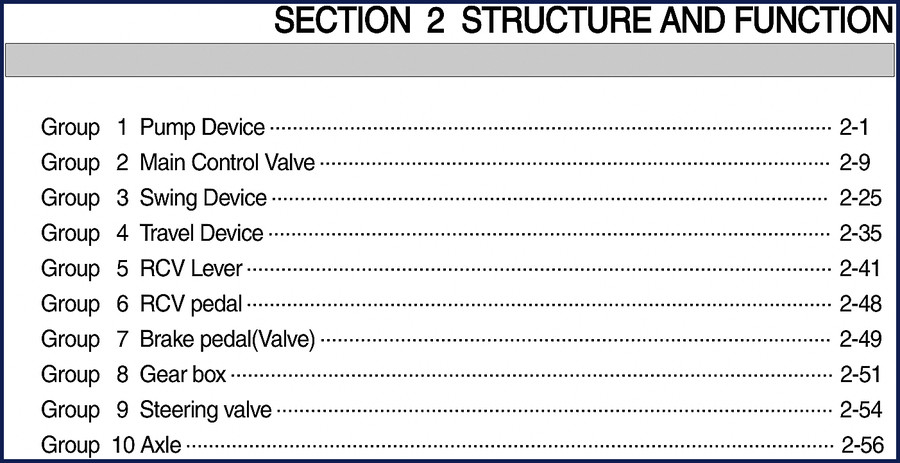
Let’s get into what’s actually inside this thing. The manual is Section 2 of the service documentation, covering groups 1 through 10. That means the pump device, main control valve, swing device, travel device, RCV lever and pedal, brake pedal valve, gear box, steering valve, and axle. If you’re rebuilding a 55W-7 wheel loader, you need every one of these.
Hyundai 55W-7 Technical Manual: What’s Inside
Look at the OCR excerpt from page 2. It starts with “GROUP 1 HYDRAULIC PUMP” and describes a variable displacement double-piston pump with one swash plate. The manual walks you through the principal components and functions – drive shaft, hanger, rotary group, control spring, control piston, gear pump, housing. It even shows the hydraulic circuit diagram with port labels A1, A2, A3, R1, A4 and their gauge ports. That’s why you buy OEM.
Aftermarket manuals will tell you “hydraulic pump – see diagram” and leave you hunting for thread sizes. Page 2 of this manual lists discharge port sizes: SAE 1½ for the suction port, PF ½ for the main discharge ports, and PF ¼ for gauge ports with quick couplers. That level of detail is the difference between a fitting that seals and a leak that costs you billable hours. For a broader view of hydraulic system standards, check the Automotive Industry Overview.
Hydraulic Pump Assembly – Section 2 Coverage
Group 1 covers the pump itself. The manual tells you the rated capacity: 2×25 + 16.2 + 6.5 cc/rev. Rated oil flow: 2×60 + 38.9 + 15.6 ℓ/min. Rated pressure: 2×220 + 200 + 30 kgf/cm². You get the spec for the third pump and pilot pump connections too. That’s not guesswork – that’s factory data. If you’re replacing a pump or rebuilding the rotary group, you need those numbers to match the replacement parts.
The pump section also explains the constant-output control method. The discharge pressure from both pumps acts on the control piston to tilt the hanger. Tilting changes the piston stroke, which changes flow. That’s how the system keeps (P1+P2)×Q constant. If you don’t understand that relationship, you’ll misdiagnose a low-flow condition every time.
Does This Manual Cover the Main Control Valve and Swing Device?
Groups 2 and 3 cover those exactly. Group 2 is the main control valve – pages 2-9 onward. Group 3 is the swing device – pages 2-25. The manual doesn’t skip. Every group has its own sub-sections with exploded views and port descriptions. You get the RCV lever (Group 5), RCV pedal (Group 6), brake pedal valve (Group 7), gear box (Group 8), steering valve (Group 9), and axle (Group 10).
If you need to service the travel device (Group 4), the manual covers the hydraulic motor and reduction gear. That’s 10 major subsystems in 40 pages. Each one has the same level of detail as the pump section – function description, component layout, and hydraulic circuit. That’s OEM documentation, not a reprint of a Chilton’s page.
Get the Right Specs for Port Sizes and Pressures
Page 2 includes a table titled “Description of the ports” with eight rows. It lists every port by name, function, and thread size. Example: A1 and A2 are suction ports with SAE 1½ standard. A1G and A2G are discharge ports with PF ½. PPG is the gauge port – PF ¼ with quick coupler. That’s the kind of data you need when you’re plumbing a new pump and don’t want to guess which adapter fits.
The specifications table on page 3 gives you the rated oil flow and pressure in both metric and imperial? No – it’s in ℓ/min and kgf/cm². If you’re working in PSI, you’ll need to convert. 2×220 kgf/cm² is roughly 2×3130 PSI. That’s important when setting relief valves. This manual doesn’t include torque specs – it’s a technical manual, not a repair manual. But for structural understanding and part verification, it’s the source.
3 Reasons to Trust Factory Hyundai Documentation
First, the diagrams and port layouts are verified against real production machines. The hydraulic circuit drawing on page 2 shows the actual port numbering used on the 55W-7. Second, the component descriptions list internal seals and spring arrangements – aftermarket manuals will gloss over that. Third, the manual uses OEM part reference numbers (like 55W72MP01 and 55W72MP02) that tie directly to Hyundai parts catalogs. You won’t find that in a third-party PDF.
If you’re working on a Hyundai 55W-7 and need the hydraulic system structure, this is the manual. Pair it with the Hyundai Universe Technical Manual – 16-Page OEM Spec Reference if you need engine specs. For smaller engine platforms, the Hyundai Beta, Alpha, Gamma, Theta, Mu 2012 Technical Manual – OEM Specs covers those powertrains. And the Hyundai 1.5 L, 1.6 L, 1.8 L Technical Manual – 88 Pages OEM Specs is useful for passenger cars. But for the 55W-7 loader, stick with the factory technical manual.
For general knowledge on manual transmission systems, the Manual Transmission article provides a good overview of principles that apply to the gear box section (Group 8).
- Q1: Does this manual cover the engine?
- No. It covers the hydraulic and drivetrain systems only.
- Q2: What port sizes are listed in the manual?
- Page 2 lists port sizes including SAE 1½ for the suction port, PF ½ for discharge ports A1G and A2G, PF ⅜ for A3G, PF ¼ for A4G, and PF ¼ with quick couplers for gauge ports PPG and A4G. The air bleeder port also has a bleeder valve. If you’re ordering replacement fittings, you need those exact thread sizes to avoid leaks. The manual also provides rated pressure specs in kgf/cm² – 2×220 for the main pumps, 200 for the third pump, and 30 for the pilot pump. That data isn’t in any aftermarket copy.
- Q3: Is this manual in English?
- Yes, the original file is in English with clear labeling.
- Q4: Where can I find assembly torque values for the pump?
- This manual does not contain torque values. It’s a technical manual focused on structure and function. For torque specs, you need the corresponding service repair manual.
If you’re tired of chasing down wrong port sizes and guessing at hydraulic layouts, stop. Access the Factory Manual for the Hyundai 55W-7 and get the actual OEM documentation on your bench. 40 pages of verified pump, valve, and drivetrain specs that’ll keep your loader running right.
Additional information
| Brand | Hyundai |
|---|---|
| Language | English |
2 reviews for Hyundai 55W-7 Technical Manual – Factory Specs for Wheel Excavator
You may also like…
-
Sale!

Hyundai HD65, HD72, County Training Manual – A/C Diagnostics
Original price was: $65.00.$50.00Current price is: $50.00. -
Sale!
Hyundai HDF50III, HDF70III Service Manual – Factory Repair Specs
Original price was: $70.20.$45.00Current price is: $45.00. -
Sale!
Hyundai HDF15-5, HDF18-5 Service Manual – 227 Pages
Original price was: $61.65.$45.00Current price is: $45.00.
Related products
-
Sale!

2012 Service Manual – Body Builder Electrical Systems 480 Pages
Original price was: $48.28.$34.00Current price is: $34.00. -
Sale!

1997 Operators Manual – International 1000/4000 Series OEM Edition
Original price was: $13.49.$9.99Current price is: $9.99. -
Sale!
1994 Troubleshooting Manual – International 1000-4000 FBC
Original price was: $60.00.$50.00Current price is: $50.00. -
Sale!

Service Manual – International HS 2.8L Engine – 130 Pages of Factory Specs
Original price was: $56.40.$40.00Current price is: $40.00.
Robert M. –
This is just what I was looking for. The scan is high-quality and easy to navigate. Every wiring layout is included for Hyundai 55W7. Saves me so much time.
William H. –
Highly recommended! The PDF is high resolution. It helped me to troubleshoot my Hyundai 55W7 electrical system. Saved my weekend project! Thank you.