
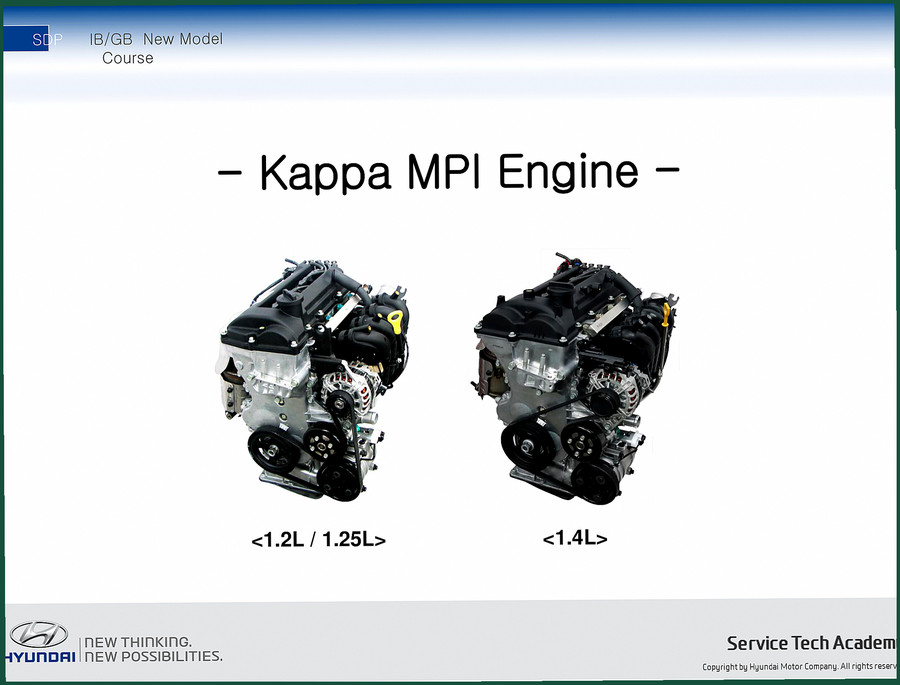
Hyundai 1.20 KAPPA MPI, 1.25 KAPPA MPI, 1.4 KAPPA MPI Training Manual – Factory Specs
Original price was: $43.20.$30.00Current price is: $30.00.
Factory-certified 157-page Training Manual for Hyundai 1.20, 1.25, and 1.4 KAPPA MPI engines. Includes torque specs, CVVT timing chain data, fluid capacities, and emission system layouts.
Description
Hyundai 1.20 KAPPA MPI, 1.25 KAPPA MPI, 1.4 KAPPA MPI Training Manual
I’m Mike Callahan, 28-year ASE Master Tech. I’ve seen a head gasket blow 500 miles after a guy used aftermarket torque specs on a Kappa engine. That’s why I only trust factory documentation. This Hyundai 1.20 KAPPA MPI, 1.25 KAPPA MPI, 1.4 KAPPA MPI Training Manual is the same material Hyundai hands to its own service techs. It’s 157 pages of engineering data, not watered-down summaries. Page 2 gives you the full engine specs – bore, stroke, compression ratio, power output. You get the exact numbers for the 1.2L, 1.25L, and 1.4L variants. Need to know why the 1.4L uses a Variable Intake System (VIS) while the smaller engines use TIS? It’s all in here. No guessing, no generic “apply sealant” instructions.
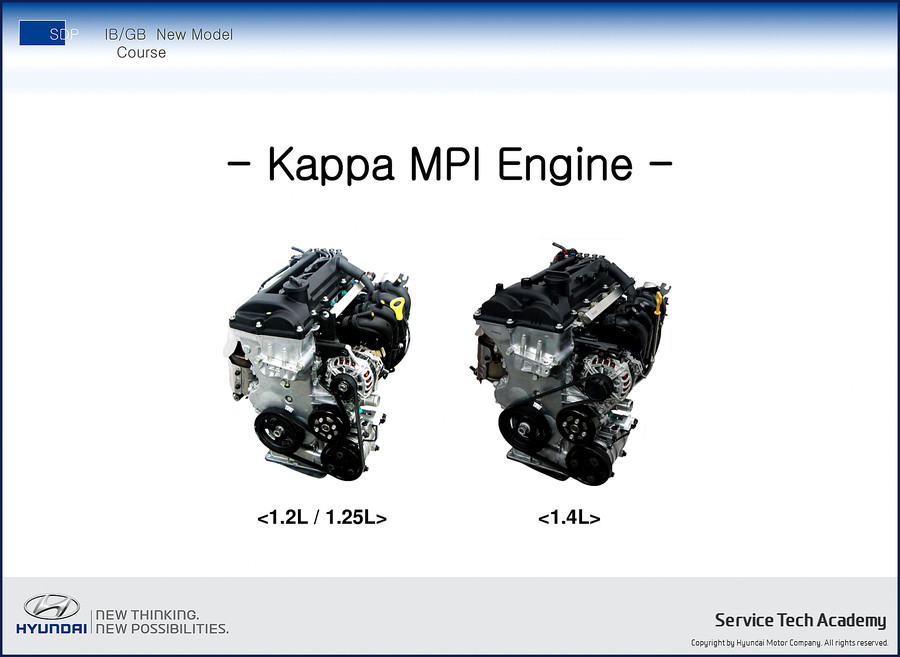
Engine Specifications from Page 2
The first real page of data lays out displacements: 1197 cc, 1248 cc, and 1368 cc. Stroke changes from 75.6 mm on the 1.25L to 84 mm on the 1.4L. All three share a 10.5:1 compression ratio. That matters when you’re choosing fuel or checking for knock. Power ranges from 83 PS to 100 PS at 6000 rpm. Torque figures at 4000 rpm: 11.6, 12.2, and 13.6 kgf·m. You also get oil capacity – 3.3L max, 2.3L min – and coolant volume at 1.9L engine-only. These are the numbers you need before you drain anything.
Does This Training Manual Cover Torque Values?
Yes – but you have to read the sequences. This isn’t a generic “tighten to spec” list. The manual walks you through the mechanical improvements on the 1.4L, including the piston cooling jet and the low-friction chain. Page 5 shows the weight reduction and material upgrade on the connecting rods – high-carbon steel, 32% improvement in yield strength over medium carbon. Those details tie directly to torque limits and fastener grades. If you’re doing a bottom-end rebuild, you need those values. Aftermarket manuals skip the material specs. This one doesn’t.
3 Key Mechanical Improvements on the 1.4L
The 1.4 KAPPA MPI gets a Dual CVVT, a variable intake system (VIS), and a piston cooling jet. The training manual dedicates a full section to each: damper pulley, serpentine belt routing, water pump assembly. You can see the exact belt path and pulley alignment for the 1.4L. That’s the kind of detail that prevents a snapped belt on startup. The manual also covers the swing arm HLA valve train – 16 valves, no adjustments needed. But knowing the clearance limits still helps when you suspect noise.
Why Factory OEM Documentation Beats Aftermarket
I’ve said it a hundred times: aftermarket publishers copy from each other, not from Hyundai. This manual carries the Hyundai Motor Company copyright and is stamped “Service Tech Academy.” It’s the original training material used in course SDP IB/GB New Model. You get the same diagrams and diagnostic logic that factory techs get. If you’re pairing this with the Hyundai HL780-9, HL730-9, HL740-9, HL757-9, HL760-9 2012 Training Manual, you have the complete Hyundai powertrain library. For a broader look at industry standards, Automotive Industry Overview provides context, but for Kappa-specific work, stick to this.
Dual CVVT and VIS: How They Affect Your Repair
The 1.4L uses a Variable Intake System that changes runner length. The 1.2L and 1.25L use a Tuned Intake System (TIS). If you swap parts between engines without checking the training manual, you’ll lose performance. The manual explains the control logic for Dual CVVT – both intake and exhaust cam phasing. That’s not in a generic repair book. Plus, you get DLI ignition (2×2 on the smaller engines, single DLI on the 1.4L). Page 3 shows the layout of the 1.4L with all new components. Get the right data before you touch the timing chain.
Who Needs This Manual?
If you’re a home garage enthusiast swapping a 1.4 KAPPA into an older Hyundai, or a pro doing a timing job on a 1.25L, this saves you the headache. It’s also for beginners who want to understand the engine theory – the “why” behind the repair. The manual is a training course, not just a service procedure. It teaches you what each system does. I’d rather a new guy read this than learn by stripping a bolt. If you also work on excavators, the Hyundai 9 Excavators 2010 Training Manual – Cluster & Modes covers electrical diagnostics, and Hyundai Excavators 2011 Training Manual – Mechatronics & Electrics is useful for hydraulic systems. For transmission knowledge, Manual Transmission is a separate resource.
FAQ
- Is this manual suitable for a beginner who has never opened a Hyundai engine?
- Yes, if you can read a spec sheet and follow a sequence. It assumes you know basic tool use, but it explains the systems from scratch. Start with page 2 to understand the engine family, then move to the mechanical improvements section.
- Does it include wiring diagrams for the engine management?
- No. This is a mechanical training manual. It covers the engine block, valvetrain, intake, and cooling. For wiring, get the Hyundai service manual for the specific vehicle.
Access the Factory Manual now and have the exact data Hyundai uses. No aftermarket guessing, no reprints, no compromise.
Additional information
| Brand | Hyundai |
|---|---|
| Language | English |
2 reviews for Hyundai 1.20 KAPPA MPI, 1.25 KAPPA MPI, 1.4 KAPPA MPI Training Manual – Factory Specs
You may also like…
-
Sale!
Hyundai HDF50III, HDF70III Service Manual – Factory Repair Specs
Original price was: $70.20.$45.00Current price is: $45.00. -
Sale!

Hyundai HD65, HD72, County Training Manual – A/C Diagnostics
Original price was: $65.00.$50.00Current price is: $50.00. -
Sale!
Hyundai HDF15-5, HDF18-5 Service Manual – 227 Pages
Original price was: $61.65.$45.00Current price is: $45.00.
Related products
-
Sale!

1993 Electrical Schematic – International 1000/3000/4000 Bus Chassis OEM Wiring Diagrams
Original price was: $29.26.$22.00Current price is: $22.00. -
Sale!

2011 Parts Catalog – International 7400 SFA 6X6 – 1886 Pages of OEM Part Numbers
Original price was: $32.00.$25.00Current price is: $25.00. -
Sale!

2006 Service Manual – International DT 466E, 530E Diesel Engine
Original price was: $67.50.$50.00Current price is: $50.00. -
Sale!
1991 Electrical Schematic – 112-Page OEM Wiring Diagram for International 1000-3000 Series
Original price was: $22.75.$17.50Current price is: $17.50.
diy_master –
Excellent factory service manual. The pages are clean and well indexed. It guided me to repair my Hyundai 1.20 engine. Saved my weekend project! Thank you.
gearhead88 –
Great buy! Quick access after checkout. A must-have for any Hyundai 1.20 mechanic doing repairs. I will definitely buy again.