
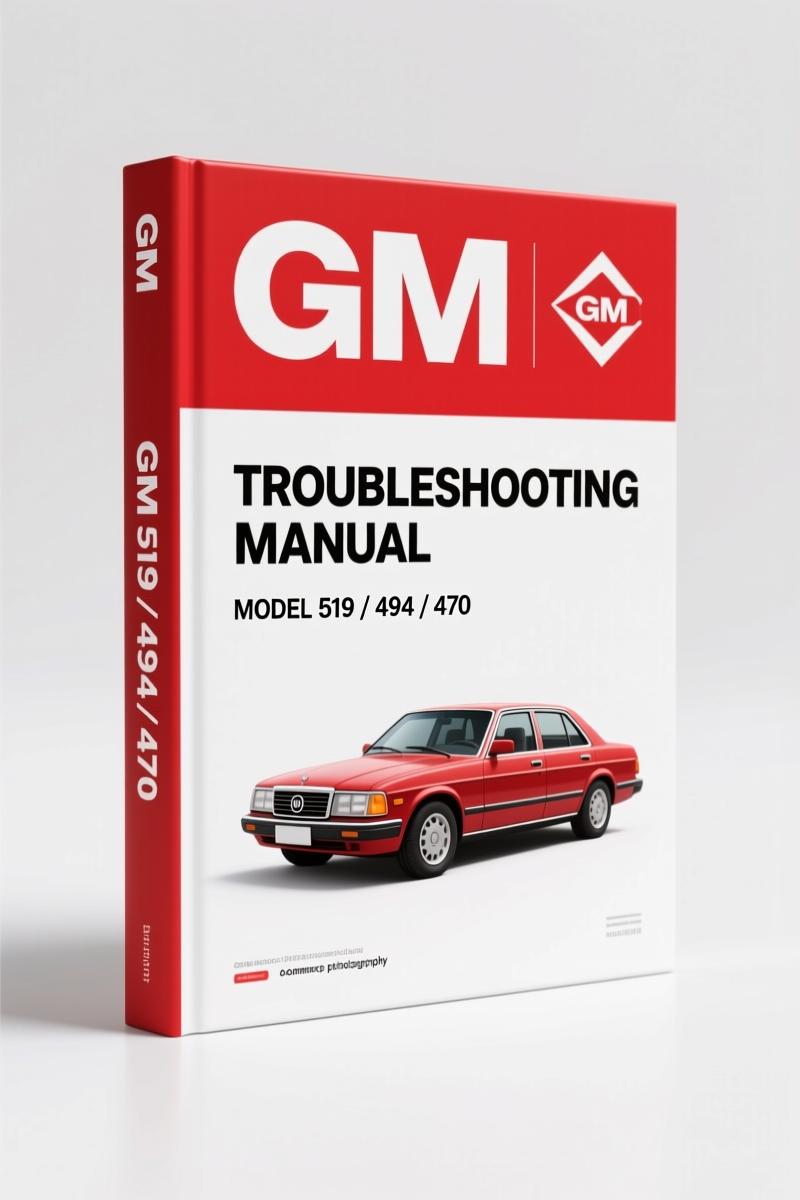
Gmdat 519, 494, 470, 444, 434 Troubleshooting Manual – Factory ECM Diagnostics
Original price was: $32.76.$26.00Current price is: $26.00.
81-page factory troubleshooting manual for Gmdat models 519, 494, 470, 444, 434 – ECM diagnostics, fault codes, fuel system repair.
Description
Gmdat 519, 494, 470, 444, 434 Troubleshooting Manual
You’re staring at a no-start on a GM truck with a 519 ECM. The aftermarket book says “check fuel pressure” but doesn’t tell you which terminal to backprobe. I’ve seen guys pick up a generic wiring diagram and toast an ECM because they didn’t have the right pinout. This 81-page manual from Gmdat covers the Gmdat 519, 494, 470, 444, 434 Troubleshooting Manual – the real GM factory troubleshooting procedure, not a reprint of a reprint. It’s the same binder the dealer techs used before laptops took over. If you’re working on any of those controllers, this is the only source you should trust for ECM diagnostics, sensor voltage checks, and fuel system repairs.
Engine Data and Firing Order – What You Need Before You Turn a Wrench
Before you dive into a code or a chart, the manual starts with the basics. Page one gives you the engine data: firing order for the GM V-6 is 1-6-5-4-3-2, spark plug gap is 0.035 in, and base timing is 0° at idle. Throttle position sensor voltage with floor plates installed must be less than 1.0 V closed, and 3.5 ± 0.1 V wide open. Miss that spec and you’ll set a code 21 or 22 before you even finish the job. The manual makes you check the floor plates – that’s the kind of detail aftermarket books skip.
Troubleshooting with the Fault Monitor System in the ECM
This section is the heart of the manual. It tells you how to read codes by jumping terminal B to ground in the ALDL connector, and how to clear them. It covers fault in the ECM, fault in the PROM, and the CalPak missing. Fuel control, idle air control (IAC) circuit, fuel pump circuit, coolant temperature sensor (CTS), MAP sensor, TPS output check, and electronic spark timing are all here. Each subsection has a circuit description and a diagnostic path. For example, the MAP output check (CHART A-7) walks you through voltage readings at idle and at key-on. If you’re trying to figure out why a 434 controller won’t give you a code 12, this is where you start.
CHART A-3: Starter Cranks the Engine, But Will Not Run
This is a common pain point. You’ve got cranking, but no fire. The chart gives you a circuit description then a step-by-step: check spark, check fuel pressure, check injector pulse. It doesn’t assume you know which wire is which – it tells you. The ECM must see a reference signal from the distributor before it fires the injectors. If you’re missing that signal, the manual shows you how to test the distributor reference signal with a voltmeter (10 megohm minimum, don’t forget). No guesswork, just a straight path from symptom to fix.
Fuel System Pressure Test – CHART A-6
Fuel pressure specs are critical on TBI systems. The manual includes a dedicated circuit description and a test procedure. You’ll need a pressure gauge that connects to the test port. The chart tells you the key-on pressure range and what to do if it’s low: check the fuel pump relay, check the pump itself, or check the pressure regulator. The fuel injector circuit (CHART A-4) and fuel pump relay circuit (CHART A-5) are also covered. If you’ve got a 470 controller that’s throwing a code 54 (low voltage on the fuel pump circuit), this chart will save you hours of swapping parts.
FAULT CODES: Code 14, 15, 21, 22, 31, 33, 34, 42, 54, 51, 52, 55
Every fault code has its own subsection with a circuit description. Code 14 and 15 are coolant temperature sensor circuits (high and low temperature indications). Code 21 and 22 are TPS signal voltage high/low. Code 31 is engine governor circuit. Code 33 and 34 are MAP sensor signal voltage high/low. Code 42 is electronic spark timing. Code 54 is fuel pump low voltage. Codes 51, 52, and 55 point to internal ECM faults – PROM failure, missing CalPak, or ECM failure. The manual tells you which pins to check, what voltage to expect, and how to test the sensor itself. No guesswork, no “maybe it’s the sensor” – it’s a diagnostic tree.
Repairs: TBI Unit, TPS, IAC Valve, and Governor
Once you’ve found the problem, the manual gives you the repair procedures. TBI unit removal, cleaning, and installation. Fuel injector removal and installation. Pressure regulator replacement. TPS removal and installation. IAC valve removal and cleaning. Governor throttle drive assembly removal, inspection, cleaning, and lubrication. Governor drive motor removal and cleaning. Each procedure lists the tools you’ll need and the torque values. For example, when installing the IAC valve, you have to measure the distance from the gasket surface to the tip of the valve – 0.035 in. Skip that and you’ll have a rough idle. The manual won’t let you skip it.
Who Needs This Manual and Why
If you’re a DIY mechanic working on a GM truck or car with a Gmdat 519, 494, 470, 444, or 434 ECM, this is the manual you need. It’s also useful for shop owners who want a reference for older GM vehicles. The manual assumes you have a basic understanding of engine operation, but it walks you through every step. You don’t need a scan tool to do the basic checks – a jumper wire and a voltmeter will get you through most of the charts. For deeper diagnostics, you can use a scan tool, but the manual shows you how to interpret the data stream. The 81 pages are dense with information, not fluff. Every circuit description, every chart, every code – it’s all from the original GM engineering team.
Source Authenticity: OEM vs. Aftermarket
I’ve seen aftermarket manuals that claim to cover the 519 controller but they copy the same generic diagrams for every model. They leave out the circuit descriptions and the specific voltage ranges. This manual is a direct PDF of the original GM troubleshooting document. The file name itself – GM_519-494-470-444-434_Troubleshooting_Manual_en-19812010320.pdf – tells you it’s factory. The charts are the same ones used in dealer training. If you want to diagnose a code 42 without chasing a ghost, you need the OEM spec. Related manuals like the Gmdat MDI 2008 User Manual – Factory GM Diagnostic Guide and the Gmdat Lumina Hummer Cadillac Saab 2008 Training Manual – OEM Specs can help with newer systems, but for this era of ECM, this is the primary source. Also check the Gmdat LGH LML 2010 Training Manual – Factory Specs if you’re working on diesel variants.
For a broader understanding of how automotive diagnostic systems evolved, the Automotive Industry Overview shows how manufacturers standardize fault codes. The Automotive Industry Overview provides context for why OEM manuals are the gold standard.
- Does this manual include the fuel system pressure test specifications?
- Yes, CHART A-6 covers the fuel system pressure test with circuit description and the exact pressure range for key-on and idle.
- What about the idle air control (IAC) valve cleaning – does it give torque values?
- It gives the measurement for the pintle travel (0.035 in) and the cleaning procedure, but torque values for the IAC valve screws are not listed in the TOC – the manual focuses on the electrical and diagnostic side. For mechanical torque specs on the TBI unit, you’ll see them in the Repairs section. The manual is 81 pages of dense troubleshooting, not a full service manual. If you need all torque values for the engine, pair it with a factory service manual for the specific vehicle. The procedures here are specific to the ECM and fuel system components, and they are written with the same precision as the diagnostic charts. Every step is there for a reason – don’t skip the cleaning and inspection steps, especially on the governor throttle drive assembly. A dirty IAC pintle can cause a code 31 or a rough idle that you’ll chase for hours. The manual tells you to check the IAC passage for carbon buildup and to use a solvent that won’t damage the O-ring. That kind of detail separates a factory manual from a generic one.
Look, I’ve been turning wrenches for 28 years. I’ve seen too many guys waste a Saturday because they used a third-party manual that had the wrong pinout for the 444 ECM. This Gmdat troubleshooting manual is the real deal. It’s 81 pages of factory-authorized procedures that will get you from a code to a repair without pulling your hair out. If you’re working on a 519, 494, 470, 444, or 434 controller, don’t gamble with your time or your parts. Access the Factory Manual.
Additional information
| Brand | Gmdat |
|---|---|
| Language | English |
3 reviews for Gmdat 519, 494, 470, 444, 434 Troubleshooting Manual – Factory ECM Diagnostics
You may also like…
-
Sale!
Gmdat 4.3L 2002 Service Manual – Factory Torque & Engine Data
Original price was: $39.30.$30.00Current price is: $30.00. -
Sale!
Gmdat 4.3 LITER V-6 2013 Service Manual – Factory Engine Overhaul Specs
Original price was: $55.48.$38.00Current price is: $38.00. -
Sale!

Gmdat Lumina, Hummer, Cadillac, Saab 2008 Training Manual – 63 Pages
Original price was: $49.78.$38.00Current price is: $38.00. -
Sale!
Gmdat LGH, LML 2010 Training Manual – DEF & Duramax Diagnostics
Original price was: $56.62.$38.00Current price is: $38.00.
Related products
-
Sale!

1995 Operators Manual – International 1000-4000 Series | OEM Documentation
Original price was: $12.49.$9.99Current price is: $9.99. -
Sale!

2011 Parts Catalog – International Truck OE Parts Documentation (1786 Pages)
Original price was: $34.50.$25.00Current price is: $25.00. -
Sale!

2012 Service Manual – Body Builder Electrical Systems 480 Pages
Original price was: $48.28.$34.00Current price is: $34.00. -
Sale!
1993 Operators Manual – International Bus 1000-3000 OEM Specs
Original price was: $12.30.$7.99Current price is: $7.99.
pro_mechanic –
Perfect OEM spec sheet. The file is very clear. Every spec sheet is included for Gmdat 519,. Saved my repair job! Thanks.
Richard G. –
Perfect factory service manual. It is easily zoomable on my iPad without blur. Every torque spec is provided for Gmdat 519,. I will recommend this shop to others.
James L. –
This is exactly what I was looking for. The scan is high-quality and easy to navigate. Every torque spec is provided for Gmdat 519,. Worth every penny.