
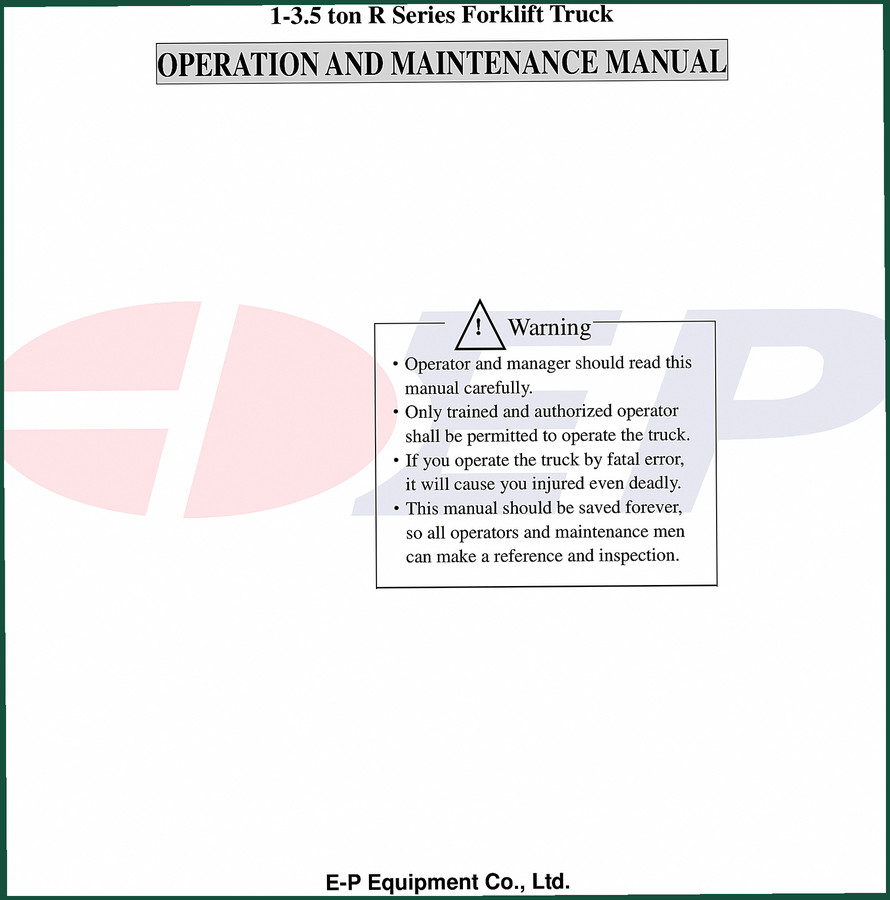
E-P Equipment R Series 2005 Operators Manual – Forklift Ops & Maintenance
Original price was: $12.49.$9.99Current price is: $9.99.
Official 2005 operators manual for E-P Equipment R Series forklifts. Covers daily checks, safety, controls, and maintenance. 62 pages. Ensure compliance.
Description
E-P Equipment R Series 2005 Operators Manual
E-P Equipment R Series 2005 Operators Manual is what you need if you’re running one of these forklifts. I’ve spent 28 years in bays from San Antonio to Houston, and I can tell you one thing: skip the daily check on page 20, and you’ll be pulling a mast rebuild inside a month. This 62-page booklet from E-P Equipment is the factory-issued operation and maintenance document, not some aftermarket copy that guessed at the torque specs. It tells you exactly which lever does what, how to read the instruments, and what to look for when the truck starts acting up.
Let me be direct. If you own a shop or run a fleet of R Series trucks, you need this manual chained to the seat. The 2005 edition covers the 1-3.5 ton range, and the chapters line up with real work: General Rules, Name of Main Parts, Safety Instructions, 8 Hour Daily Check, Structure/Stability, Operation, Deposit, Maintenance, and Truck Convey/Lifting/Towing. Every section has a purpose. Page 14 lays out safety warnings that are not suggestions—they are the difference between walking away and being carried away.
E-P Equipment R Series 2005 Operators Manual: What’s Inside
You get ten clearly labeled chapters plus a foreword that explains the CE certification and copyright (2005.8 1st Edition). The manual starts with General Rules on page 3, then jumps straight to naming every instrument, control, and body component. The 8 Hour (Daily or Every Shift) Check on page 20 is where most technicians fail—they glance at fluid levels and miss the brake linkage inspection. This manual walks you through each step with no filler. Want the charge pressure verification for the hydraulic system? It’s in the Structure and Stability section, page 29. No guessing, no third-party interpretations.
Name of Main Parts and Controls
Chapter 2 breaks down the forklift into three parts: Instruments (page 4), Controls (page 8), and Body & Others (page 11). The instrument cluster includes the hour meter, fuel gauge, temperature gauge, and warning lights—each explained with the OEM part callouts. The control section covers the steering wheel, travel lever, lift/tilt levers, parking brake, and inching pedal. If you’ve ever had a trainee stall a truck because they didn’t know the inching pedal range, you’ll appreciate the factory diagram here. The body section includes the overhead guard, counterweight, and battery compartment details. No generic “this is a lever” garbage—it’s the exact layout from the E-P assembly line.
8 Hour Daily Check: Why Page 20 Matters
Every day, every shift, you check the water, oil, fuel, air cleaner, tires, hydraulic leaks, brakes, steering, horn, lights, and seat belt. Page 20 lists them in order. I’ve had a shop foreman tell me “we do that from memory.” Then I found a loose wheel nut on a 3-tonner that missed the morning walk-around. This manual forces a structured inspection. Use the checklist as written, and you’ll catch the loose bolt before it becomes a call from OSHA. If you need a different capacity R Series, check E-P Equipment CPCD50-CPCD100 2007 Operators Manual – OEM Forklift Guide for the larger models.
Safety Instructions: Page 14 Is Not Optional
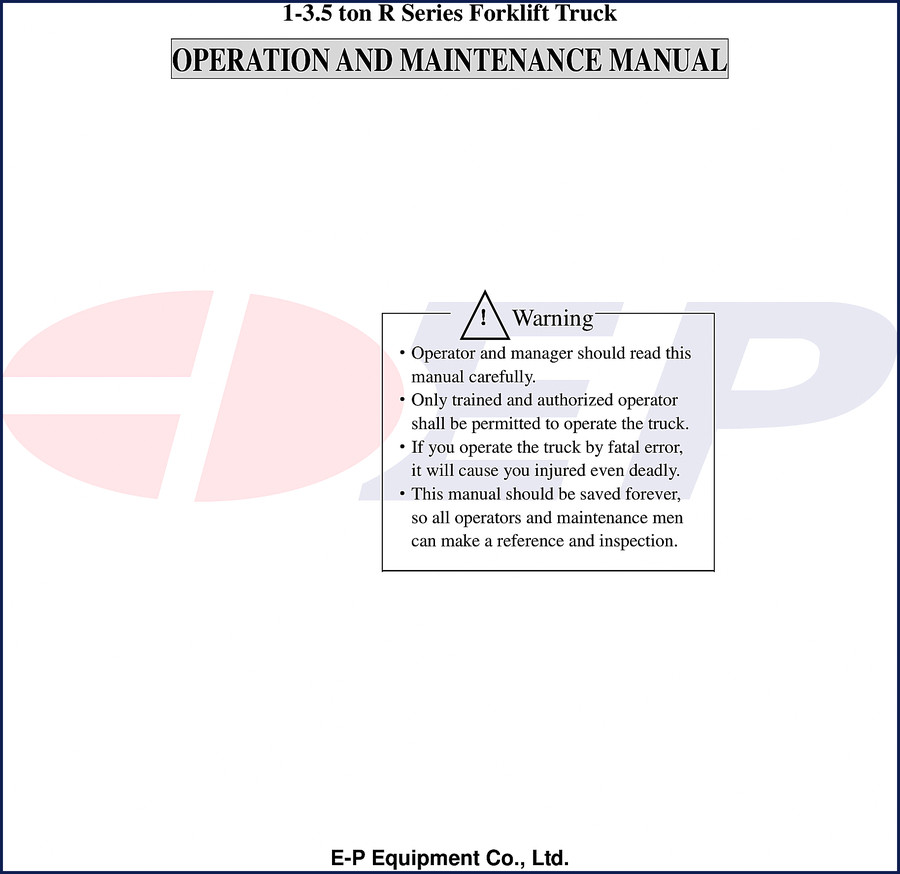
The safety chapter covers general hazard recognition, safe operation limits, and what the warning symbols mean. Every operator and maintenance man should read this section before they touch the ignition. The manual explicitly states: “Only trained and authorized operator shall be permitted to operate the truck.” That’s not a suggestion; it’s a liability line. Page 14 also explains the stability triangle and center of gravity—something many operators ignore until a loaded fork tips. The R Series platform shares design traits with other container forklifts, but the precise load capacities and mast tilt angles are model-specific. For the same R Series generation, E-P Equipment R Series Forklift Operation Maintenance Manual offers a later revision, but the 2005 version is the original factory release.
Think of the hydraulic control logic like a Manual Transmission in a car—each shift has a purpose, and the manual tells you the sequence. The clutch engagement is akin to a Manual Transmission operation; you need to feel the bite point, but the manual gives you the mechanical tolerances.
Maintenance Schedule from the Factory
Chapter 8 covers lubrication, engine oil change intervals, hydraulic filter replacement, brake adjustment, and battery maintenance. The schedule is built around the hour meter, not calendar dates. At 250 hours you inspect the steering knuckles; at 1000 hours you replace the hydraulic oil. The manual doesn’t guess—it gives the OEM part numbers for filters and seals. I’ve seen aftermarket manuals that list generic 10W-30 for everything; this one specifies the exact viscosity for the R Series engine. Following this schedule keeps your warranty intact and your mast straight. For parts diagrams specific to the 1-1.8 ton variant, E-P Equipment R Series 1-1.8t Parts Catalog – OEM Specs will get you the exact seal and bearing part numbers.
Operation and Deposit: Correct Procedures
Chapter 6 (Operation) goes from engine start to steering, lifting, tilting, and traveling with a load. It includes the safe speed during turning and the correct fork height for travel. Chapter 7 (Deposit) covers parking, lowering forks, applying the parking brake, and shutting down. These procedures are written in the same direct style as the rest of the manual—no fluff, no reprints. The Type Signification chapter on page 46 decodes the model number so you know exactly which R Series variant you have. If you’re running a fleet, that chapter alone saves hours of cross-referencing.
- Does this manual cover the 8-hour daily check?
- Yes, page 20 details the daily inspection.
- Can I use this manual for maintenance of other forklift brands?
- From the foreword: “This manual is also applicable to other types of container forklift trucks,” but the specific E-P R Series components are unique. I would never rely on it for a different make without cross-referencing the factory specs. If you have a Toyota or Clark, you need their dedicated manual. The safety warnings and basic operation principles may carry over, but torque values, part numbers, and hydraulic pressures are model-specific. Stick to the OEM manual for your exact machine to avoid component damage or injury. Page 14 has critical safety notes that apply generally, but don’t take shortcuts on the specifics.
That’s it. No excuses. You need this 62-page factory document on your bench, not a PDF stashed in a folder. The E-P Equipment R Series 2005 Operators Manual gives you the exact procedures from the manufacturer. Access the Factory Manual now and get the full chapter content, including the 8-hour check and safety instructions.
Additional information
| Brand | E-P Equipment |
|---|---|
| Language | English |
2 reviews for E-P Equipment R Series 2005 Operators Manual – Forklift Ops & Maintenance
You may also like…
-
Sale!
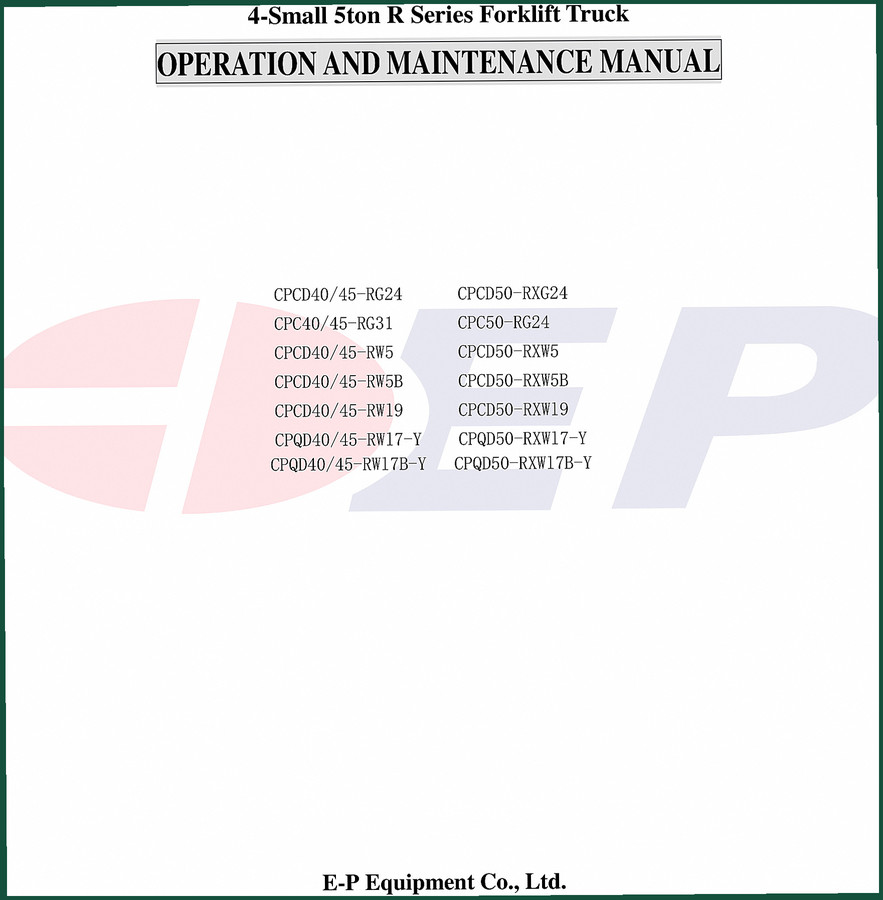
E-P Equipment CPCD40-RG24, CPCD45-RG24 2006 Operators Manual – OEM Specs
Original price was: $12.10.$10.00Current price is: $10.00. -
Sale!

E-P Equipment CPQD15/18N-RW21-Y, CPQD20/25/30/35N-RW22-Y 2008 Service Manual
Original price was: $44.70.$30.00Current price is: $30.00. -
Sale!

E-P Equipment CPC10/15/18N-RG26 Parts Catalog – 262 Pages OEM
Original price was: $35.00.$28.00Current price is: $28.00. -
Sale!

E-P Equipment CPCD50–CPCD100 2007 Service Manual | 92 Pages
Original price was: $34.93.$27.50Current price is: $27.50.
Related products
-
Sale!

CDS 705C, 706C, 708C 1981 Parts Catalog – OEM Forklift Specs
Original price was: $61.60.$40.00Current price is: $40.00. -
Sale!

Aisle-master ELECTRIC Parts Catalog – 120 Pages of OEM Specs
Original price was: $33.36.$24.00Current price is: $24.00. -
Sale!
Aisle-master 20, 44 Parts Catalog – OEM Component ID for Fleet Maintenance
Original price was: $37.00.$25.00Current price is: $25.00. -
Sale!

Baoli CPCD 80, CPCD 100 Service Manual – 112 Pages OEM Factory Specs
Original price was: $44.48.$32.00Current price is: $32.00.
James L. –
I am extremely satisfied with this manual. The document is very clear. It helped me to rebuild my E-P Equipment Equipment electrical system. Saved my repair job! Thanks.
Robert M. –
Highly recommended! The scan is high-quality and well indexed. It assisted me to troubleshoot my E-P Equipment Equipment electrical system. Worth every penny.