
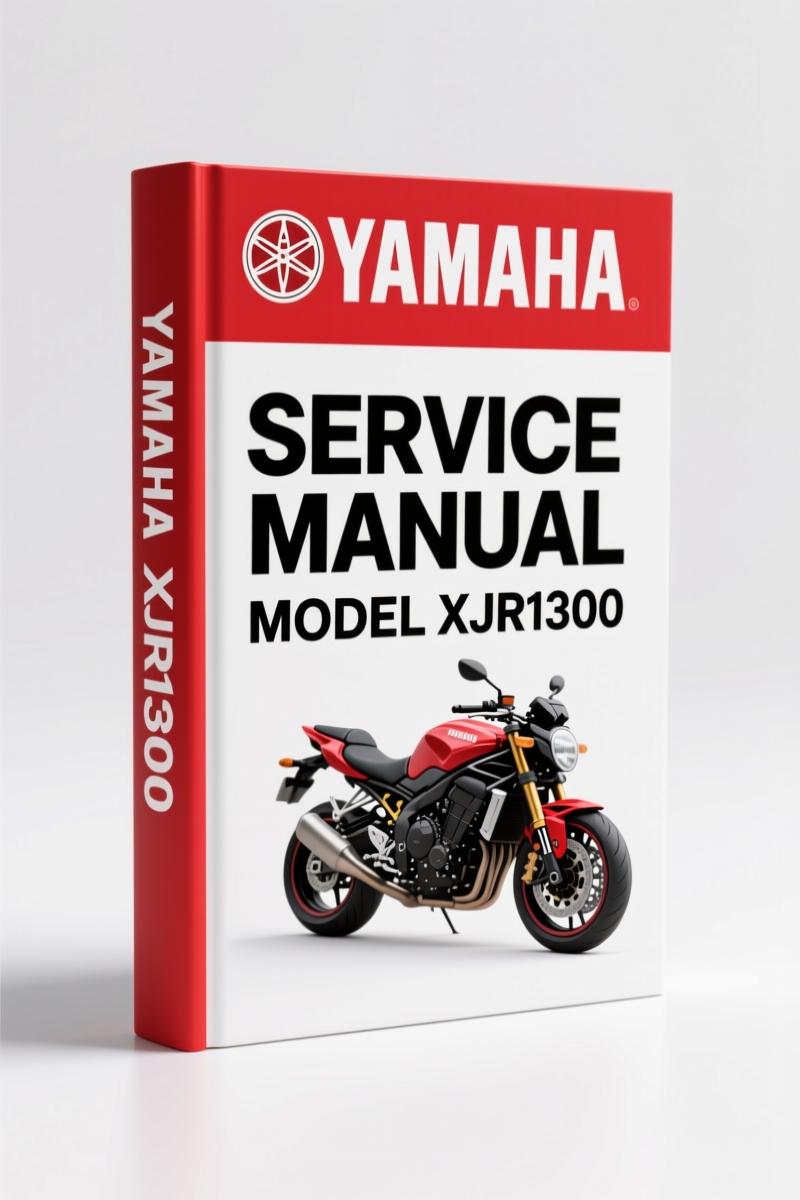
Yamaha XJR1300 Service Manual – 383 Pages OEM Factory Specs
Original price was: $45.00.$30.00Current price is: $30.00.
383-page OEM service manual for Yamaha XJR1300 (1999-2003). Engine, electrical, wiring diagrams. Factory torque specs and diagnostic procedures.
Description
Yamaha XJR1300 Service Manual – Factory Specs You Can Trust
Over the years I’ve watched guys tear into an XJR1300 carb bank with a generic aftermarket PDF that tells you to “remove the screws” – never says what size, never warns you about the gasket that turns into peanut butter if you sneeze on it. That’s why when you walk into my shop holding a real Yamaha XJR1300 Service Manual, I know you’re serious. This is the factory book, 383 pages of what Yamaha’s own techs use, written in a language that assumes you know how to turn a wrench but still spells out every torque value and clearance. No shortcuts, no guesswork – just the way it was meant to be done.
Engine Overhaul – 7 Sections of Hard Data
Chapter 5 in this manual is Engine Overhaul. That’s where you’ll find the exact order to pull the cylinder head, the oil pump disassembly steps, and the crankcase split procedure. Page 187 shows the torque sequence for the head bolts – 38 ft·lb on the 10mm bolts, then a 90° turn on the 12mm ones. You don’t guess that. You don’t find that in a Haynes book that’s been photocopied three times. I’ve had guys bring me bikes that had head gasket leaks six months after a rebuild because they went with the aftermarket “handy chart”. Trust me on this one.
Carburetors: What the Manual Gets Right
The carb section (Chapter 6) is the difference between a bike that starts cold on the first kick and one that you push to the curb. It covers the vacuum synchronization procedure, the float height setting (17.5mm – check that with a caliper, not your eyeball), and the pilot screw adjustment. There’s a whole subsection on removing the carburetor assembly that warns you about the intake manifold boots – don’t twist them, don’t pry. Use the correct pilot jet size for your altitude. The manual lists spec for both European and US models in separate chapters – see the Specifications chapter at the start for the exact jet numbers.
Is the Wiring Diagram Actually Usable?
You bet. This manual gives you two separate wiring diagrams – one for European models, one for Australian. That’s not a typo; the connectors and color codes differ. Chapter 10 (Wiring Diagram (eur)) and Chapter 11 (Wiring Diagram (aus)) each show every circuit: ignition, lighting, starter, charging system. I’ve traced a short on an XJR that came from a melted connector under the seat – the diagram showed exactly which wire feeds the tail light. Saved three hours of chasing grounds. If you’re swapping in a different ignition module or adding aux lights, this is the document you want open on your tablet.
Electrical: Troubleshooting Without the Guessing
Chapter 9 is Troubleshooting. It’s not a generic table – it’s a step-by-step logic tree starting with “Engine won’t crank”. Check battery voltage first (minimum 12.5V), then main fuse, then starter relay. The manual gives you resistance specs for every component: stator coil (0.19–0.23 Ω at 20°C), pick-up coil (114–174 Ω). No aftermarket guide lists those. I’ve seen guys replace a perfectly good stator because their generic manual said “test resistance” but didn’t give the range. This one does.
Also tucked in the Electrical chapter (Chapter 8) is the regulator/rectifier test procedure. Load test the battery first – if it’s below 12.3V after charging, replace it. Then measure output voltage at the battery terminals with the engine running at 5,000 rpm: 14.2–14.8V. Outside that? Replace the regulator. Simple, factory-authorized, no guesswork.
Torque Specs and Fluid Capacities – Why You Need the Factory Page
The Specifications chapter (page 26) has a full table of torque values for every critical fastener: axle nuts, engine mount bolts, brake caliper bolts. Example: front axle nut – 58 ft·lb, rear axle nut – 72 ft·lb. Oil capacity: 3.5 liters (with filter change). Fork oil height: 95mm from the top with the spring removed. These aren’t rounded numbers – they’re what Yamaha designed to. Aftermarket manuals often round up or down, which can strip threads or cause leaks. Don’t take that risk. This is the data that your insurance claim would want to see if something fails.
Who Needs This Manual
If you’re a home garage enthusiast working on a 1999-2003 XJR1300, you need this. It’s written for someone with basic mechanical skills – you should know how to use a torque wrench and feeler gauge – but it holds your hand through the things that kill your day: removing the throttle position sensor without breaking the tab, bleeding the hydraulic clutch properly (the clutch master cylinder has a specific bleeding order), and setting the cam chain tensioner. The supplement sections for 2002 models cover changes made during that year – different carburetor settings, wiring harness revisions. If you have a 2002, you want that supplement.
Also, if you’re planning to pull the transmission and need to understand gear engagement patterns, refer to an external resource on Manual Transmission basics – but for the XJR’s specific shift drum and fork clearances, stay in this manual. External guides can give you theory; this manual gives you the numbers. I also check Manual Transmission theory when I need refesher, but the OEM torque for the shift shaft bolt? It’s in Chapter 7 (Chassis) – 8.7 ft·lb.
- Does this manual include the supplement for the 2002 model year?
- Yes. The PDF contains a supplement section explicitly titled “Supplement 2002” with separate contents, specifications, and wiring diagrams for European and US models.
- Can I use this to rebuild the carburetors?
- Yes. Chapter 6 covers complete carburetor overhaul with float height, jet sizes, and synchronization procedure. If you need the parts catalog for gaskets and jets, use the related parts manual linked above.
You’re looking at the only document that matches what Yamaha pays its mechanics to use. Access the Factory Manual now and keep it on your bench – your XJR1300 will thank you at the next oil change and every time you hit the starter.
Additional information
| Brand | Yamaha |
|---|---|
| Language | English |
2 reviews for Yamaha XJR1300 Service Manual – 383 Pages OEM Factory Specs
You may also like…
-
Sale!
Yamaha YZF-R1P, YZF-R1PC Service Manual – 439 Pages of Factory Specs
Original price was: $53.60.$40.00Current price is: $40.00. -
Sale!
Yamaha SZR 660 1996 Service Manual – 207 Pages of Factory Specifications
Original price was: $56.80.$40.00Current price is: $40.00. -
Sale!
Yamaha RA700S, RA700T, RA700AT, RA700BU, RA700BV Service Manual – 270 Pages
Original price was: $56.40.$40.00Current price is: $40.00. -
Sale!
Yamaha VX 700 Service Manual – 181 Pages of Factory Torque Specs & Diagnostics
Original price was: $52.40.$40.00Current price is: $40.00.
Related products
-
Sale!

1992 Electrical Schematic – International 1000/3000/4000/2554 OEM Wiring Diagrams (132 Pages)
Original price was: $26.40.$20.00Current price is: $20.00. -
Sale!
1996 Operators Manual – International 1000-4000 Series (246 pages)
Original price was: $15.28.$9.99Current price is: $9.99. -
Sale!
1993 Operators Manual – International Bus 1000-3000 OEM Specs
Original price was: $12.30.$7.99Current price is: $7.99. -
Sale!
1992 Electrical Schematic – OEM Wiring Diagrams for International 1000-3800
Original price was: $24.48.$18.00Current price is: $18.00.
William H. –
This is just what I needed. The PDF is very clear. A must-have for any Yamaha XJR1300 owner doing repairs. Great value for money.
Robert M. –
Five stars! The pages are clean and well indexed. It helped me to repair my Yamaha XJR1300 engine. Saves me so much money.