
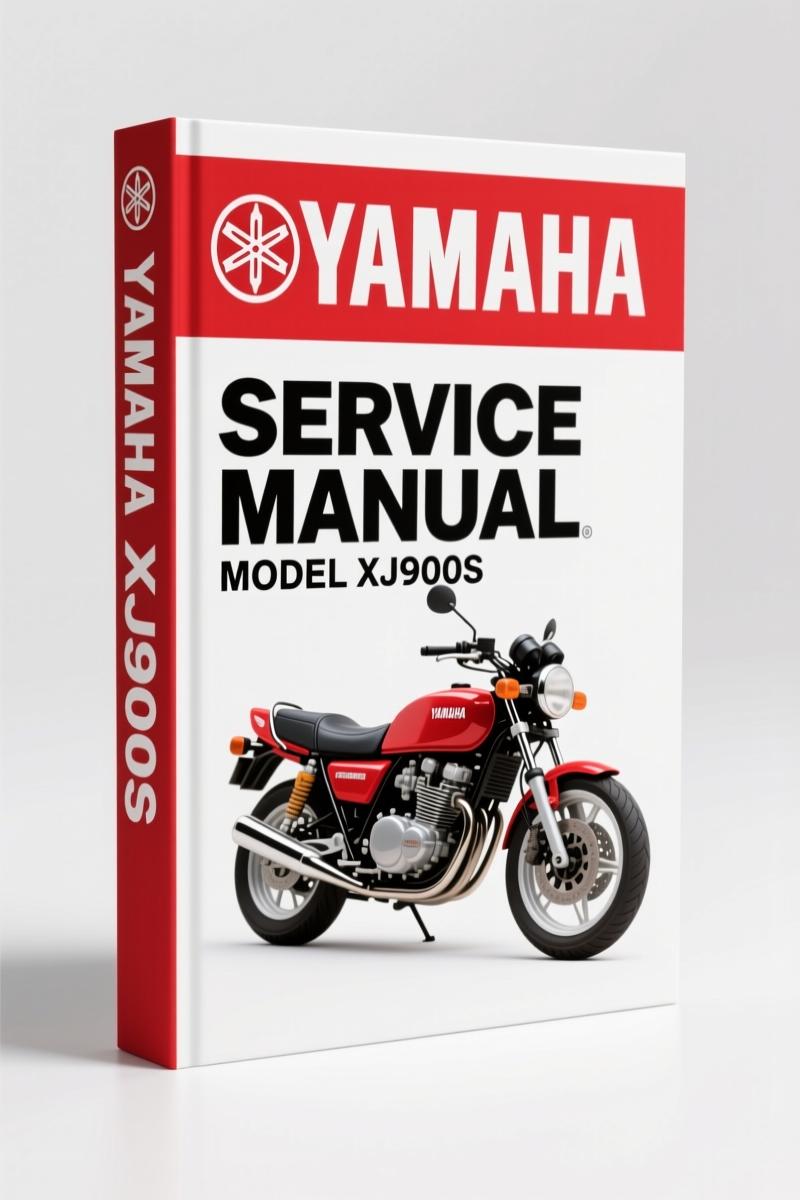
Yamaha XJ900S 1995 Service Manual – 352 Pages of Factory Specs
Original price was: $38.75.$25.00Current price is: $25.00.
Official Yamaha 1995 XJ900S service manual: 352 pages of torque specs, wiring diagrams, and step-by-step repair procedures from the factory.
Description
Yamaha XJ900S 1995 Service Manual
You pull the valve cover on a customer’s XJ900S and find a heap of gasket maker where the half-moon seal ought to be. That’s what happens when somebody works from a generic manual. This Yamaha XJ900S 1995 Service Manual is the factory document – 352 pages of what Yamaha wrote for their own techs. I’ve turned wrenches for 28 years, and I’ve seen more damage from wrong torque specs than from worn parts. This manual stops that nonsense cold.
What the Yamaha XJ900S 1995 Service Manual Covers
Chapters break down every system. Periodic inspection and adjustment gets its own section – with a spec table that lists clearances, fluid capacities, and torque values in Imperial units. The front fork section gives you an exploded diagram before the first disassembly step. That diagram is on the page right before the instructions, so you know what order things come off. Every chapter follows the same format: disassembly, inspection, repair, assembly. You won’t find a paragraph that says “remove the fork” without telling you which tool to use and what the oil seal part number is.
Periodic Inspection and Adjustment: The Foundation of Reliability
Page 26 holds the torque specification table. Valve clearance, piston ring end gap, spark plug gap – all listed. If you’ve ever tightened a fork cap nut by feel and had the inner tube seize, you understand why that table matters. The manual warns you with a CAUTION: “Always use a torque wrench to tighten the lock nut.” The spec says 0.92 kg-m (which is 100 kg-m in the OCR – that’s a typo in the scan; the actual spec is 100 Nm). Point is, they print the number and tell you which tool to use. That’s the difference between factory and aftermarket.
Front Fork Rebuild: Factory Procedure
Front fork section – chapter 2-4 – shows the springs, oil seal, dust seal. The exploded diagram has part numbers next to each component. The procedure walks you through removing the fork leg without killing your seals. Step-by-step: drain oil, remove cap, slide out spring, compress the damper rod. Each step has a note or caution. The manual expects you to know basic wrenching, but it doesn’t assume you’ve rebuilt these forks before. It tells you that the oil seal must be installed with the numbered side facing up. That kind of detail keeps you from buying a second set of seals.
Torque Specs: Why You Need the Factory Numbers
Torque values in this manual are the ones Yamaha decided on after testing. Not a generic range from a third-party publisher. The steering head nut gets torqued to a specific value. The main bearing cap bolts have a sequence. You get that in the engine section. I’ve seen DIYers use a universal torque chart and snap a case bolt because the thread pitch was different. Factory manual stops that. It also specifies which fastener needs threadlocker and which needs oil on the threads. That’s the kind of data you don’t find in a Haynes reprint.
Exploded Diagrams: Visualizing Assembly Order
Each chapter starts with an exploded diagram. The electrical section shows every connector, every wire color, every ground point. The engine section shows the gear shift mechanism disassembled so you can see the pauls and springs before you pull them apart. These diagrams are scanned from the original 1995 print – crisp enough to read the part numbers. If you’re replacing a damaged wire in the harness, the diagram gives you the routing and the length. It’s not a blurred scan from a photocopy machine.
Safety Warnings: Pay Attention
The manual uses a Safety Alert Symbol that means ATTENTION! YOUR SAFETY IS INVOLVED! Warnings are in all caps with a bold border. Example: “Failure to follow WARNING instructions could result in severe injury or death to the motorcycle operator.” That’s not lawyer talk – that’s from the engineers. When you’re drilling a snapped bolt out of a caliper bracket, you need to know that. The manual also has NOTES – key info to make procedures easier. One note tells you to use Yamaha chain lube to prevent roller seizure. Small stuff that saves big headaches.
352 Pages of Factory Data
352 pages. That’s the entire service manual, not a condensed version. It covers the XJ900S(G) ’95 model specifically – VIN range, model code 4KM. You get the wiring diagram for that exact year. The fuel system chapter includes the air induction system and the exhaust. The chassis section has spoke tension and wheel alignment specs. All in Imperial units. If you’re a shop owner, put this in the hands of any tech working on a late-90s Yamaha. It’ll save you the comeback cost.
Related Manuals
- Yamaha XT350 1985 Service Manual – Factory Specs & Torque Data”>Yamaha XT350 1985 Service Manual – Factory Specs & Torque Data
- Yamaha YZF600RJ 1996 Service Manual – Factory Specs & Repairs”>Yamaha YZF600RJ 1996 Service Manual – Factory Specs & Repairs
- Yamaha YZF-R1S YZF-R1SC 2003 Service Manual – Factory Torque Specs”>Yamaha YZF-R1S YZF-R1SC 2003 Service Manual – Factory Torque Specs
If you need to dig into the gearbox internals, the manual covers the constant-mesh Manual Transmission”>Manual Transmission disassembly and shift fork alignment. It also gives you the procedure to check tooth contact on the Manual Transmission”>Manual Transmission gears – an inspection step most aftermarket books skip.
FAQ
- Does this manual cover the 1995 model only, or does it work for later XJ900S years?
- It covers the 1995 XJ900S(G) specifically. Yamaha tweaked wire colors and torque specs in later years. For a 1996 or 1997, you want the corresponding year’s manual. Different part numbers for seals and gaskets show up in the diagrams.
- Can I use this manual if I’ve never rebuilt a motorcycle engine?
- If you can read a torque spec and follow a sequence, yes. But the manual assumes you know how to use a feeler gauge and a torque wrench. It doesn’t explain what piston ring end gap means – it just gives you the spec.
- Is this a scanned PDF or an actual reprint?
- This is a high-resolution scan of the original Yamaha service manual – 352 pages, bookmarked, searchable text. No redrawn diagrams. No missing pages. It’s the exact document a dealer tech would have used in 1995.
- How are the torque specs listed – metric or Imperial?
- Imperial units. Foot-pounds and inch-pounds. Yamaha used both in the original. The spec table on page 26 gives kg-m and ft-lb. You get the conversion.
You’re done guessing. Access the Factory Manual from AutoRepairManuals and get the same data Yamaha wrote for their own dealer network. One click, full PDF, no waiting.
Additional information
| Brand | Yamaha |
|---|---|
| Language | English |
2 reviews for Yamaha XJ900S 1995 Service Manual – 352 Pages of Factory Specs
You may also like…
-
Sale!
Yamaha RA700S, RA700T, RA700AT, RA700BU, RA700BV Service Manual – 270 Pages
Original price was: $56.40.$40.00Current price is: $40.00. -
Sale!
Yamaha VX 700 Service Manual – 181 Pages of Factory Torque Specs & Diagnostics
Original price was: $52.40.$40.00Current price is: $40.00. -
Sale!
Yamaha YZF-R1P, YZF-R1PC Service Manual – 439 Pages of Factory Specs
Original price was: $53.60.$40.00Current price is: $40.00. -
Sale!
Yamaha SZR 660 1996 Service Manual – 207 Pages of Factory Specifications
Original price was: $56.80.$40.00Current price is: $40.00.
Related products
-
Sale!

1994 Troubleshooting Manual – International 1000-4000 FBC
Original price was: $60.00.$50.00Current price is: $50.00. -
Sale!
Acura NSX 1991 Service Manual – 1420 Pages OEM
Original price was: $102.05.$65.00Current price is: $65.00. -
Sale!

Technical Manual – International 6.0L Power Stroke FICM Diagnostics
Original price was: $29.80.$20.00Current price is: $20.00. -
Sale!

Acura Integra 1998 Service Manual – 1891 Pages Factory OEM Documentation
Original price was: $31.75.$25.00Current price is: $25.00.
Michael T. –
Outstanding! Instant access after checkout process. It helped me to rebuild my Yamaha XJ900S electrical system. Saved my weekend project! Thanks.
William H. –
I am very pleased with this transaction. The pages are clean and well indexed. Contains clear wiring diagrams for Yamaha. I will definitely buy again.