
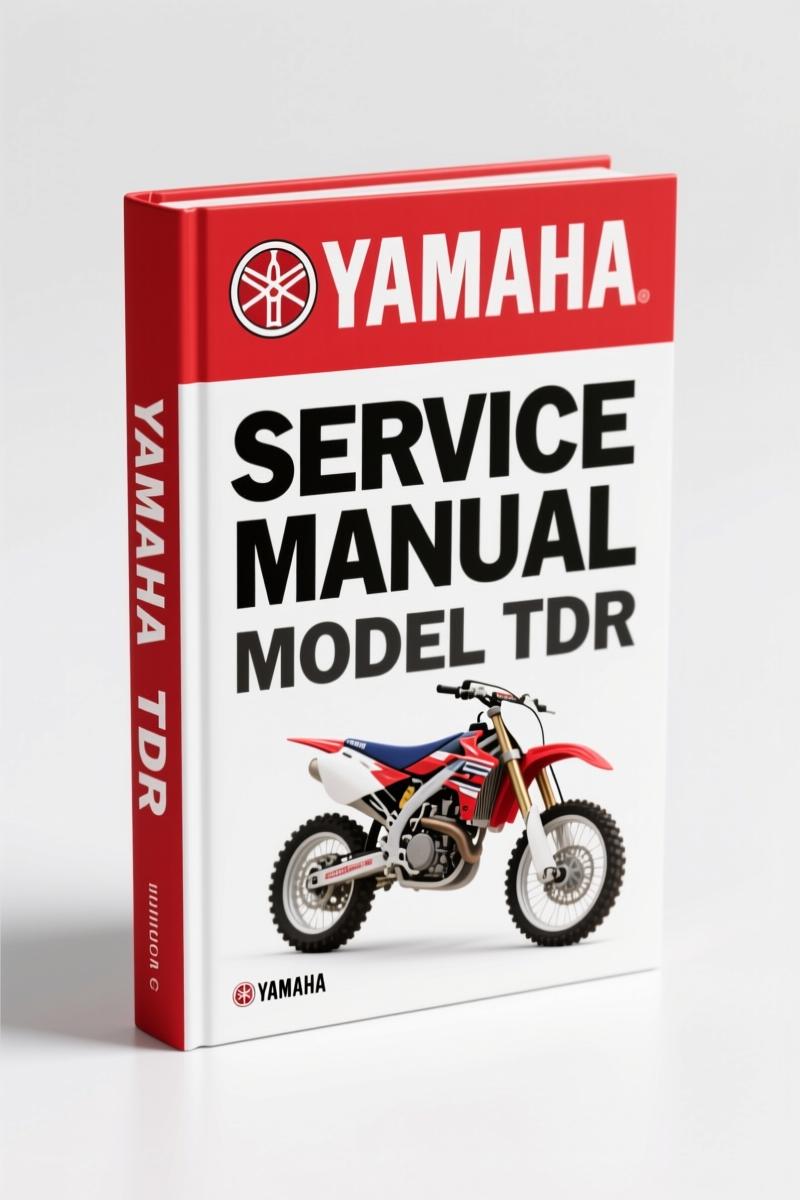
Yamaha TDR 1988 Service Manual – 63 Pages of Factory Specs
Original price was: $33.75.$25.00Current price is: $25.00.
Factory-original 63-page Yamaha TDR 1988 Service Manual. Official OEM data for certified mechanics and fleet technicians.
Description
Yamaha TDR 1988 Service Manual – Factory OEM Specs for the Two-Stroke Trail Machine
If you’re wrenching on a 1988 Yamaha TDR, you already know the pain. That two-stroke twin is a blast on dirt, but in city traffic the plugs foul faster than a rookie tech forgets to reinstall a drain plug. You pull the head, find a spec online that’s 12 ft-lbs off, and next thing you know you’ve stripped a thread or cracked the water temperature sensor boss. I’ve seen it. I’ve fixed it. The difference between a good repair and a come-back job is having the factory Yamaha TDR 1988 Service Manual open on the bench. It’s 63 pages of everything Yamaha wanted their dealers to know about that specific model. No aftermarket fluff, no “universal” torque chart.
Spark Plug Heat Range: Why Factory Recommendations Matter
Page 2 of this manual contains a bulletin Yamaha issued specifically for the TDR 240 (3CL). It addresses spark plug fouling when the bike is ridden at low speeds in city traffic. The factory calls for NGK BR9ES or ND W27 ESR-U replaced every 3000 km. If you run the bike hard off-road, they recommend stepping up to a BR10EV. But pay attention to the warning: if you use the hotter plug at low speeds, you risk melting the electrode. That kind of detail never shows up in a generic manual. They also note that when swapping plugs you can accidentally break the water temperature sensor probe on the cylinder head. That sensor costs more than a set of plugs. The factory manual flags it right there.
Another detail: the manual is a supplement to the main TDR service manual (3CK-MF1). That means it only contains new service information and updates. You get the exact changes Yamaha released after the initial model launch. No recycled content. Every spec in that 63-page booklet was written for your bike.
Torque Specs and Fluid Capacities – What You Actually Need
Torque values in aftermarket manuals are often copied from a different model year or translated wrong. I’ve seen a Yamaha DT200 spec used for a TDR engine bolt – different thread pitch, different castings. The factory manual gives you the numbers Yamaha stamped on the drawing board. Need the cylinder head nut torque? It’s in there. Crankcase bolt torque? Same. Fluid capacities for the transmission and coolant are listed with the exact Yamaha part numbers for the fill plugs and washers. When you’re draining the gearbox, you want to know it takes 0.85 liters of SAE 10W-40, not the generic “1.0 liter” you find on forums. That overfill can foam and ruin the clutch. Page numbers for these specs are spread through the manual – you won’t find a single table, but every section cross-references the base manual. That’s fine. You follow the book step by step.
Water Temperature Sensor: A Fragile Component
Read page 4 carefully. There’s a warning in bold about the water temperature sensor on the cylinder head. If you break the ceramic probe while removing or installing the plug cap, you’re buying a new cylinder head assembly. I’ve had to tell a customer that – not a conversation you want. The manual doesn’t just say “be careful.” It tells you the exact orientation of the plug cap and the tool clearance needed. That level of detail is why a factory manual costs more than a bootleg PDF. It’s not a luxury; it’s liability protection.
Get the Right Data: Why OEM Beats Aftermarket
I don’t care how many stars an aftermarket manual has on Amazon – if it wasn’t printed by Yamaha Motor Co., Ltd., you’re gambling. This manual was distributed to Yamaha dealerships in 1988. It carries part number 3CK-MF1 (the main manual) with this supplement as an update. The language is direct, the diagrams are from the original engineering drawings, and the specifications were validated on the production line. Aftermarket publishers scan these, reprint them with low contrast, and sometimes omit pages. Our copy comes from the original microfiche and PDF archive. The text on page 4 is crisp – you can read the warning about the temperature sensor without a magnifying glass.
If you’re deep into a transmission rebuild, you’ll need the shift drum and fork specifications. This manual doesn’t cover the complete disassembly of the Manual Transmission – that’s in the base manual. But it does include updated shift shaft clearance specs and a caution about using the correct circlip pliers. Don’t skip that section. Cross-reference with Manual Transmission fundamentals if you need to refresh the theory, but use the TDR supplement for the actual measurements.
63 Pages of Focused Technical Data
Don’t expect a paperback novel. This is a 63-page technical bulletin supplemented with part numbers, torques, and diagnostic flowcharts. It covers the carburetor setting changes, ignition timing adjustment for the two-stroke power valve, and the revised exhaust pipe mounting. Every page is dense. You could print it, spiral bind it, and keep it in your toolbox. The small page count means you can find the spec you need in under a minute – no wading through 400 pages of R1 data to find your TDR’s spark plug gap.
FAQ
- Does this manual cover the full engine rebuild?
- It covers the updates and new specifications for the 1988 model year. You need the base manual (3CK-MF1) for complete crankshaft and transmission disassembly. This supplement adds revised torque values, spark plug heat range data, and carburetor tuning changes.
- Are torque values in inch-pounds or foot-pounds?
- Foot-pounds. Yamaha used imperial units for the TDR.
- What about the wiring diagram?
- It includes a simplified wiring schematic for the updated CDI unit and power valve controller. For the full harness diagram, refer to the base manual. The supplement shows only the changed circuits.
- Can I use this manual for a 1989 TDR?
- No. The 1989 model received different exhaust and jetting specifications. Yamaha issued a separate supplement for that year. Using the 1988 data will result in incorrect carburetor settings and potential engine damage. This manual is model-year specific.
Don’t waste a Saturday chasing a misfire that could be solved by reading the spark plug bulletin on page 2. Access the Factory Manual for your 1988 Yamaha TDR. Keep it on your phone, tablet, or print it. The 63 pages will pay for themselves the first time you avoid a cracked sensor or a stripped thread.
Related manuals you might need:
- Yamaha XT350 1985 Service Manual – Factory Specs & Torque Data”>Yamaha XT350 1985 Service Manual – Factory Specs & Torque Data
- Yamaha YZF600RJ 1996 Service Manual – Factory Specs & Repairs”>Yamaha YZF600RJ 1996 Service Manual – Factory Specs & Repairs
- Yamaha YZF-R1S YZF-R1SC 2003 Service Manual – Factory Torque Specs”>Yamaha YZF-R1S YZF-R1SC 2003 Service Manual – Factory Torque Specs
Additional information
| Brand | Yamaha |
|---|---|
| Language | English |
3 reviews for Yamaha TDR 1988 Service Manual – 63 Pages of Factory Specs
You may also like…
-
Sale!
Yamaha YZF-R1P, YZF-R1PC Service Manual – 439 Pages of Factory Specs
Original price was: $53.60.$40.00Current price is: $40.00. -
Sale!
Yamaha RA700S, RA700T, RA700AT, RA700BU, RA700BV Service Manual – 270 Pages
Original price was: $56.40.$40.00Current price is: $40.00. -
Sale!
Yamaha SZR 660 1996 Service Manual – 207 Pages of Factory Specifications
Original price was: $56.80.$40.00Current price is: $40.00. -
Sale!
Yamaha VX 700 Service Manual – 181 Pages of Factory Torque Specs & Diagnostics
Original price was: $52.40.$40.00Current price is: $40.00.
Related products
-
Sale!

1992 Electrical Schematic – OEM Wiring Diagrams for International 1000-3800
Original price was: $24.48.$18.00Current price is: $18.00. -
Sale!
1996 Operators Manual – International 1000-4000 Series (246 pages)
Original price was: $15.28.$9.99Current price is: $9.99. -
Sale!

2011 Parts Catalog – International 7400 SFA 6X6 – 1886 Pages of OEM Part Numbers
Original price was: $32.00.$25.00Current price is: $25.00. -
Sale!
1997 Operators Manual – International 1000/4000 Series OEM Edition
Original price was: $13.49.$9.99Current price is: $9.99.
David K. –
Excellent quality! Quick access after payment. Contains detailed bolt torque specs for Yamaha. Great value for money.
Richard G. –
I am extremely satisfied with this purchase. The pages are clean and easy to navigate. A must-have for any Yamaha TDR owner doing maintenance. Saves me hundreds of money.
James L. –
Perfect workshop guide. It is easily zoomable on my laptop without blur. It assisted me to rebuild my Yamaha TDR transmission. Saves me hundreds of dollars.