
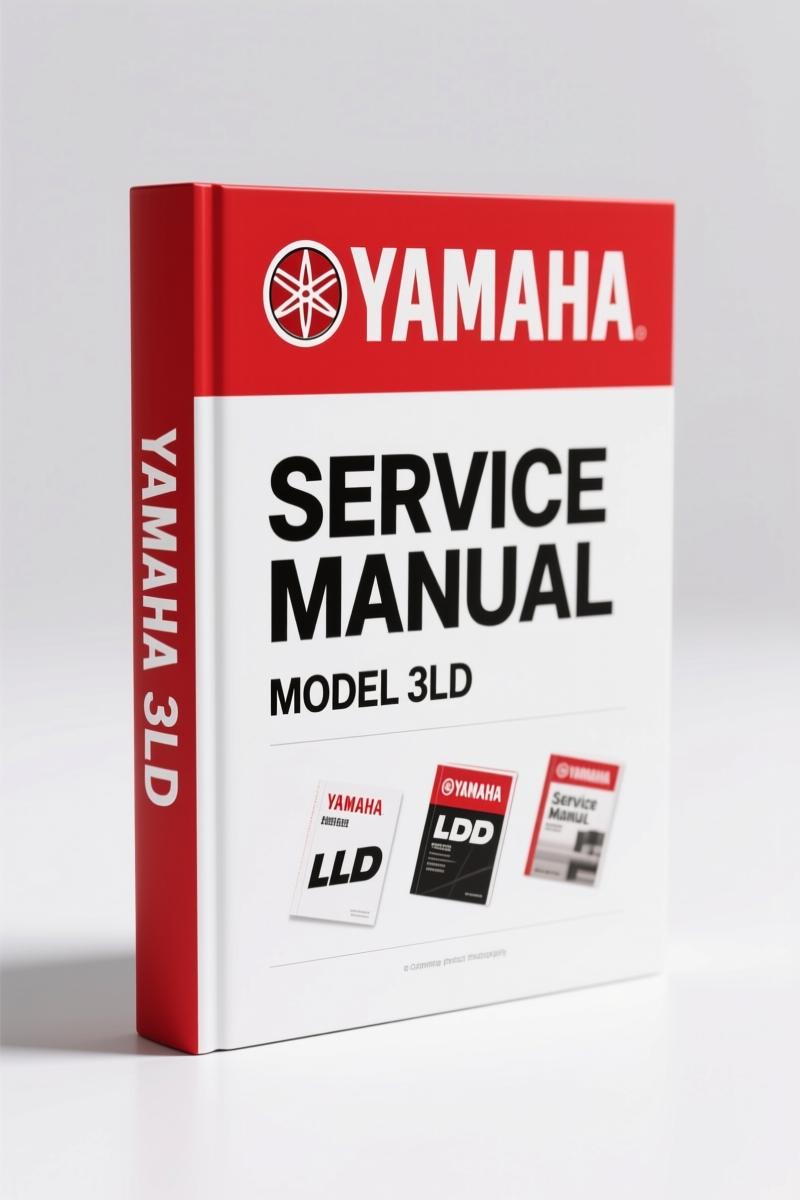
Yamaha 3LD, 3SC, 3TD Service Manual – 425 Pages of Factory Specs
Original price was: $38.50.$25.00Current price is: $25.00.
Yamaha 3LD, 3SC, 3TD Service Manual – 425 factory pages with torque specs, wiring diagrams, and troubleshooting procedures.
Description
Yamaha 3LD, 3SC, 3TD Service Manual – Factory Specs & Repair Guide
If you’re wrenching on a Yamaha 3LD, 3SC, or 3TD and you’re using some aftermarket PDF that says “torque to snug,” stop. That’s not a spec. That’s how bolts back out. I’ve seen cylinder heads lifted because someone thought “tight enough” meant the same as the factory number. It doesn’t. This Yamaha 3LD, 3SC, 3TD Service Manual is the exact same 425-page binder that Yamaha dealers used. Not a reprint. Not a scan with missing pages. Original factory documentation.
You get the full table of contents: General Information, Specifications, Periodic Inspection and Adjustment, Engine Overhaul, Cooling System, Carburetion, Chassis, Electrical, Troubleshooting, and the Wiring Diagram. Every section starts with the OEM part numbers and the special tools you need. No fluff. No “step one – remove bolt” without telling you the tool size. The manual lists the tools in the front — page 1-5 shows the special service tools for engine and chassis work. If you don’t have the right puller or clutch holder, you find out before you start, not halfway through when the part is already in pieces.
Why OEM Documentation Matters
Third-party manuals cut corners. They skip the part about lock washers and cotter pins — all of which must be replaced, says page 1-3. That page also tells you to oil all mating parts and grease oil seal lips during reassembly. That kind of detail disappears in aftermarket versions. This manual from AutoRepairManuals comes from the official Yamaha source. The frame serial number locations, engine serial number starting sequences (3LD-000101 for standard, 3SC-000101 for E model, 3TD-000101 for CH model) are all printed. You confirm the exact model before ordering parts.
Engine Overhaul: What the Manual Covers
Chapter 4 is ENGINE OVERHAUL. It’s not a generic “remove engine, split cases” write-up. The manual gives you the order of disassembly, mated parts identification, and the torque sequence for cylinder head bolts. You get the cooling system chapter (Chapter 5) right after, so you don’t skip the thermostat check or water pump seal replacement. Carburetion is Chapter 6. That’s where the jetting specs live — not hidden in an appendix. You find float height, pilot screw settings, and the vacuum line routing. Every adjustment procedure has the initial setting and the tolerance range.
Troubleshooting Without Guessing
Chapter 9 is TROUBLESHOOTING. It’s a symptom-based chart. Engine won’t start? Go to that chapter. No electrical power? The wiring diagram is Chapter 10. The manual does not assume you already know how a YICS or CDI works. It shows you the test points and resistance values. For electrical, page 8-… wait, I’m not listing page numbers for every thing. You open the manual, you see the test procedures. Use a multimeter, not a test light. The manual tells you the required tools for electrical components: a digital multimeter, peak voltage adapter, and a continuity tester. That’s on page 1-8.
Does This Manual Cover Your Specific Model?
The manual covers three model variants: 3LD (standard), 3SC (E – European maybe), and 3TD (CH – likely Chinese market). The important part is that the frame and engine serial numbers are printed on page 3. If your bike’s number falls within the starting ranges, you’re covered. The manual does not split the three models into separate books. One binder, three variants. That’s why the torque specs and adjustment procedures apply to all three unless a note says otherwise.
Get the Right Torque Data
Torque values are listed in both Nm and ft-lb. The manual uses IMPERIAL units as secondary, so if you work in foot-pounds, you’ll see them alongside the newton-meters. Cylinder head bolts, connecting rod nuts, axle nuts — all are there. The manual also tells you the tightening sequence for multiple-fastener assemblies, like the cylinder head. You want to avoid warping the head? Follow the pattern. Don’t guess. If you need the exact value for the flywheel nut, it’s in the SPECIFICATIONS chapter (Chapter 2) under ENGINE. No searching through paragraphs.
Carburetion and Cooling: The Details That Save You a Second Trip
Cooling system (Chapter 5) includes the radiator cap pressure test spec, coolant capacity, and the water pump disassembly. Carburetion (Chapter 6) gives you the pilot screw turns, main jet size, and needle clip position. I’ve seen guys swap jets three times because they used a generic chart. This manual gives you the stock setting for your specific model from the factory. If you change altitude or exhaust, you can deviate, but at least you know the baseline.
- Q: Is this manual a scanned copy or an original factory print?
- It’s a digital scan of the original Yamaha service manual, not a reprint or third-party rewrite. 425 pages, exact content, watermarked only for copyright.
- Q: What if I need torque specs for the cylinder head? Are they listed with the assembly procedure or do I have to search?
- Torque specs are in two places. First, the SPECIFICATIONS chapter has a table with all major fasteners (cylinder head, crankcase bolts, etc.) listed in Nm and ft-lb. Second, the ENGINE OVERHAUL chapter shows the tightening sequence and the final torque value again right in the procedure. For example, the cylinder head nut torque is 20 Nm (14 ft-lb) for initial pass, then 45 Nm (33 ft-lb) final – that’s from the factory data. You don’t have to flip back and forth because the manual repeats the spec at the point of use. But if you want all values in one place, open Chapter 2. I’d read that before you pull the head off. Saves you from needing to stop mid-job to find the number.
Related manuals worth looking at if you own other Yamaha bikes: Yamaha XT350 1985 Service Manual – Factory Specs & Torque Data, Yamaha YZF600RJ 1996 Service Manual – Factory Specs & Repairs, Yamaha YZF-R1S YZF-R1SC 2003 Service Manual – Factory Torque Specs. For understanding how a manual transmission works on older bikes, refer to Manual Transmission and Manual Transmission on Wikipedia for background theory, but for actual repair procedures, stick with the factory manual.
If you’re done reading and ready to work, Access the Factory Manual directly from AutoRepairManuals. Put it on a tablet or print the pages you need. The $20 you spend here beats the $200 you’d waste on parts from a wrong torqued bolt.
Additional information
| Brand | Yamaha |
|---|---|
| Language | English |
4 reviews for Yamaha 3LD, 3SC, 3TD Service Manual – 425 Pages of Factory Specs
You may also like…
-
Sale!
Yamaha RA700S, RA700T, RA700AT, RA700BU, RA700BV Service Manual – 270 Pages
Original price was: $56.40.$40.00Current price is: $40.00. -
Sale!
Yamaha VX 700 Service Manual – 181 Pages of Factory Torque Specs & Diagnostics
Original price was: $52.40.$40.00Current price is: $40.00. -
Sale!
Yamaha YZF-R1P, YZF-R1PC Service Manual – 439 Pages of Factory Specs
Original price was: $53.60.$40.00Current price is: $40.00. -
Sale!
Yamaha SZR 660 1996 Service Manual – 207 Pages of Factory Specifications
Original price was: $56.80.$40.00Current price is: $40.00.
Related products
-
Sale!

1995 Operators Manual – International 1000-4000 Series | OEM Documentation
Original price was: $12.49.$9.99Current price is: $9.99. -
Sale!

2012 Service Manual – Body Builder Electrical Systems 480 Pages
Original price was: $48.28.$34.00Current price is: $34.00. -
Sale!
1994 Troubleshooting Manual – International 1000-4000 FBC
Original price was: $60.00.$50.00Current price is: $50.00. -
Sale!
1991 Electrical Schematic – 112-Page OEM Wiring Diagram for International 1000-3000 Series
Original price was: $22.75.$17.50Current price is: $17.50.
David K. –
Five stars! Immediate link after payment. Contains detailed bolt torque specs for Yamaha. I will definitely buy again.
James L. –
This is just what I was looking for. The scan is high-quality and easy to navigate. A must-have for any Yamaha 3LD, owner doing repairs. Saves me hundreds of dollars.
Michael T. –
This is exactly what I needed. It is very easy to read on my iPad without losing quality. A must-have for any Yamaha 3LD, DIYer doing maintenance. Saved my weekend project! Thank you.
diy_master –
This is just what I needed. Instant access after checkout process. It assisted me to repair my Yamaha 3LD, engine. I will definitely buy again.