
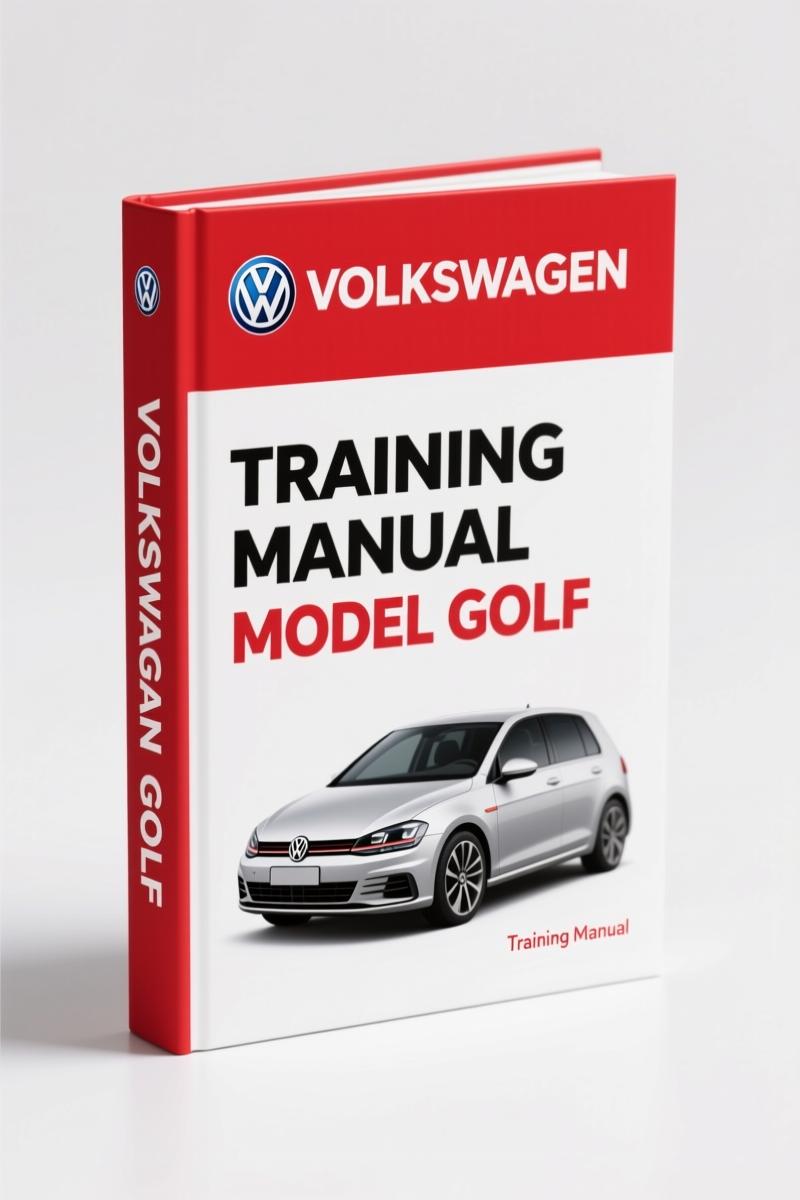
Volkswagen Golf, A3 Training Manual – 39 Pages Factory System Control
Original price was: $33.00.$25.00Current price is: $25.00.
Factory 39-page training manual for VW Golf/Audi A3. System control, refrigerant circuit, pressure switch thresholds, cooling fan diagnostic logic.
Description
Volkswagen Golf, A3 Training Manual – Factory A/C System Diagnostics
If you’ve ever had a Golf or A3 come in with an A/C that cycles on and off, or a compressor that won’t engage, you know the trap of swapping parts without understanding the control logic. I’ve seen guys replace the compressor, the condenser, the expansion valve, and still have the same complaint because they never looked at the pulse‑width signal from the pressure sensor. This 39‑page Volkswagen Golf, A3 Training Manual is the exact binder VW hands to its own techs during factory training. It’s not a reprint of some Chilton’s. It’s the real deal.
You get the actual diagnostic steps for the refrigerant circuit, including the low‑ and high‑pressure switches and the microprocessor that reads the silicon crystal inside the sensor. Page 38 walks you through the pulse‑width modulated signal – period duration 20 ms, pulse width that jumps to 18 ms at 3.7 MPa (37 bar). That’s 90% duty cycle. If you don’t know what that looks like on a scope, you’re guessing. This manual shows you exactly what waveform to expect, and what test voltage the VAS 5051 will show. Volkswagen Golf Passat Touran 2003-2006 Workshop Manual covers the same generation if you need full engine and chassis procedures, but for A/C diagnostics this training manual is the focused source.
Air Conditioning System Control – Pulse Width Signal
The core of VW’s A/C control is a silicon crystal that deforms under pressure. The microprocessor reads that deformation as a resistance change, then outputs a pulse‑width modulated signal. Page 38 gives you the numbers: at low pressure the pulse width narrows, at high pressure it widens. They even tell you to use the digital memory oscilloscope of the VAS 5051 to visualise it. If you’re using a generic multimeter, you’ll miss the duty‑cycle reading. The manual doesn’t waste space telling you to buy the expensive tool – it just shows you what the waveform looks like so you can verify it on whatever scope you have.
Does This Manual Cover the Refrigerant Circuit Safeties?
Yes, and it names every switch. Page 39 lists the low‑pressure switch F73 that cuts the compressor below 0.17 MPa (1.7 bar), and the high‑pressure switch F118 that cuts it above 3.0 MPa (30 bar). Those are system‑specific, meaning you don’t swap in a generic switch from the parts store and assume it’s right. The manual also covers the coolant temperature switch that monitors engine load – compressor cuts out at 119 °C, cuts in at 112 °C. That’s information you won’t find in any aftermarket data because aftermarket resellers don’t license VW’s internal training docs.
3 Critical Safety Switches Explained
Three switches protect the compressor and the engine: F73 (low pressure), F118 (high pressure), and the coolant temperature switch with pilot lamp. Page 39 shows you the exact wiring arrangement for the VW Golf/Audi A3. There’s also a mention of the radiator fan thermo switch F18 and the A/C cut‑off thermo switch F163, but those are vehicle‑dependent. The manual tells you which vehicles use which switches, so you don’t waste time hunting for a part that doesn’t exist on the car in your bay.
Get the Right Diagnosis Tools
Before you even open the hood, read page 38. You’ll see the pulse‑width signal diagram and the test voltage graph. If you don’t have a digital memory oscilloscope, borrow one. The manual doesn’t suggest you “maybe try a test light.” It tells you the instrument you need. That’s the difference between a factory training manual and a parts‑store supplement. Volkswagen Golf Golf Plus 2004 2005 Workshop Manual is another option if you’re working on the later models with extended electronic sensor evaluation – the training manual notes that on page 39.
Why This Training Manual Beats Aftermarket Copies
I’ve seen aftermarket manuals that claim to cover the VW A/C system but skip the pulse‑width modulation entirely. They’ll tell you to “check the refrigerant pressure” with a manifold gauge, but they won’t explain that the pressure sensor outputs a digital signal, not an analog one. This training manual is from Volkswagen itself, published for their own technicians. It’s 39 pages of concentrated factory knowledge. No filler, no generic wiring diagrams that don’t match the actual car. Volkswagen Golf Jetta 2005 Workshop Manual uses the same A/C principles, but this training manual gets into the theory of operation in a way a workshop manual doesn’t. If you’re serious about A/C diagnostics, get both.
For a broader perspective on vehicle electrical systems, Automotive Industry Overview shows how manufacturers standardize training. But for VW/Audi specifically, this is the document you need. Automotive Industry Overview is a general resource, but this manual is model‑specific and model‑accurate.
Fan Control Circuit – What the Manual Covers
Page 40 details the cooling fan circuit for the VW Golf/Audi A3. The fan control unit J293 regulates the radiator and condenser fans based on coolant temperature and refrigerant pressure. The manual warns that absolute values are always vehicle‑specific – so don’t assume the fan on button from a Passat will work on a Golf. You get the circuit diagram with the switches and the fan motor. If your fan doesn’t run, you can trace the signal from the J293 back to the pressure sensor using the waveforms you learned on page 38. That’s a complete diagnostic flow.
- Is this manual for the standard Golf or the A3?
- It covers both the Golf and Audi A3 refrigerant circuits. The circuit diagrams on page 40 use the VW Golf/Audi A3 as an example.
- What tools do I need to follow the procedures?
- You need a digital memory oscilloscope (like the VAS 5051) to visualise the pulse‑width signal. The manual references it on page 38. You also need a manifold gauge set to confirm static pressures, but the real diagnostics rely on the electrical signal from the pressure sensor. If you don’t have a scope, you’ll be limited to checking switch continuity with a multimeter, but you’ll miss the duty‑cycle test that detects a failing sensor. The manual doesn’t list a full tool inventory, but from what I’ve read, a scope and a factory scan tool that can read the A/C control unit are essential. For the mechanical checks, standard A/C service tools will do. The training manual assumes you already know how to evacuate and recharge; it’s focused on the control system.
Don’t waste another hour chasing A/C ghosts that a quick waveform check would have found. Access the Factory Manual and get the VW‑specific training that the dealer techs use. It’s 39 pages, no reprints, no generic aftermarket crap – just the OEM specs and procedures you need to fix it right the first time.
Additional information
| Brand | Volkswagen |
|---|---|
| Language | English |
2 reviews for Volkswagen Golf, A3 Training Manual – 39 Pages Factory System Control
You may also like…
-
Sale!

Volkswagen Golf Jetta GTI Service Manual – 4954 Pages Official Specs
Original price was: $95.55.$65.00Current price is: $65.00. -
Sale!

Volkswagen Phaeton Training Manual – Auxiliary Heater System (52 pages)
Original price was: $55.80.$45.00Current price is: $45.00. -
Sale!

Volkswagen Serie C 2003 Service Manual – OEM Factory Specs
Original price was: $53.60.$40.00Current price is: $40.00. -
Sale!

Volkswagen Passat 1995 Repair Manual – Factory Wiring & Engine Specs
Original price was: $57.20.$40.00Current price is: $40.00.
Related products
-
Sale!

1989 Service Manual – International 1000-4000, 7000, 8000 Instruments
Original price was: $58.80.$40.00Current price is: $40.00. -
Sale!

2011 Parts Catalog – International Truck OE Parts Documentation (1786 Pages)
Original price was: $34.50.$25.00Current price is: $25.00. -
Sale!
Acura NSX 1991 Service Manual – 1420 Pages OEM
Original price was: $102.05.$65.00Current price is: $65.00. -
Sale!
1993 Operators Manual – International Bus 1000-3000 OEM Specs
Original price was: $12.30.$7.99Current price is: $7.99.
John S. –
I am so happy with this manual. It is easily zoomable on my iPad without blur. It helped me to rebuild my Volkswagen Golf, electrical system. Saves me a lot of money.
pro_mechanic –
I am extremely satisfied with this transaction. Instant access after checkout process. Contains precise schematics for Volkswagen. I will recommend this shop to others.