
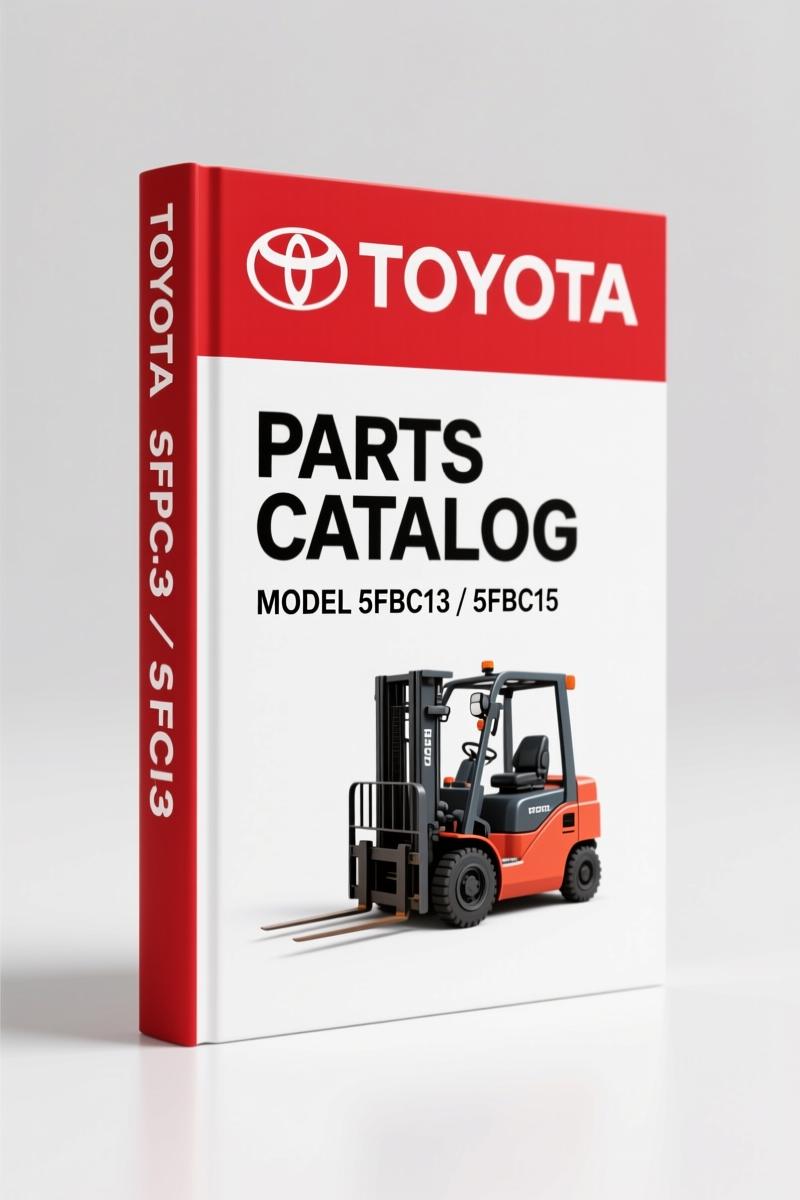
Toyota 5FBC13-30 1991 Service Manual | 485 Pages
Original price was: $76.20.$60.00Current price is: $60.00.
Factory 1991 service manual for Toyota 5FBC13-30 forklift. 485 pages of OEM electrical, brake, and cylinder specs.
Description
Toyota 5FBC13, 5FBC15, 5FBC20, 5FBC25, 5FBC30 1991 Service Manual
You’ve got a battery forklift that’s dead on the dock, and the aftermarket manual you pulled up says “torque to snug” – that’s a lawsuit waiting to happen. I’ve been torquing head bolts since before some of you were born, and let me tell you: a job without factory numbers is a job you’re going to do twice. This is the Toyota 5FBC13, 5FBC15, 5FBC20, 5FBC25, 5FBC30 1991 Service Manual, 485 pages of OEM documentation straight from Toyota Motor Corporation. No reprints, no third-party hacks. You get the actual procedures the dealer techs used in 1991, still valid today unless Toyota issued a service bulletin – which they did, but this manual gives you the baseline to catch those updates.
Every section in this manual was written for working mechanics. The foreword says it covers the 5FBC13-30 Series as of November 1991. That means every torque spec, every wire color, every cylinder rebuild step is locked to the factory build. Aftermarket manuals love to cut corners – they’ll tell you “refer to similar model” and then you strip a 12mm bolt on the Drive Unit because the torque was off by 15 lb-ft. Not here. The Standard Bolt & Nut Tightening Torque table on page 0-11 gives you the wrench numbers for every bolt strength grade. You need the charge pressure? Page 0-16 lists recommended lubricants and capacities. That’s the difference between getting the job done and ordering new parts.
Toyota 5FBC13, 5FBC15, 5FBC20, 5FBC25, 5FBC30 1991 Service Manual – What You Get
This manual is structured like a proper shop manual: General section up front (exterior views, frame numbers, abbreviations, circuit tester usage), then each system in its own indexed chapter. The TOC lists 17 sections including Battery, Control Circuit, Multidisplay Functions, Electrical System Troubleshooting, Motor, Drive Unit, Front Axle, Rear Axle, Steering, Brake, Body & Frame, Material Handling System, Mast, Cylinder, Oil Pump, Oil Control Valve, and Appendix. That’s every major system on these forklifts. If you’re chasing a short in the control circuit or rebuilding a lift cylinder, the manual takes you from theory of operation to disassembly to spec check. And it tells you which tools you need – no guessing.
For parts lookup, you’ll want the TOYOTA 5FBC13 5FBC15 Parts Catalog to cross-reference exploded views with this manual’s procedures. For the larger 5FBC18-25 models, the TOYOTA 5FBC18 5FBC20 5FBC25 5FBCH20 5FBCH25 Parts Catalog covers those variations. If you’re also working on a Toyota SCP10, the Toyota SCP10, NCP1, NLP10 2001 Service Manual – Factory OEM gives you a similar level of detail for car work.
3 Critical Sections: Electrical, Brake, and Steering
Let me save you some time. If your forklift won’t move, start with the Electrical System Troubleshooting section. It walks through the control circuit, multidisplay functions, and battery diagnostics with actual Toyota flowcharts – not generic “check voltage” advice. The Brake section covers adjustment and overhaul for the drum brakes on these trucks. And the Steering section includes the hydraulic steering unit – you’ll find the seal kit specs and pressure tests there. Don’t skip the Standard Bolt Torque table on page 0-11 before you reassemble anything. I’ve seen guys snap a steering arm bolt because they used an impact on a 10.9 grade bolt.
Does This Manual Cover the Mast and Cylinder Repair?
Yes, and it covers them properly. The Mast chapter includes disassembly of the lift mast and nested rails. The Cylinder chapter gives you the rebuild procedure for tilt and lift cylinders, including O-ring sizes and packing material specs. The Oil Pump and Oil Control Valve sections are where most aftermarket manuals fall flat – they show a generic hydraulic schematic and say “rebuild as per standard practice.” This manual gives you the Toyota-specific valve body disassembly and pressure setting for the relief valve. You want a leak-free cylinder after rebuild? Use the torque sequence specified on page 0-11, and use the lubricants from page 0-16.
Why OEM Matters: Battery Forklift Specifics
Battery forklifts have a different electrical system than engine-powered ones. The Motor section in this manual covers the traction and hydraulic pump motors – brush inspection, commutator undercutting specs, and field coil resistance. The Battery section includes charging procedures for the specific battery voltage used in these models. Aftermarket manuals will tell you to use a generic charger profile; this manual gives you the correct charge voltage and current limits to avoid boiling the battery. Safety warnings are threaded throughout – things like “disconnect battery before working on control circuit” and “cool hydraulic oil before opening.” Those aren’t suggestions; they’re factory requirements. You can verify updates through Automotive Industry Overview, though that site covers vehicle manuals, not forklift service. Still, it shows Toyota’s commitment to documentation.
3 Reasons to Choose OEM Documentation
- Torque specs that come from Toyota’s engineering – not copied from a generic table.
- Wiring diagrams that match the actual harness colors – no “refer to similar model” nonsense.
- Procedures that follow the order Toyota designed the machine to be disassembled. Skip a step, and you’ll be fighting a hidden clip.
- Q: Can I use this manual for a 5FBC40?
- No. This manual only covers the 5FBC13, 5FBC15, 5FBC20, 5FBC25, and 5FBC30 models. The 5FBC40 uses different axles and a larger motor.
- Q: Do I need special tools for the hydraulic system?
- Some procedures call for a pressure gauge, flow meter, and a puller for the oil pump gear. The manual lists required tools in each section – for example, the Cylinder chapter specifies a seal driver kit. It also includes wire rope suspension angle charts on page 0-14 to calculate safe lifting loads when removing the mast assembly. Don’t skip that page if you’re pulling the mast; you’ll need a spreader bar or you’ll damage the mast channels. The appendix has a list of special service tools with Toyota part numbers. You can source equivalents, but you need to know the dimensions – and those are in the manual.
Bottom line: if you’re paying shop labor rates to guess, you’re wasting money. I’ve used enough aftermarket junk to know the difference. This manual is the original OEM print for the Toyota 5FBC13-30 Series battery forklifts. It gives you the exact same information a Toyota dealer technician would have in 1991 – still correct for these models unless superseded by a service bulletin. Get the factory procedures, the torque values, and the safety warnings that keep you from crushing a finger or cooking a battery. Access the Factory Manual and keep it on your workbench. You’ll thank me when a cylinder seal job takes three hours instead of three days.
Additional information
| Brand | Toyota |
|---|---|
| Language | English |
4 reviews for Toyota 5FBC13-30 1991 Service Manual | 485 Pages
You may also like…
-
Sale!

Toyota 6FGCU33, 6FGCU45 1997 Service Manual – Factory Forklift Repair
Original price was: $94.25.$65.00Current price is: $65.00. -
Sale!

Toyota 5FBE10, 5FBE15, 5FBE18, 5FBE20 Service Manual – 463 Pages
Original price was: $102.05.$65.00Current price is: $65.00. -
Sale!
Toyota 5FBE10, 5FBE13, 5FBE15, 5FBE18, 5FBE20 Service Manual – 463 Pages
Original price was: $102.05.$65.00Current price is: $65.00. -
Sale!

Toyota 7FGU35 7FGU80 2005 Service Manual – 136 Pages Official Factory Data
Original price was: $82.55.$65.00Current price is: $65.00.
Related products
-
Sale!

1992 Electrical Schematic – International 1000/3000/4000/2554 OEM Wiring Diagrams (132 Pages)
Original price was: $26.40.$20.00Current price is: $20.00. -
Sale!

2011 Parts Catalog – International 7400 SFA 6X6 – 1886 Pages of OEM Part Numbers
Original price was: $32.00.$25.00Current price is: $25.00. -
Sale!

1991 Operators Manual – International Truck OEM Specs (108 Pages)
Original price was: $13.63.$10.99Current price is: $10.99. -
Sale!

2005 Parts Catalog – International NGD 3.0 L Engine (77 pages)
Original price was: $44.70.$30.00Current price is: $30.00.
Thomas B. –
Great buy! It is very easy to read on my iPad without blur. Every spec sheet is included for Toyota 5FBC1330. Saved my weekend project! Thank you.
Michael T. –
Excellent quality! The PDF is high resolution. Contains precise bolt torque specs for Toyota. I will definitely buy again.
John S. –
I am extremely satisfied with this transaction. Immediate link after checkout process. A must-have for any Toyota 5FBC1330 owner doing maintenance. Worth every penny.
William H. –
Perfect workshop guide. The file is high resolution. It helped me to troubleshoot my Toyota 5FBC1330 electrical system. Saved my weekend project! Thank you.