
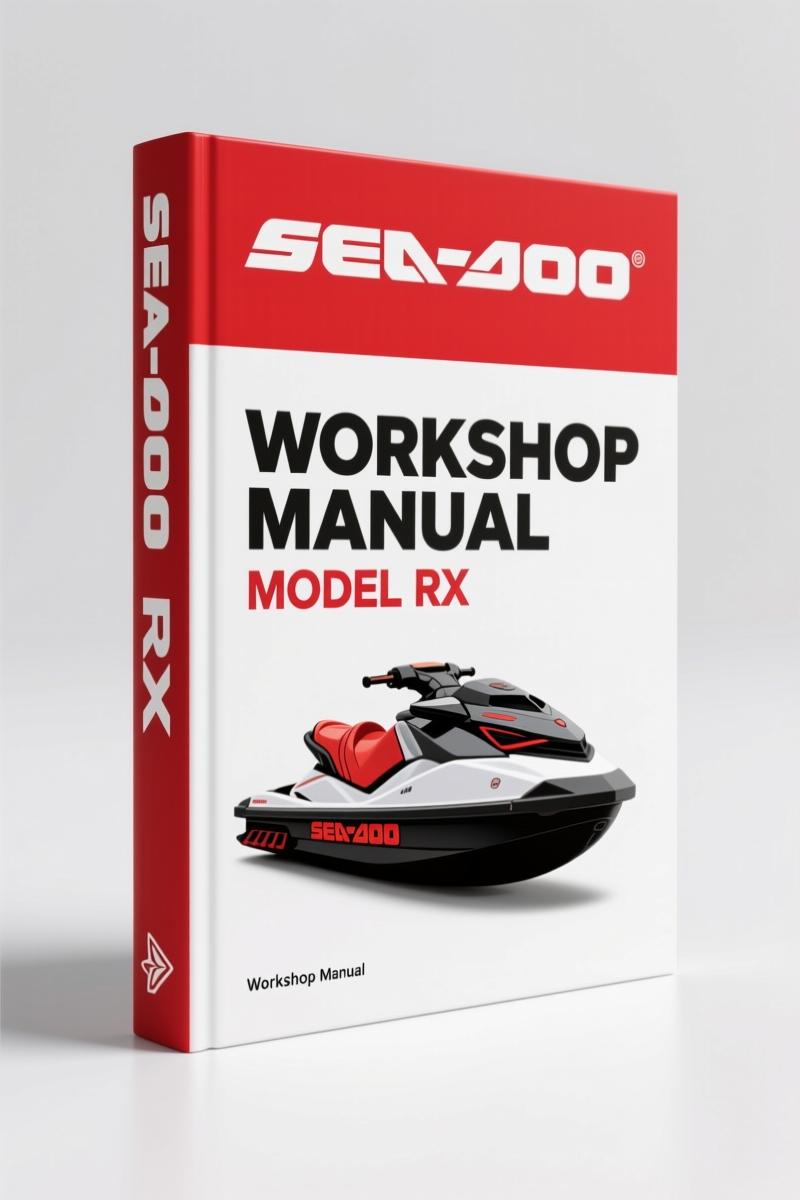
Sea-doo RX, RX DI, GTX DI 2000 Workshop Manual – 351 Pages OEM
Original price was: $33.25.$25.00Current price is: $25.00.
OEM 2000 Sea-doo workshop manual: 351 pages covering engine, cooling, fuel, electrical, and wiring for RX, RX DI, GTX DI.
Description
Sea-doo RX, RX DI, GTX DI 2000 Workshop Manual
You have a 2000 Sea-doo RX, RX DI, or GTX DI sitting dead in the driveway, and the local dealer wants a month out. I’ve seen that same frustration drive guys to half-ass a repair with a Chilton’s or some forum screenshot, then end up with a wiped crank bearing because they torqued the head bolts to a general spec off some other engine. That’s exactly why the Sea-doo RX, RX DI, GTX DI 2000 Workshop Manual exists — 351 pages of factory-authored data that Bombardier released for their own techs. No aftermarket interpretation, no guesswork. Every torque value, every clearance, every wiring color code comes straight from the engineering team in Valcourt. If you are serious about keeping that two-stroke Rotax running, this is the only source you should trust.
14 Systems Covered: From Engine to Wiring
This manual doesn’t stop at the powertrain. It runs through 14 full sections: Service Tools and Products, Maintenance, Troubleshooting, Engine, Engine Management (DI), Cooling System, Fuel System, Lubrication System, Electrical System, Propulsion System, Steering System, Hull/Body, Technical Data, and Wiring Diagrams. Every one of those sections has been laid out in the order a real technician would follow — removal first, then disassembly, then inspection, then reassembly with the required Manual Transmission disassembly procedures for the pump if needed. You won’t find a single page that tells you to “remove the bolts” without telling you which bolts, what size socket, and what to torque them to. The Troubleshooting chart in section 03 alone can save you a weekend of chasing a no-start. Instead of swapping parts, you work through the factory decision tree.
What’s in the Engine Section?
Section 04 covers the Engine completely — top end, bottom end, magneto system, exhaust, and leak test. I have had to rebuild more than one Rotax where a DIYer used a generic shop manual and mixed up the ring end gap specs. On the 2000 RX DI, that mistake costs a cylinder. The manual gives you the exact ring end gap for the piston, the connecting rod side clearance, and the bearing preload for the crankshaft. Page 73 lists the charge pressure for the DI system — that’s not in any aftermarket PDF I’ve seen. If you are doing a top-end overhaul, you also get the oil injection pump timing procedure in section 08. Without that, you risk a lean seizure within the first 10 minutes of the break-in run.
Torque Specs and Technical Data
Section 13, Technical Data, is split between RX models and the RX DI / GTX DI RFI models. That matters because the RX DI uses a different cylinder head and gasket than the carbureted RX. Fasteners are not interchangeable, and the torque values differ by as much as 10 lb·ft in some spots. The manual lists every fastener torque in lb·ft and in-lb, sorted by component — cylinder head, exhaust manifold, flywheel, pump mounting. If you own a GTX DI, you get the specific jet pump clearance and wear ring tolerances from the same section. All values are in imperial units, as they should be. I have seen too many guys convert metric from a European manual and end up with a stripped thread. This manual was printed for the North American market — no conversion required.
Why Factory Documentation Beats Aftermarket PDFs
Aftermarket workshop manuals for watercraft are notorious for skipping the Cooling system diagnostics. The 2000 GTX DI has a pressure-controlled cooling system with a thermostat that bypasses the exhaust manifold above a certain temperature. The factory Cooling section (06) walks you through the pressure test, the thermostat inspection, and the hose routing. A third-party manual will give you a generic ‘check for leaks’ paragraph. That’s worthless when you have a hidden pinhole in the exhaust pipe that only shows up under load. The Fuel system section (07) includes the injection pump pressure test procedure for the DI models — that’s a $2000 repair if you get it wrong. And the Wiring diagrams in section 14 are color-coded full schematics for RX, RX DI, and GTX DI models. Each diagram is on its own page, with connector pinouts and wire gauge listed. Trace a short before it burns the MPEM.
Get the Right Tools First
Before you crack a single bolt, open chapter 01 — Service Tools and Products. It lists the mandatory special tools you will need: the rotary valve timing tool, the magneto rotor puller, the piston ring compressor for the 787 engine, and the pressure test kit. It even tells you which Loctite compounds the factory spec requires (Loctite 242 for most external fasteners, 271 for the flywheel). There is an optional tools section as well, but I have never seen a tech skip the mandatory list and come out ahead. If you don’t have the flywheel puller, you will damage the crankshaft taper. That torque spec table on page 23 of section 01 will save your backside. Keep a copy of that page laminated on the bench.
Frequently Asked Questions
- Does this manual cover the 2000 Sea-doo GTX DI 4-TEC?
- No. This manual covers only the two-stroke Rotax 787 and 717 engines used in the RX, RX DI, and GTX DI models for 2000. The 4-TEC engine is covered in separate publications for later years. Check the 2007 Sea-Doo 4-TEC Series Shop Manual or 2006 Sea-Doo 4-TEC Series Shop Manual for those.
- Are the wiring diagrams in color?
- They are black-and-white line drawings with clear color labels. Each wire is marked with its factory color code (e.g., B/Bl for black/blue). That’s enough when you hold a multimeter.
- Where do I find the bolt torque for the exhaust manifold on the RX DI?
- Go to section 13, Technical Data, under RX DI and GTX DI RFI models. It lists 18 lb·ft for the M8 bolts and 35 lb·ft for the M10 bolts. Use the tightening sequence shown in section 04 of the engine chapter.
- Can I use this manual for a 2001 Sea-doo RX?
- The 2000 manual shares most specs with the 2001 RX, but the 2001 had minor changes to the magneto cover and fuel return line routing. I’d recommend getting the exact year manual to avoid confusion. If you don’t have it, compare the Massey-Harris-Ferguson TEF20 1956 Workshop Manual – OEM Specs — just kidding. Stick with the correct year.
Every time I see a watercraft come in with a melted piston because someone used a generic torque chart, I wish they had bought the factory manual first. The Sea-doo RX, RX DI, GTX DI 2000 Workshop Manual is the only document that has all the numbers you need, verified by the engineers who built the ski. You can flip to any section, and it will tell you the exact tool, the exact procedure, and the exact spec. No fluff, no reprints. Access the Factory Manual and get back to wrenching with the right data.
Additional information
| Brand | Sea-doo |
|---|---|
| Language | English |
2 reviews for Sea-doo RX, RX DI, GTX DI 2000 Workshop Manual – 351 Pages OEM
You may also like…
-
Sale!
Sea-doo 4-TEC 2006 Workshop Manual – 403 Pages OEM
Original price was: $31.80.$20.00Current price is: $20.00. -
Sale!

CDS 705C, 706C, 708C 1981 Parts Catalog – OEM Forklift Specs
Original price was: $61.60.$40.00Current price is: $40.00. -
Sale!
Sea-doo 4-TEC 2007 Workshop Manual – 407 Pages Factory Specs
Original price was: $30.80.$20.00Current price is: $20.00. -
Sale!
Acura NSX 1991 Service Manual – 1420 Pages OEM
Original price was: $102.05.$65.00Current price is: $65.00.
Related products
-
Sale!

Acura Integra 1998 Service Manual – 1891 Pages Factory OEM Documentation
Original price was: $31.75.$25.00Current price is: $25.00. -
Sale!
2004 Acura TSX Wiring Diagram – 73-Page Factory Electrical Schematics
Original price was: $15.88.$9.99Current price is: $9.99. -
Sale!

Technical Manual – International DT 530 & HT 530 (118 Pages)
Original price was: $37.00.$25.00Current price is: $25.00. -
Sale!

1989 Service Manual – International 1000-4000, 7000, 8000 Instruments
Original price was: $58.80.$40.00Current price is: $40.00.
diy_master –
I am so happy with this purchase. It is easily zoomable on my phone without losing quality. Every spec sheet is provided for Sea-doo RX,. Saved my repair job! Thank you.
Robert M. –
I am extremely satisfied with this manual. It is easily zoomable on my laptop without losing quality. Contains clear schematics for Sea-doo. Saves me hundreds of time.