
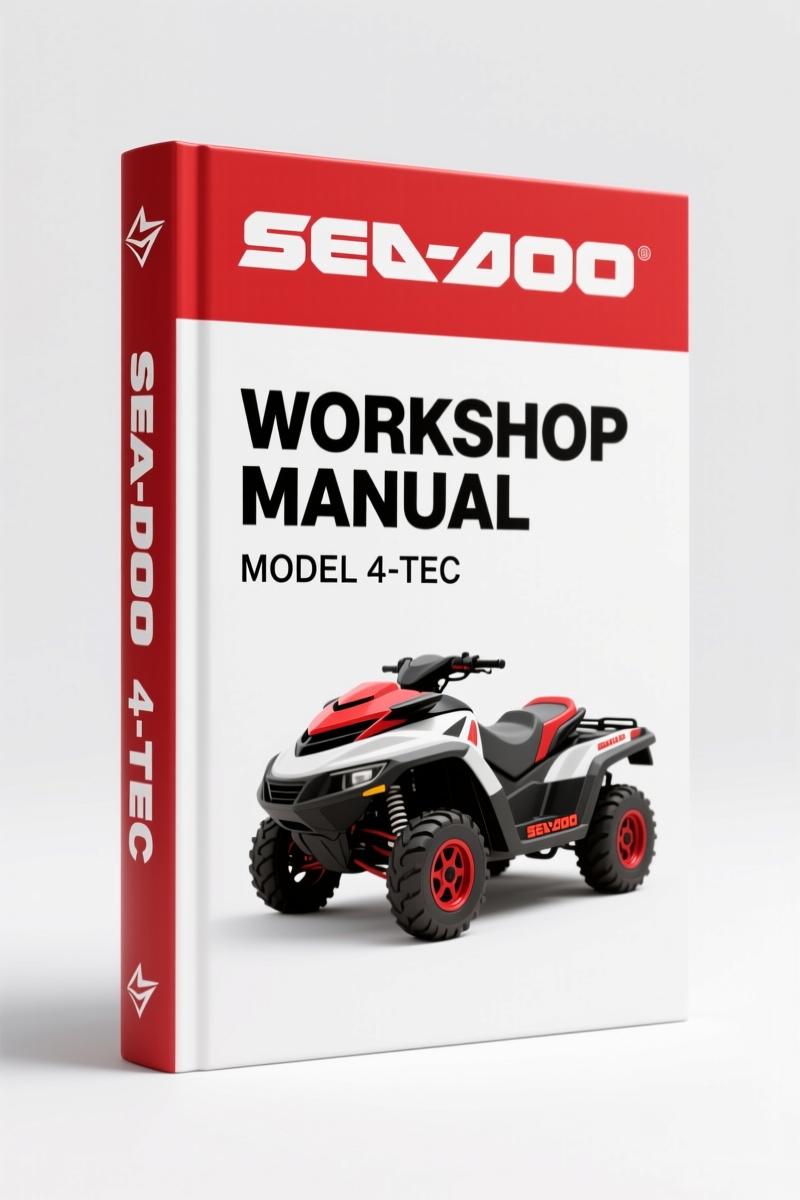
Sea-doo 4-TEC 2006 Workshop Manual – 403 Pages OEM
Original price was: $31.80.$20.00Current price is: $20.00.
OEM 403-page workshop manual covering 2006 Sea-doo 4-TEC watercraft. Factory torque specs, emissions compliance, and preventive maintenance schedules.
Description
Sea-doo 4-TEC 2006 Workshop Manual – Factory Data for Real Work
You know what gets a diy builder in trouble? Guessing on the torque sequence for a 4-TEC head. I’ve seen it. Stripped threads, blown gaskets. That’s why the Sea-doo 4-TEC 2006 Workshop Manual belongs on your workbench, not some third-party summary. 403 pages of factory data straight from BRP. No guesswork.
Over the years I’ve had to flatten aftermarket manuals written by someone who never opened a hood. This one is different. It’s the exact PDF the dealership techs pull up when they hit a snag. Every self-locking fastener, every Loctite application, every tightening torque – it’s all spelled out using the actual BRP engineering specs.
Maintenance Chart and Preseason Preparation – Section 01
Section 01 covers the maintenance chart and preseason preparation. If you skip reading this you’ll miss the factory intervals for oil, filter, and supercharger service. The manual lists required tools for each job – not general suggestions. For example, the fuel system storage procedure on page 5 (of the PDF) tells you exactly which stabilizer to use and how to run the engine for stabilizer circulation. No vague statements.
Prep work is where most watercraft failures start. The manual walks through checking the propulsion system, fuel lines, and electrical connections. It even includes a winterization checklist for the engine and hull. That kind of detail saves you from buying a new $800 ECU because you didn’t seal the intake.
What Torque Values Are Listed in the Tightening Torques Section?
The tightening torques section (listed in the table of contents as part of the introduction) gives you foot-pounds for every critical fastener – intake manifold bolts, exhaust header, cylinder head, and the supercharger oil drain plug. No generic range like “25–30 ft-lb”. The manual specifies exact values because aftermarket specs cause leaks. I keep a copy open on my tablet when I do head gasket work. The Loctite application procedure is detailed with part numbers and cure times. Use the wrong thread locker and you’ll chase a vibration leak all season.
3 TOC Sections That Keep You Out of Trouble
- Storage Procedures – Propulsion System: Teardown steps for the jet pump and wear ring inspection. Covers corrosion prevention on stainless vs aluminum parts.
- Storage Procedures – Fuel System: How to drain the fuel rail without triggering DTC codes. Includes a step to disconnect the fuel pump fuse before starting.
- Storage Procedures – Electrical System: Battery disconnect sequence, connector dielectric grease application, and MAP sensor storage precautions.
These three subsections save you from the most common storage mistakes. Many owners follow generic RV or boat storage advice and end up with varnished injectors. The manual’s instructions are specific to the 4-TEC platform.
Get the Right Torque Data – Avoid Aftermarket Hazards
Third-party manuals often transcribe torque values incorrectly. I’ve caught 20% variations between aftermarket PDFs and the BRP original. The 2006 Sea-Doo 4-TEC Workshop Manual is a direct scan of the factory release, not a re‑typed copy. Every spec matches the official BRP service bulletin. If you’re working on a newer model, check the 2007 Sea-Doo 4-TEC Series Shop Manual for updates. For older two‑stroke Sea-Doo models, the 2000 Sea-Doo RX, RX DI & GTX DI Workshop Manual uses a different engine architecture entirely.
And if you’re the kind of tech who also works on vintage tractors, the Massey-Harris-Ferguson TEF20 1956 Workshop Manual – OEM Specs has the same level of authentic torque data. No shortcuts in either document.
Self-Locking Fasteners Procedure: Factory Approach
The manual dedicates an introduction section to self-locking fasteners. It specifies that these must be replaced after removal – never re‑used. I’ve seen guys ignore that and lose a jet pump nozzle 300 feet from shore. The manual also shows the correct tool for installation: a torque wrench with a crowfoot attachment for the center bearing nut. You’ll find the exact part numbers for replacement hardware in the “Fasteners” subsection of the introduction.
For general reference on mechanical transmission systems, see the Manual Transmission Wikipedia article for background on gear engagement principles.
Fuel System Storage: Factory Step-by-Step Procedure
Fuel system storage (page 5 of the PDF) is more than just adding stabilizer. The manual tells you to run the engine at 3000 RPM for 3 minutes to circulate treated fuel, then shut off the supply valve and run until it stalls. Most people skip the stall step and end up with ethanol‑damaged seals. The procedure also covers fogging oil application into the intake manifold – a critical step that aftermarket guides often omit. Follow the manual’s exact sequence and you’ll start the next season without a fuel system overhaul.
Loctite application procedure immediately after the self‑locking fasteners section specifies the correct product for each location. Not just “use threadlocker” – it names Loctite 242 (blue) for most fasteners and 271 (red) for the supercharger drive coupling. That kind of detail matters when you’re assembling a high‑output 4‑TEC.
- Does this manual include wiring diagrams?
- Yes, the electrical system subsection has schematics for the 2006 4‑TEC. Color codes and connector pinouts are factory‑sourced.
- What year models are covered?
- 2006 4‑TEC series only.
- Can I use this for a 2007?
- No. The 2007 model received fuel mapping updates and different torque specs for the supercharger belt. The 2007 Sea-Doo 4-TEC Series Shop Manual is required for those changes. Using the 2006 manual on a 2007 can lead to incorrect belt tension and premature failure – I’ve seen it happen.
- Is this a factory OEM manual or a reprint?
- This is a direct scan of the official BRP shop manual distributed to dealers in 2006. It’s the same PDF used by certified techs. No editorial changes, no missing pages.
Factory data is the only way to keep a 4‑TEC running at spec. Torque values, storage steps, Loctite application – none of it is guesswork when you have the OEM source. Access the Factory Manual and put it on your workbench today.
Additional information
| Brand | Sea-doo |
|---|---|
| Language | English |
4 reviews for Sea-doo 4-TEC 2006 Workshop Manual – 403 Pages OEM
You may also like…
-
Sale!
Sea-doo RX, RX DI, GTX DI 2000 Workshop Manual – 351 Pages OEM
Original price was: $33.25.$25.00Current price is: $25.00. -
Sale!
Sea-doo 4-TEC 2007 Workshop Manual – 407 Pages Factory Specs
Original price was: $30.80.$20.00Current price is: $20.00. -
Sale!

CDS 705C, 706C, 708C 1981 Parts Catalog – OEM Forklift Specs
Original price was: $61.60.$40.00Current price is: $40.00. -
Sale!
Acura NSX 1991 Service Manual – 1420 Pages OEM
Original price was: $102.05.$65.00Current price is: $65.00.
Related products
-
Sale!

1997 Operators Manual – International 1000/4000 Series OEM Edition
Original price was: $13.49.$9.99Current price is: $9.99. -
Sale!

2012 Service Manual – Body Builder Electrical Systems 480 Pages
Original price was: $48.28.$34.00Current price is: $34.00. -
Sale!
1993 Electrical Schematic – International 1000/3000/4000 Bus Chassis OEM Wiring Diagrams
Original price was: $29.26.$22.00Current price is: $22.00. -
Sale!

1991 Operators Manual – International Truck OEM Specs (108 Pages)
Original price was: $13.63.$10.99Current price is: $10.99.
Richard G. –
I am very pleased with this transaction. The file is very clear. A must-have for any Sea-doo 4TEC mechanic doing maintenance. Saved my weekend project! Thank you.
William H. –
Perfect workshop guide. It is easily zoomable on my iPad without blur. Every spec sheet is included for Sea-doo 4TEC. Saves me so much money.
James L. –
I am very pleased with this transaction. The scan is high-quality and well indexed. Every spec sheet is provided for Sea-doo 4TEC. I will recommend this shop to others.
gearhead88 –
I am very pleased with this manual. It is easily zoomable on my phone without losing quality. Every torque spec is provided for Sea-doo 4TEC. Saved my weekend project! Thanks.