
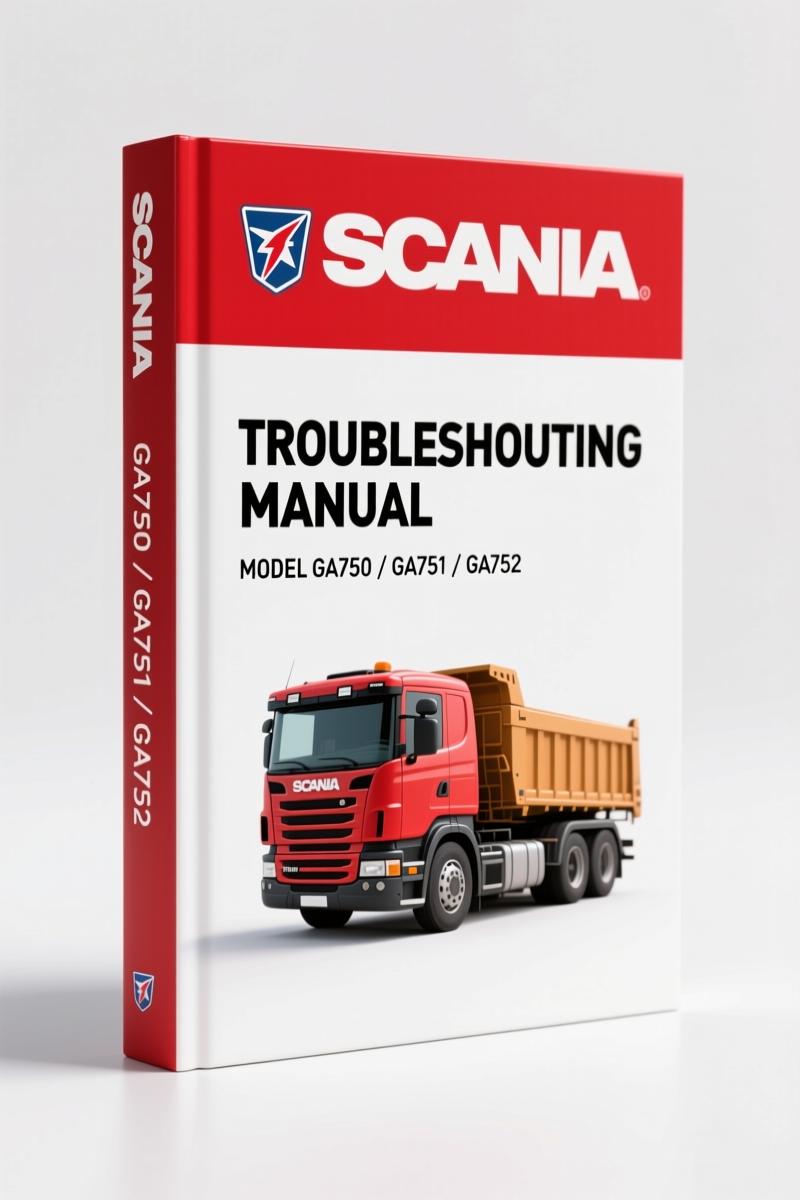
Scania GA750 GA751 GA752 GA851 GA852 1999 Troubleshooting Manual – OEM Specs
Original price was: $53.20.$40.00Current price is: $40.00.
Factory troubleshooting procedures for Scania GA750–GA852 Allison transmissions: fault codes, stalling speed test, basic pressure measurement. 51 pages.
Description
Scania GA750, GA751, GA752, GA851, GA852 1999 Troubleshooting Manual – OEM Factory Specs
If you’ve ever chased a transmission fault on a Scania GA750 or GA852 using a generic aftermarket guide, you know the drill — wrong test pressures, missing fault codes, and a truck sitting on the lift too long. That’s why this 1999 Troubleshooting Manual matters. It’s the factory document Scania issued for the GA750, GA751, GA752, GA851, and GA852 gearboxes (Allison World Transmission MD and HD variants). 51 pages of diagnostic procedures written for the mechanic who needs to decide: fix it on the truck or pull it for a core. No fluff, no reprints — just the original OEM PDF.
I’ve been turning wrenches 28 years. When I troubleshoot an Allison-based Scania, I don’t grab a Chilton. I grab this. Because the ‘Quick reference of fault codes’ starting on page 8 gives you the code, the symptom, and the probable cause in a table that matches what the MODE/PERF buttons flash. You don’t guess. You read the blink and go.
General Troubleshooting: Where Diagnostics Start
The manual opens with a general procedure that forces you to ask one question: can this be fixed without pulling the gearbox? If the answer is no, it tells you to call your Allison dealer before going further. That’s real-world advice from engineers who know when a diag turns into a core swap. Section one covers visual checks, fluid condition, and basic electrical verifications — the kind of steps beginners skip because they want to jump to fault codes. Don’t skip them.
Quick Reference of Fault Codes: Page 8
Fault codes are stored in the TCM and displayed via the MODE/PERF buttons on the shift pad. Page 8 through page 45 lists every code Scania programmed for these boxes. Each code gets a one-line description and a reference to the deeper test procedure. I’ve used this page to diagnose a speed sensor dropout in fifteen minutes — a job that would have taken an hour with a third-party scan tool that doesn’t know Scania’s specific thresholds. If you work on these trucks regularly, memorize how to enter code recall mode. The manual tells you exactly how.
Stalling Speed Test: Procedure on Page 46
The stall test confirms converter clutch lockup and internal clutch pack condition. Page 46 outlines the safety precautions: chock wheels, set parking brake, run engine to operating temperature. The spec for stall speed is model-specific. Without the factory number, you can’t tell if 1800 RPM is a slipping clutch or a converter that’s already grenaded. This manual gives you the range. Scania GA750-GA852 Automatic Gearbox Service Manual has the rebuild specs when you find something wrong, but for quick diagnosis, this troubleshooting guide is faster.
Measuring Basic Pressure: Page 48 Specs
Basic pressure tests use a 0–300 psi gauge connected to the main pressure tap. Page 48 tells you the exact pressure range at idle and at stall for each model. If the pressure is low, you’re looking at a bad pump or a stuck regulator valve — not a clean solenoid. This is where aftermarket manuals lie. They give you a generic “100–150 psi” for every Allison. Scania’s spec is tighter. Use the wrong number and you’ll replace parts that aren’t broken. The manual also warns: never exceed the maximum pressure when test-driving. That’s a safety callout that belongs on your shop wall.
3 Diagnostic Tests That Save You a Core Exchange
Three tests in this manual — stall speed, basic pressure, and fault code recall — can tell you if the gearbox comes out or stays in. I’ve seen shops swap a whole GA852 because of a bad wiring harness connector at the TCM. The troubleshooting tree on page 3 walks through that before you condemn the hard parts. Beginners: read the general section twice. It’s short, but it catches the stupid mistakes. And if you need to cross-reference with similar electrical faults, check out Scania 21218S380003 1997 Troubleshooting Manual – OEM Diagnostic Guide for older harness designs.
OEM vs Aftermarket: Why 1999 Still Matters
This manual was published in 1999 and applies to vehicles built from December 1997 (chassis no. 123759 onward). That means it matches the exact Allison MD/HD control logic used in those trucks. Aftermarket troubleshooting guides often reprint generic Allison material that leaves out Scania-specific connector pinouts and fault code definitions. I’ve seen a tech replace an ECU based on a non-factory code list — the actual fault was a low battery voltage at the controller. This manual catches that because the factory wrote the code definition specifically for Scania’s electrical architecture. For more advanced electrical diagnostics, see Scania 16:07-00 2002 Troubleshooting Manual – OEM Electrical Diagnostic Guide.
Compared to a Manual Transmission, the automatic’s hydraulics are sealed and self-contained. That makes troubleshooting simpler in some ways — fewer moving parts to check — but harder when a valve body sticks. The fault code system on these Scania boxes is the same family used in later Allison World transmissions, so learning this manual sets you up for newer chassis too. Another good external reference is the general Manual Transmission page on Wikipedia for understanding the mechanical differences, but for this job, stick with the factory diagnostics.
FAQ – Scania GA750-GA852 Troubleshooting Manual
- Does this manual cover the GA750 only?
- It covers all five models: GA750, GA751, GA752, GA851, and GA852 with Allison MD or HD internals.
- What torque values are listed for reassembly?
- This is a troubleshooting manual — it does not list bolt torque specs for disassembly or reassembly. It focuses on diagnostic pressures (basic pressure, stall speed) and fault code interpretation. For rebuild torque values, you need the corresponding service manual, which differs from this troubleshooting guide. The pressure ranges on page 48 are factory specific and critical for correct diagnosis, but torque figures are not included.
- Can I use this for a 1998 Scania with the same gearbox?
- Yes, as long as the chassis number is 123759 or higher. The manual applies to vehicles built from December 1997. Earlier chassis may have different TCM software or wiring.
- Is this the same as the Allison factory service manual?
- No. This is a Scania-specific troubleshooting supplement designed for rapid diagnosis. Allison’s own manual covers rebuild procedures and theory of operation. Scania tailored the fault code references and test specs to their truck’s wiring and shift programming. For a complete library, pair this with the Allison factory manual.
Bottom line: if you’re pulling your hair out over an intermittent fault in a GA750 or a GA852 that won’t shift into sixth, stop relying on forum threads. Get the factory document that sixty-hour mechanic paid for when it was new. It’s 51 pages, it’s OEM, and it’s the only thing I let my junior techs touch when they’re working on these boxes. Access the Factory Manual and start diagnosing the right way.
Additional information
| Brand | Scania |
|---|---|
| Language | English |
3 reviews for Scania GA750 GA751 GA752 GA851 GA852 1999 Troubleshooting Manual – OEM Specs
You may also like…
-
Sale!
Scania 4-series 1999 Service Manual – Factory ABS/TC Diagnostics
Original price was: $70.00.$50.00Current price is: $50.00. -
Sale!
Scania CP12 1995 Diagnostics Manual – Bosch ABS/TC System
Original price was: $73.50.$50.00Current price is: $50.00. -
Sale!
Scania Comfort Shift, CS 1997 Service Manual – 67 Pages
Original price was: $69.50.$50.00Current price is: $50.00. -
Sale!
Scania T cab 11-16 Litre 2002 Repair Manual – Fuel System Specs
Original price was: $72.60.$60.00Current price is: $60.00.
Related products
-
Sale!

1992 Electrical Schematic – International 1000/3000/4000/2554 OEM Wiring Diagrams (132 Pages)
Original price was: $26.40.$20.00Current price is: $20.00. -
Sale!

2011 Parts Catalog – International 7400 SFA 6X6 – 1886 Pages of OEM Part Numbers
Original price was: $32.00.$25.00Current price is: $25.00. -
Sale!
1989 Service Manual – International 1000-4000, 7000, 8000 Instruments
Original price was: $58.80.$40.00Current price is: $40.00. -
Sale!

Technical Manual – International 6.0L Power Stroke FICM Diagnostics
Original price was: $29.80.$20.00Current price is: $20.00.
pro_mechanic –
Five stars! The scan is high-quality and well indexed. It helped me to repair my Scania GA750 transmission. Saved my repair job! Thank you.
gearhead88 –
This is exactly what I needed. Quick access after payment. Contains precise bolt torque specs for Scania. I will recommend this shop to others.
workshop_guy –
This is exactly what I needed. Quick access after checkout. Contains clear bolt torque specs for Scania. I will recommend this shop to others.