
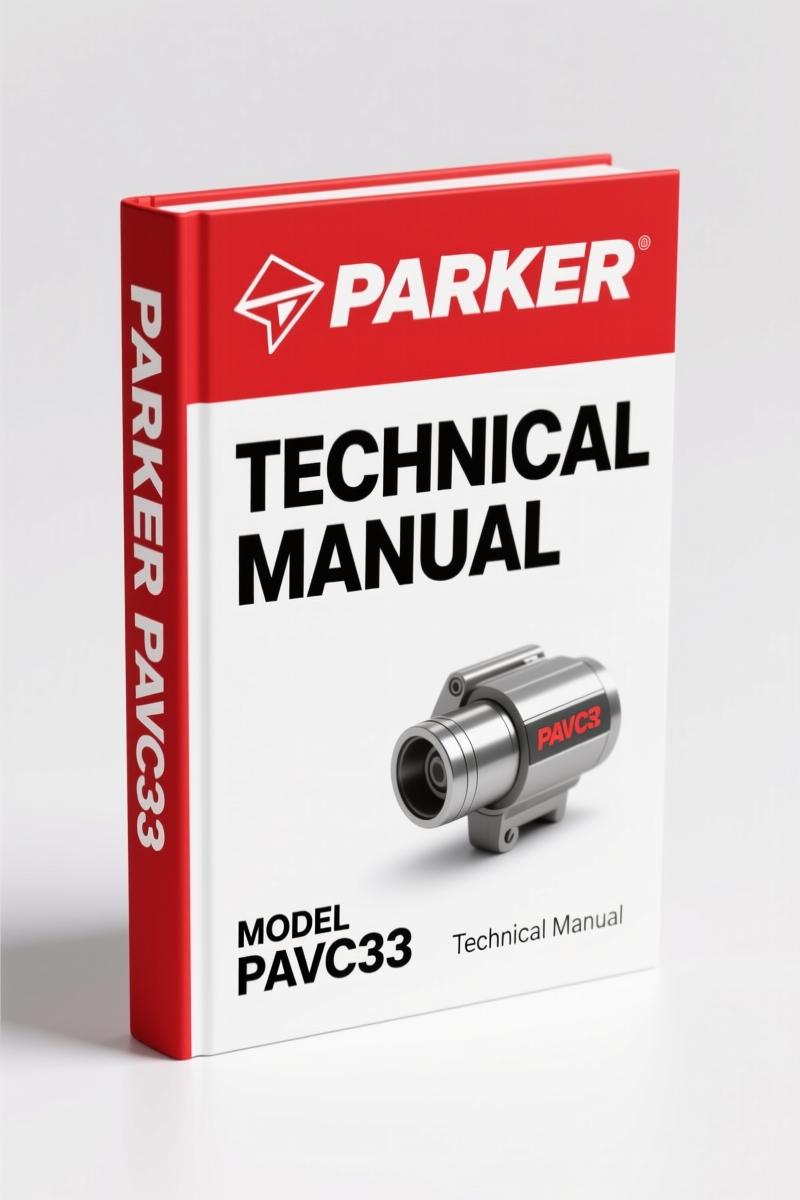
Parker PAVC33, PAVC65, PAVC100, PAVC38 Technical Manual – 46 Pages
Original price was: $33.50.$25.00Current price is: $25.00.
Factory-certified Parker PAVC33, PAVC65, PAVC100, PAVC38 Technical Manual. 46 pages of OEM specs, torque data, and performance charts.
Description
Parker PAVC33, PAVC65, PAVC100, PAVC38 Technical Manual
If you’ve ever torn down a Parker piston pump without the factory spec sheet, you know the drill. You guess at the control spring setting. You hope the swash plate angle matches what you measured. Then you button it up and cross your fingers. That’s not how hydraulic systems stay together. This Parker PAVC33, PAVC65, PAVC100, PAVC38 Technical Manual puts all the numbers on the bench where they belong. 46 pages of OEM data straight from Parker Hannifin’s Hydraulic Pump Division. No aftermarket rehash.
Quick Reference Data: What You Get on Page 2
Page 2 of this manual lays out the Quick Reference Data Chart. You get displacement in cm³/rev and in³/rev, pump delivery in LPM and GPM at both 1200 and 1800 RPM, approximate noise levels in dB(A) at four pressure points, and input power at 1800 RPM and 207 bar. For the PAVC33, you’re looking at 33 cm³/rev (2.0 in³/rev), 59.0 LPM (15.6 GPM) at 1800 RPM, and 21.3 kW (28.5 hp) input. That chart saves you from pulling out a calculator or trusting a third-party table.
Control Options: Pressure Compensation vs Load Sensing
The manual catalogs all control options. Pressure compensation, load sensing, power (torque) limiting, power and load sensing combined, remote pressure compensation, adjustable maximum volume stop, electrohydraulic flow and pressure, and low pressure standby. Each control type has its own performance curves and adjustment procedures. If you’re swapping a control on a PAVC65 in the field, you need the factory spring rates and porting diagrams. This manual has them.
3 Systems Covered in the Installation Section
The Installation Information section covers three critical areas: mounting, plumbing, and startup. Mounting orientation affects case drain pressure. Plumbing size and routing determine cavitation risk. Startup procedure with airbleed prevents dry running. The manual specifies minimum inlet pressure and maximum case drain line pressure (7 bar / 100 PSI). Ignore those numbers and you’ll replace shaft seals inside a year.
Why OEM Documentation Beats Aftermarket Copies
Aftermarket pump manuals often omit the fine-print notes. Page 2 of this Parker manual includes a warning that noise levels vary with mounting, tank style, and plant layout. The values are for guidance only. That footnote keeps you from blaming the pump when your installation is the problem. The factory also includes the full part number system for ordering information – something reprints typically truncate. If you need a replacement port plate for a PAVC38, the ordering index gives you the correct code.
Technical Data: PAVC33/38 vs PAVC65 vs PAVC100
Each model gets its own subsection with technical data, ordering information, performance curves, and dimensional drawings. The PAVC33 and PAVC38 share a page because their displacement difference is small (33 vs 38 cm³/rev) and both top out at 3000 RPM and 207 bar continuous. The PAVC65 bumps displacement to 65 cm³/rev and input power to 43.1 kW. The PAVC100 hits 100 cm³/rev but max speed drops to 2600 RPM. Dimensional data includes mounting flange patterns, shaft extensions, and port locations. That’s critical when you’re retrofitting into an existing Manual Transmission housing or a custom power unit.
Page 4 gives you the general description and a cutaway diagram of the pump. You can see the swash plate, servo piston, rotating barrel, and the hydrodynamic bearing. The manual states “All control is achieved by the proper positioning of the swash plate.” If you don’t understand that linkage, you’ll chase control issues for hours.
What You Won’t Find in a DIY Video
Online tutorials skip the torque specs. They don’t tell you the port plate bolt pattern or the servo piston preload. This manual includes the full Pressure Compensation and Load Sensing adjustment ranges. It also covers the Electrohydraulic Flow and Pressure control option – a closed-loop system that requires specific electrical setup. If you’re working on a mobile equipment hydraulic system and the pump integrates with the vehicle’s Manual Transmission pump drive, you need these factory wiring and porting details.
- Does this manual include torque values for mounting bolts?
- It provides dimensional data, but the torque specs for mounting bolts are not listed in the OCR excerpt. Check the Installation Information section for recommended bolt grades and tightening sequences.
- Can I use this manual for the PAVC100 with the thru-shaft option?
- Yes. The PAVC100 section covers the thru-shaft (through-drive) feature, including dimensional data for the rear shaft extension. The manual notes that only the PAVC100 offers this option.
- What’s the difference between the PAVC65 and PAVC38 performance curves?
- The PAVC65 has nearly double the displacement – 65 vs 38 cm³/rev – and requires about 43 kW input at 1800 RPM and 207 bar, versus 24.6 kW for the PAVC38. The noise levels also run a few dB higher.
- Is the Quick Reference Data Chart on page 2 for all four models?
- Yes, it’s a single table covering PAVC33, PAVC38, PAVC65, and PAVC100 with the same parameters for each.
You’ve got the pump open on the bench. The old control cartridge is worn, and the customer needs the machine back tomorrow. Don’t guess at the settings. Access the Factory Manual now – 46 pages of OEM data that keeps you from making a comeback repair.
Related Manuals
Additional information
| Brand | Parker |
|---|---|
| Language | English |
2 reviews for Parker PAVC33, PAVC65, PAVC100, PAVC38 Technical Manual – 46 Pages
You may also like…
-
Sale!
Acura NSX 1991 Service Manual – 1420 Pages OEM
Original price was: $102.05.$65.00Current price is: $65.00. -
Sale!

CDS 705C, 706C, 708C 1981 Parts Catalog – OEM Forklift Specs
Original price was: $61.60.$40.00Current price is: $40.00. -
Sale!
Parker PAVC33, PAVC36, PAVC65, PAVC100 2011 Technical Manual | AutoFix Global
Original price was: $36.00.$25.00Current price is: $25.00. -
Sale!
Parker Truck Hydraulics Training Manual – 50 Pages OEM Documentation
Original price was: $39.25.$25.00Current price is: $25.00.
Related products
-
Sale!

International 1000-3000 Series Operators Manual – 132 Pages of OEM Specs
Original price was: $14.40.$10.99Current price is: $10.99. -
Sale!

Technical Manual – International DT 530 & HT 530 (118 Pages)
Original price was: $37.00.$25.00Current price is: $25.00. -
Sale!

1989 Service Manual – International 2000-8000 Electrical Systems
Original price was: $72.00.$50.00Current price is: $50.00. -
Sale!
2004 Acura TSX Wiring Diagram – 73-Page Factory Electrical Schematics
Original price was: $15.88.$9.99Current price is: $9.99.
Richard G. –
This is exactly what I was looking for. The scan is high-quality and well indexed. A must-have for any Parker PAVC33, DIYer doing maintenance. Great value for money.
Michael T. –
This is exactly what I needed. The scan is high-quality and well indexed. It helped me to rebuild my Parker PAVC33, electrical system. Highly recommended for mechanics.