
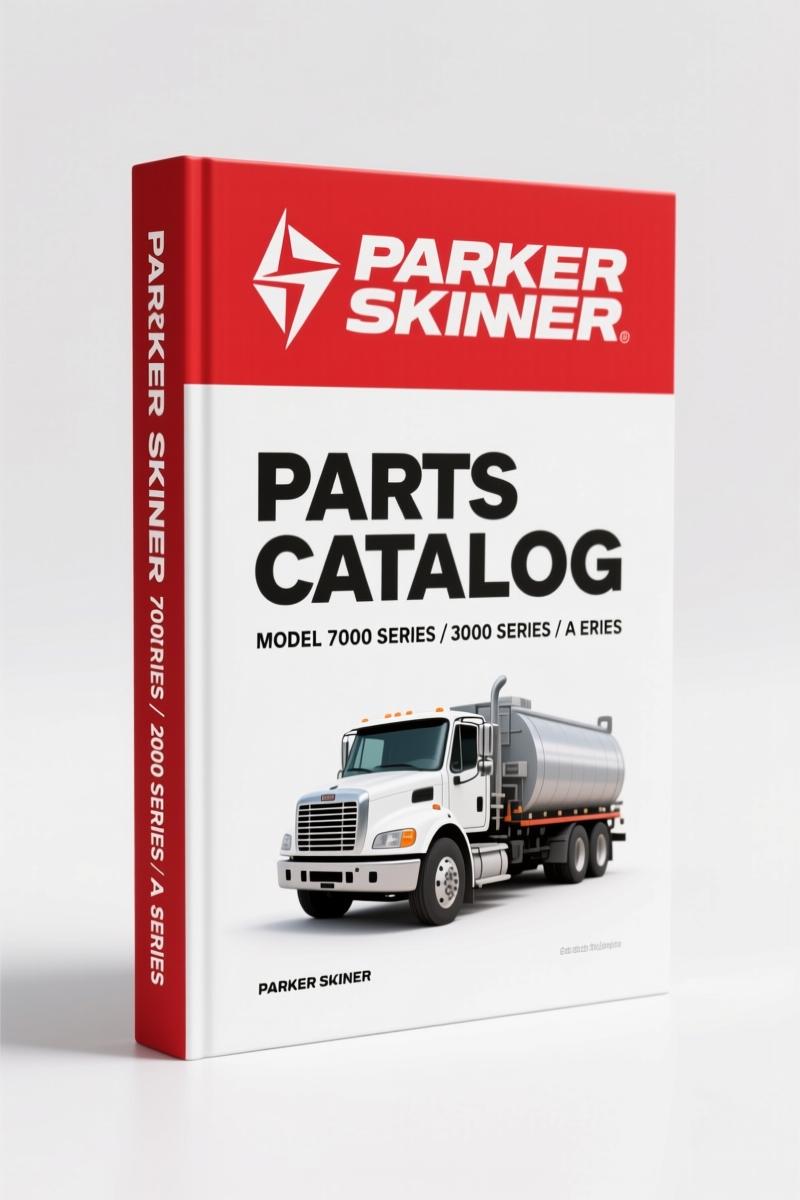
Parker Skinner 7000 Series 3000 Series 1997 Parts Catalog – 148 Pages
Original price was: $53.60.$40.00Current price is: $40.00.
OEM parts catalog covering Parker Skinner 7000, 3000, A, B, C series solenoid valves. 148 pages of exploded views and part numbers.
Description
Parker Skinner 7000 Series, 3000 Series, A Series, B Series, C Series 1997 Parts Catalog
I’ve been turning wrenches and rebuilding pneumatic systems long enough to know that the second you order a solenoid valve by “looks about right,” you’ll be staring at the wrong port size or a coil that burns out in 20 minutes. That’s why OEM documentation isn’t optional – it’s the difference between a system that runs for 10,000 cycles and one that leaks on startup. This 1997 Parker Skinner parts catalog is the real thing: factory-original part numbers, exploded views, coil specs, and ordering codes for the 7000 Series, 3000 Series, A Series, B Series, and C Series valves. No third-party transcription errors, no fuzzy reprints – just the PDF that Parker shipped to their distributors.
3 Valve Families Under One Cover
You’ve got Skinner’s core solenoid valve lines here. The 7000 Series and 3000 Series get the most pages – two-way, three-way, four-way configurations with general-purpose, high-pressure, hot water/steam, and manual-reset variants. Then the A Series, B Series, and C Series round out the lineup with their own dedicated spec sections. Need a replacement coil for a 7000 Series valve? Flip to pages 12-13 where the coil information is laid out with voltage ratings, wattage, and enclosure type. The same treatment appears on page 13 for 3000 Series coils. Every part number is listed with the exact factory code – you don’t guess, you order.
Why OEM Part Numbers Matter – Skinner Valve History
Skinner started building solenoid valves in 1949 and has been vertically integrated ever since. That means Parker Skinner machines their own plungers, winds their own coils, and grinds their own seat seals. An aftermarket “equivalent” might look the same from 10 feet away, but the Cv curve, seal material, and response time will be off. This catalog gives you the OEM reference you need to cross-reference to Parker’s current part numbering system. The Automotive Industry Overview link might help you understand where these valves end up – on air brakes, transmission shift solenoids, and fuel-handling skids – but only the factory catalog tells you which o-ring groove depth is correct.
What This 148-Page Catalog Contains
Let me walk you through the sections so you know exactly what you’re getting. It starts with a Condensed Valve Listing (pages 2-8) – a quick reference that lists every valve model in the book with basic specs. Then Valve Ordering Information (pages 9-13) breaks down how to build a part number for each series: 7000 on page 9, 3000 on page 10, A/B/C/MB/V9 on page 10, Intrinsically Safe on page 11, and K-Series on page 11. The Two-Way Valve Specifications section runs from page 15 to 48, covering 7000 Series valves (general-purpose, hot water/steam, high-pressure, anti-water hammer, manual reset, remote pressure) followed by 3000, B, C, LB27, and A2. Three-way valves start on page 50 and go to 77, four-way from page 79 to 88, and specialty valves (hydraulic, dry operator, dual-flow, proportional, intrinsically safe) from page 90 to 127. You want the coil enclosure for an intrinsically safe valve? That’s on pages 106-111. Every page is scan-quality original – no reprints, no generic diagrams.
Using the Condensed Valve Listing
When you’re under a machine and need to identify a valve quickly, the condensed listing on pages 2-8 is your lifeline. It shows the series, port size, voltage, and pressure rating in a compact table. Cross-check the body casting number with the catalog, and you’ll know within 30 seconds whether you need a standard 7000 Series or a high-pressure variant. Don’t waste time measuring threads – the catalog gives you the port thread spec and the exact orifice diameter. That’s how you avoid ordering a ⅛” NPT valve when your manifold is ¼” NPT.
Common Mistakes When Replacing Solenoid Valves
The biggest screw-up I see: swapping a valve body without checking the coil voltage. This catalog lists all coil options – 12 VDC, 24 VAC, 120 VAC, 240 VAC – with part numbers for each. Another mistake: using the wrong seal material for the media. The Hot Water and Steam Valve subsection (pages 29-33) clearly specifies which models use EPDM vs. Viton. If you skip that and drop a general-purpose valve into a steam line, you’ll be replacing it in a week. This Internal Combustion Engine article has nothing to do with Skinner valves, but the point is – engines and valves both demand exact specs. Don’t guess.
- Does this catalog include torque values for the valve body mounting bolts?
- No. This is a parts catalog, not a service manual. It focuses on part numbers, ordering codes, and coil specifications. For torque values, you need the corresponding service manual.
- Can I use this catalog to identify a valve that has no visible part number?
- If the valve body still has a casting number or a tag, you can match it to the condensed listing. The catalog shows all model numbers and their features (port size, voltage, pressure range). Without a legible tag, you’ll need to measure port threads, coil resistance, and body dimensions – then cross-reference against the spec tables. It’s workable, but the catalog was designed for valve identification from a known part number.
- What coils are covered for the 3000 Series?
- Page 13 gives the full 3000 Series coil information, including AC and DC voltages, wattage ratings, and enclosure types (general-purpose, explosion-proof, molded).
- Is this catalog still accurate for current Parker Skinner production?
- Parker has updated some part numbers since 1997, but the physical dimensions, port configurations, and performance specs for the 7000, 3000, A, B, and C Series haven’t changed. Use this for legacy cross-referencing, then confirm with Parker’s current Parker Skinner catalog if you’re ordering a new valve. The 1997 catalog is the original reference – it’s what the factory used when those valves were built.
If you maintain any equipment with Skinner solenoids – air compressors, hydraulic presses, irrigation controllers, or industrial automation – this catalog belongs on your hard drive. It’s 148 pages of factory-correct data that stops the cycle of wrong parts and returns. Don’t trust a photocopy or a scanned reprint; get the original OEM PDF from AutoRepairManuals. Access the Factory Manual and keep it with your other reference material. It’s cheaper than one wrong solenoid, and it saves you the phone call to a tech support line that doesn’t have the 1997 files anymore.
Related Manuals
Additional information
| Brand | Parker Skinner |
|---|---|
| Language | English |
4 reviews for Parker Skinner 7000 Series 3000 Series 1997 Parts Catalog – 148 Pages
You may also like…
-
Sale!
Acura NSX 1991 Service Manual – 1420 Pages OEM
Original price was: $102.05.$65.00Current price is: $65.00. -
Sale!

Acura Integra 1998 Service Manual – 1891 Pages Factory OEM Documentation
Original price was: $31.75.$25.00Current price is: $25.00. -
Sale!

CDS 705C, 706C, 708C 1981 Parts Catalog – OEM Forklift Specs
Original price was: $61.60.$40.00Current price is: $40.00. -
Sale!
2004 Acura TSX Wiring Diagram – 73-Page Factory Electrical Schematics
Original price was: $15.88.$9.99Current price is: $9.99.
Related products
-
Sale!

2005 Parts Catalog – International NGD 3.0 L Engine (77 pages)
Original price was: $44.70.$30.00Current price is: $30.00. -
Sale!

Service Manual – International HS 2.8L Engine – 130 Pages of Factory Specs
Original price was: $56.40.$40.00Current price is: $40.00. -
Sale!

1991 Operators Manual – International Truck OEM Specs (108 Pages)
Original price was: $13.63.$10.99Current price is: $10.99. -
Sale!

International 1000-3000 Series Operators Manual – 132 Pages of OEM Specs
Original price was: $14.40.$10.99Current price is: $10.99.
Michael T. –
This is exactly what I required. Immediate link after checkout process. A must-have for any Parker Skinner Skinner owner doing repairs. I will recommend this shop to others.
diy_master –
Highly recommended! The document is very clear. A must-have for any Parker Skinner Skinner owner doing repairs. Worth every penny.
John S. –
This is just what I was looking for. The PDF quality is excellent. Contains detailed wiring diagrams for Parker Skinner. Saves me a lot of dollars.
Charles W. –
Superb resource! The pages are clean and easy to navigate. Contains precise schematics for Parker Skinner. Saves me so much dollars.