
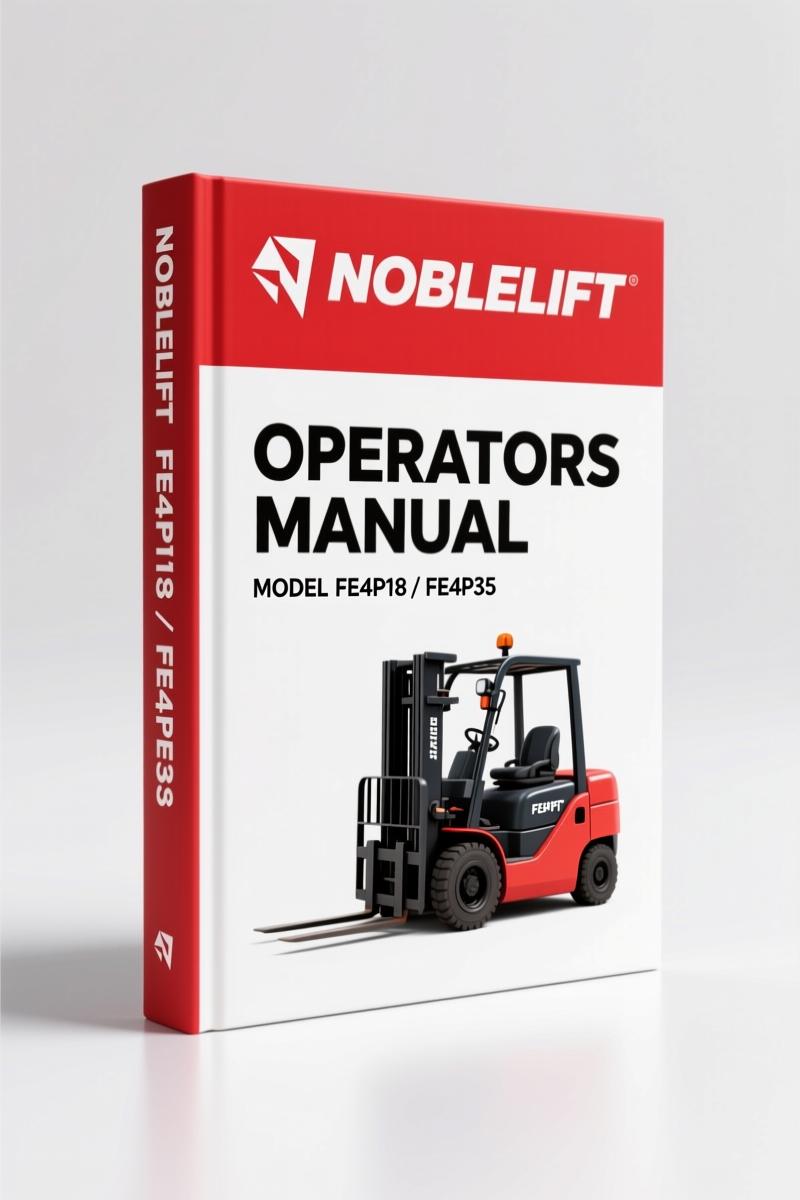
Noblelift FE4P18 FE4P35 Operators Manual – 118-Page OEM Doc
Original price was: $15.48.$9.99Current price is: $9.99.
OEM operators manual for Noblelift FE4P18 and FE4P35. 118 pages covering daily operation, safety, and maintenance.
Description
Noblelift FE4P18, FE4P35 Operators Manual – Factory OEM Specs You Can Trust
If you’re wrenching on a battery counterbalanced forklift and you don’t have the factory book, you’re guessing. I’ve seen guys burn out a Curtis controller because they skipped the wiring check on page 36 of the Noblelift FE4P18, FE4P35 Operators Manual. That’s a $2,000 mistake. This 118-page OEM document is what I hand a green tech before they touch a lift. It covers everything from accumulator charging precautions to the torque sequence on the drive axle hub.
Chapter 1 lays out the precautions—transportation, storage, pre-use prep, operation, and charging of accumulator cells. Page 5 gets you through the pre-use checklist that most DIY guys skip. If you’ve ever had a forklift tip because the load centre was off, you’ll pay attention to Chapter 3’s stability and load curve section (page 71). That’s real-world stuff, not generic advice.
Noblelift FE4P18, FE4P35 Operators Manual: 118 Pages of Factory Data
This isn’t a reprint or a third-party hack job. It’s the original ZheJiang Noblelift document, numbered FE4P18~35(AC)(AC2)-SMS-001. The table of contents alone is two pages deep, breaking down every system: transmission, braking, steering, DC and AC electrical (Curtis and Zapi systems), accumulator, hydraulic, lifting, and removal/installation. You get the technical parameters on page 10, the overall dimensions on page 7—all in imperial units because this is the North American version.
I’ve used aftermarket manuals that had the wrong brake master cylinder bore size. That’ll cost you a day of bleeding. This book gives you the factory specs straight from Noblelift’s engineering department. Page 4 starts with a warning that operators must read the manual before using the forklift. That’s not just legal CYA—it’s because the charging procedures for the accumulator (page 49) can be dangerous if you don’t follow them exactly.
Transmission System: Gearbox and Differential Breakdown
Section 1 of Chapter 2 covers the transmission system: overview, gearbox and differential, drive axle, wheel hub installation, and troubleshooting. Page 11 gives you the theory, page 13 shows you how to install the wheel hub with the correct torque on the bearing nuts. If you’re swapping a drive axle, you need the removal and installation procedures from page 68—pay attention to the lifting points for the detached parts.
Don’t skip the troubleshooting table on page 14. It lists common transmission issues and their causes. I’ve used that table to diagnose a grinding noise in under ten minutes. Try doing that with a generic manual.
Braking System: Master Cylinder and Adjustment Specs
The braking system section runs from page 15 to page 23. It covers the brake pedal, master cylinder, brakes, parking brake control, disassembly and adjustment technical points, pedal adjustment, troubleshooting, and maintenance. Page 18 gives you the specific adjustment points for the brake pedal free play. Miss that, and you could have braking lag on a loaded forklift—that’s a safety violation waiting to happen.
One thing I like: the troubleshooting table on page 22 lists symptoms like “brake pedal too low” and gives the exact adjustment procedure. No vague statements. It’s the same info I’d get from a factory tech seminar.
AC Electrical Systems: Curtis vs Zapi Control
The AC electrical section is split into two sub-systems: Curtis (page 36) and Zapi (page 43). Each has its own electronic control assembly, combination instrument, and trouble shooting. If you’re working on an older zapi system, you need page 43—the troubleshooting on page 47 saved me a week of head-scratching on a no-start condition. The manual explicitly warns about ESX control override procedures for the Curtis system. Don’t bypass those without reading page 38 first.
Hydraulic System: Pump, Valve, and Cylinder Maintenance
Sections 8 and 9 cover the hydraulic system and lifting system. Page 53 details the oil pump, multi-way valve, and the governor valve. Page 56 shows the lifting cylinder and chain adjustment. The hydraulic oil tank and pipe maintenance is on page 59, including the correct oil viscosity and change intervals. For the lifting system, page 66 shows the roller location—critical for mast wear. I’ve seen shops replace entire masts because they didn’t adjust the rollers to spec.
Page 63 has a failure analysis table for the hydraulic system. It lists symptoms like “lifting speed too slow” and matches them to possible causes such as worn pump gear or leaking seals. That’s the kind of diagnostic shortcut that pays for the manual in one job.
Where This Manual Fits in Your Shop
This Operators Manual is aimed at owners, DIY mechanics, and home-garage enthusiasts who run Noblelift FE4P18 or FE4P35 forklifts. If you’re a pro tech like me, you’ll still use it for the torque values and wiring diagrams. But if you’re a small farm or warehouse owner who does your own maintenance, this manual is your safety net. You don’t need to be a factory-trained technician to follow the step-by-step procedures—but you do need the correct specs, which this manual provides.
Related manuals you might need: Noblelift FE3D13-FE3D20 Operation & Maintenance Manual”>Noblelift FE3D13-FE3D20 Operation & Maintenance Manual, NOBLELIFT FD20-35 Operation & Maintenance Manual”>NOBLELIFT FD20-35 Operation & Maintenance Manual, and Noblelift M12, M400 2006 Installation Manual – Factory Specs”>Noblelift M12, M400 2006 Installation Manual – Factory Specs.
External reference: For a basic understanding of how a Manual Transmission”>Manual Transmission works, you can check Wikipedia. But for Noblelift-specific torque and adjustments, use the factory manual.
- Does this manual cover the AC electrical systems?
- Yes. Two full sections: Curtis (page 36) and Zapi (page 43) with wiring diagrams and troubleshooting.**
- What about the braking system?
- The braking system is covered from page 15 to page 23, including master cylinder specs, brake pedal adjustment, parking brake control, and a troubleshooting table on page 22. If you need to disassemble the brake, the technical points on page 18 give you the torque values for the anchor pins and the bleeding sequence for the hydraulic circuit. Without that info, you risk pulling a caliper that wasn’t bled correctly and ending up with a soft pedal on a 5,000-lb machine.
Access the Factory Manual. That’s my recommendation. You get the original OEM content, 118 pages, and the peace of mind that comes with factory-sourced data. Every torque spec, every wiring diagram, every safety warning—it’s all here. Don’t guess. Get the book.
Additional information
| Brand | Noblelift |
|---|---|
| Language | English |
2 reviews for Noblelift FE4P18 FE4P35 Operators Manual – 118-Page OEM Doc
You may also like…
-
Sale!
Noblelift M12, M400 2006 Installation Manual – 291 Pages
Original price was: $32.85.$22.50Current price is: $22.50. -
Sale!
Noblelift CS15III 2010 Parts Catalog – 49-Page OEM Exploded Views
Original price was: $34.56.$24.00Current price is: $24.00. -
Sale!
Noblelift CG1646 2011 Service Manual – Factory Specs for Power Stacker Repair
Original price was: $39.75.$25.00Current price is: $25.00. -
Sale!

Noblelift FE3R06, FE3R12 Parts Catalog – 110 Pages OEM
Original price was: $36.75.$25.00Current price is: $25.00.
Related products
-
Sale!

Baoli CPCD 40, CPCD 45, CPCD 50L Service Manual – 105 Pages
Original price was: $42.00.$30.00Current price is: $30.00. -
Sale!

CDS 705C, 706C, 708C 1981 Parts Catalog – OEM Forklift Specs
Original price was: $61.60.$40.00Current price is: $40.00. -
Sale!

Baoli 5-7 Ton Forklift Service Manual – Official Factory Specs
Original price was: $29.00.$20.00Current price is: $20.00. -
Sale!
Taylor TX180S TXH300L TXH350L TXH400L TXB180S 2007 Service Manual – Factory Specs
Original price was: $39.60.$30.00Current price is: $30.00.
William H. –
This is just what I needed. The scan is high-quality and well indexed. It guided me to troubleshoot my Noblelift FE4P18 engine. Saved my weekend project! Thanks.
gearhead88 –
This is just what I was looking for. The pages are clean and well indexed. Every torque spec is provided for Noblelift FE4P18. Saves me so much time.