
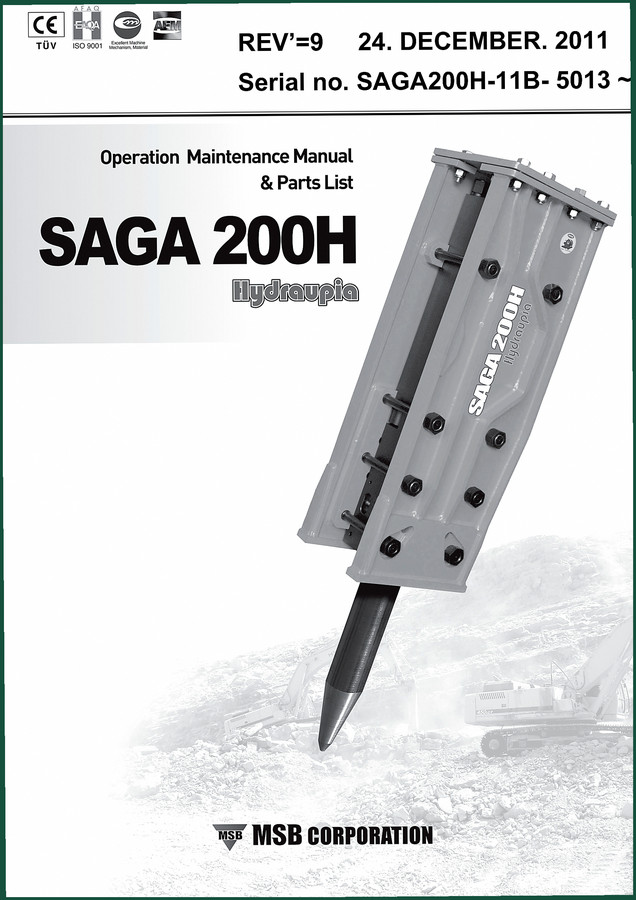
MSB SAGA 200H 2011 Service Manual – Factory Hydraulic Breaker Specs
Original price was: $38.40.$32.00Current price is: $32.00.
54-page OEM service manual for MSB SAGA 200H hydraulic breaker. Torque tables, hydraulic circuit diagrams, and wear limits from MSB Corporation.
Description
MSB SAGA 200H 2011 Service Manual – Factory OEM Specs for Hydraulic Breaker
If you are turning wrenches on an MSB SAGA 200H 2011 Service Manual breaker and you don’t have the factory service manual in front of you, you’re guessing. Guessing gets a breaker pulled down to nothing because the gas charge in the backhead was wrong or the side rods got torqued to spec from some third-party PDF. I have seen more than one breaker come into the shop with stripped threads and leaking accumulators because someone relied on a copied manual. This 54-page OEM document from MSB Corporation puts an end to that.
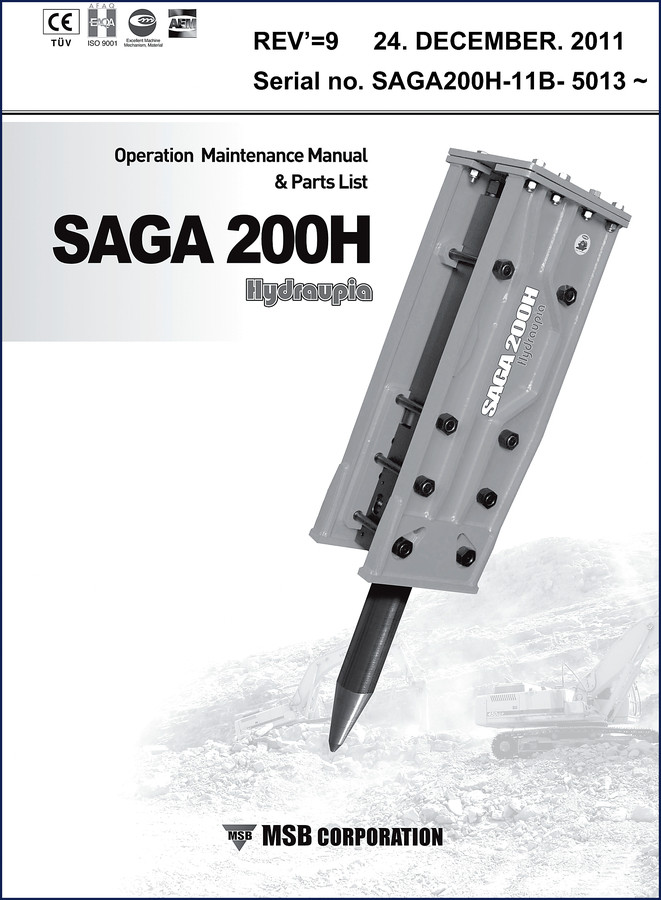
Specifications and Tool Dimensions: Page 4 Details
Page 4 of this manual gives you the general specifications for the open-type breaker. Working weight is 1680 kg (3703.7 lb), impact frequency ranges from 400 to 800 BPM, and operating pressure sits at 160–180 bar (2320–2610 psi). Relief pressure is set at 200–210 bar. Oil flow must be between 125 and 150 l/min. Tool diameter is 135 mm (5.31 in). These numbers are stamped from the factory, not guessed from a parts catalog. You will also find accumulator pressure at 60 bar (870 psi) and backhead nitrogen charge at 6 bar (87 psi). If you skip those numbers, you risk blowing seals or bending the tool. Page 1 shows the serial number range starting from SAGA200H-11B-5013, so verify your machine falls within that.
Torque Specs and Assembly Tolerances
Section 5-3 on page 30 lists the torques for every major fastener on this breaker. Side rods, bolts on the backhead, mounting plate hardware—each one has a specific value. Aftermarket manuals often combine torque values from different models, which leads to over-torquing and cracked castings. This OEM manual gives you the exact numbers MSB designed for. Do not use a generic hydraulic breaker torque chart. Section 5-4 also includes the required workshop tool list, so you know exactly what wrenches and gauges you need before starting any disassembly.
Does This Manual Cover All Hydraulic Systems?
Section 2-11 covers the hydraulic circuit, and Section 2-10 specifies hose and pipe dimensions (pressure line 25 mm, return line 25 mm, port PF 1/2). Section 6, the troubleshooting guide, walks you through oil leakage, no impact, irregular blows, and lack of blowing. Each fault has a factory diagnosis step—not a generic checklist. For example, if the breaker loses impact after running normally, Section 6-3 instructs you to check the accumulator precharge and the valve adjuster oil flow rates (Section 4-6). That level of detail saves hours of tear-down guessing.
Get the Right Operating Pressure: Section 2-9
Setting operating pressure wrong is the number one killer of hydraulic breakers. Section 2-9 gives the procedure for adjusting the pressure on the carrier’s hydraulic system to match the SAGA 200H spec. You need a flow meter and pressure gauge—listed in the workshop tool list. The manual tells you to start the carrier, run the breaker at idle, and adjust the relief valve until you see 160–180 bar at the hammer inlet. Do that with a third-party manual and you might get a generic range that doesn’t account for your specific carrier’s pump curve. MSB wrote this for the SAGA 200H on carriers from 18 to 25 tons.
Safety and Pre-Delivery Checks: Skip These at Your Own Risk
Section 7 is the safety information, and Section 4-1 covers precautions before delivery. Before you even mount the hammer on a carrier, this manual tells you to inspect the nitrogen gas charging in the backhead (Section 4-2) and in the accumulator (Section 4-3). Page 26 shows the wear limits for the tool and tool bushing—if the bushing ID exceeds spec, you replace it. Skipping these checks leads to blown seals and tool breakage. Section 4-4 covers side rod inspection and replacement; three pages of torque specs and wear limits are not optional.
Why OEM Documentation Beats Aftermarket for This Breaker
This is an original MSB Corporation manual published in 2011. It is not a reprint or a scan from a third-party. The 54 pages include the full parts list and exploded views—Section 1-5 shows the structure. Every torque value, wear limit, and pressure spec came from MSB’s engineering department. Aftermarket manuals for the SAGA 200H often omit the backhead nitrogen pressure (6 bar) or swap metric and imperial units. I have seen one that listed accumulator pressure in psi without converting correctly. Do not trust your equipment to someone else’s copy. If you also work on other equipment, check the White Outdoor LT-5 – 700 Series Rider Service Manual and Maruti MB308 Service Manual Procedures and Repair – Section: Section 8A Wiring D for other machines. And for a direct comparison, the HUSKIE Hydraulic Hammers Service Manual covers a similar product.
Understanding the breaker’s hydraulic circuit is different from working on a Manual Transmission, but the same care with torque specs applies. If you are also doing drivetrain work, the Manual Transmission manual is another resource.
Frequently Asked Questions
- Is this manual for the SAGA 200H only?
- Yes. This is specifically for the MSB SAGA 200H hydraulic breaker, serial numbers starting SAGA200H-11B-5013.
- What torque values are included in the manual?
- Section 5-3 on page 30 provides torque specifications for all major fasteners: side rod nuts, backhead bolts, mounting plate hardware, and tool retaining pins. Each value is listed in Nm and includes the thread size. The manual also gives wear limits for the tool bushing (page 26) and guidance on when to replace the tool itself. Using the correct torque prevents leaking at the backhead and keeps the side rods from stretching. Many aftermarket manuals omit these values or give a single number for all bolts—this one is bolt-specific. You also get the nitrogen charge pressures for both the backhead (6 bar) and accumulator (60 bar), which are critical for proper impact energy. If you ignore these, the breaker will either bounce off the work or drive the tool too deep. The workshop tool list in Section 5-4 tells you exactly what torque wrench range to use so you do not overtighten a 12-M27 bolt. This level of detail is why OEM matters.
Get this factory document on your bench before you touch a wrench on the SAGA 200H. Access the Factory Manual. It will pay for itself the first time you avoid a misdiagnosis or a stripped thread.
Additional information
| Brand | MSB |
|---|---|
| Language | English |
3 reviews for MSB SAGA 200H 2011 Service Manual – Factory Hydraulic Breaker Specs
You may also like…
-
Sale!

CDS 705C, 706C, 708C 1981 Parts Catalog – OEM Forklift Specs
Original price was: $61.60.$40.00Current price is: $40.00. -
Sale!
Acura NSX 1991 Service Manual – 1420 Pages OEM
Original price was: $102.05.$65.00Current price is: $65.00. -
Sale!

Acura Integra 1998 Service Manual – 1891 Pages Factory OEM Documentation
Original price was: $31.75.$25.00Current price is: $25.00. -
Sale!
2004 Acura TSX Wiring Diagram – 73-Page Factory Electrical Schematics
Original price was: $15.88.$9.99Current price is: $9.99.
Related products
-
Sale!

1991 Electrical Schematic – 112-Page OEM Wiring Diagram for International 1000-3000 Series
Original price was: $22.75.$17.50Current price is: $17.50. -
Sale!

2006 Service Manual – International DT 466E, 530E Diesel Engine
Original price was: $67.50.$50.00Current price is: $50.00. -
Sale!
1992 Electrical Schematic – OEM Wiring Diagrams for International 1000-3800
Original price was: $24.48.$18.00Current price is: $18.00. -
Sale!

Service Manual – International HS 2.8L Engine – 130 Pages of Factory Specs
Original price was: $56.40.$40.00Current price is: $40.00.
John S. –
Excellent OEM spec sheet. It is very easy to read on my phone without blur. Contains clear bolt torque specs for MSB. Saved my repair job! Thanks.
Thomas B. –
Superb resource! Quick access after checkout process. Every spec sheet is included for MSB SAGA. Saved my repair job! Thank you.
Michael T. –
Great factory service manual. The document is high resolution. Every torque spec is provided for MSB SAGA. I will definitely buy again.