
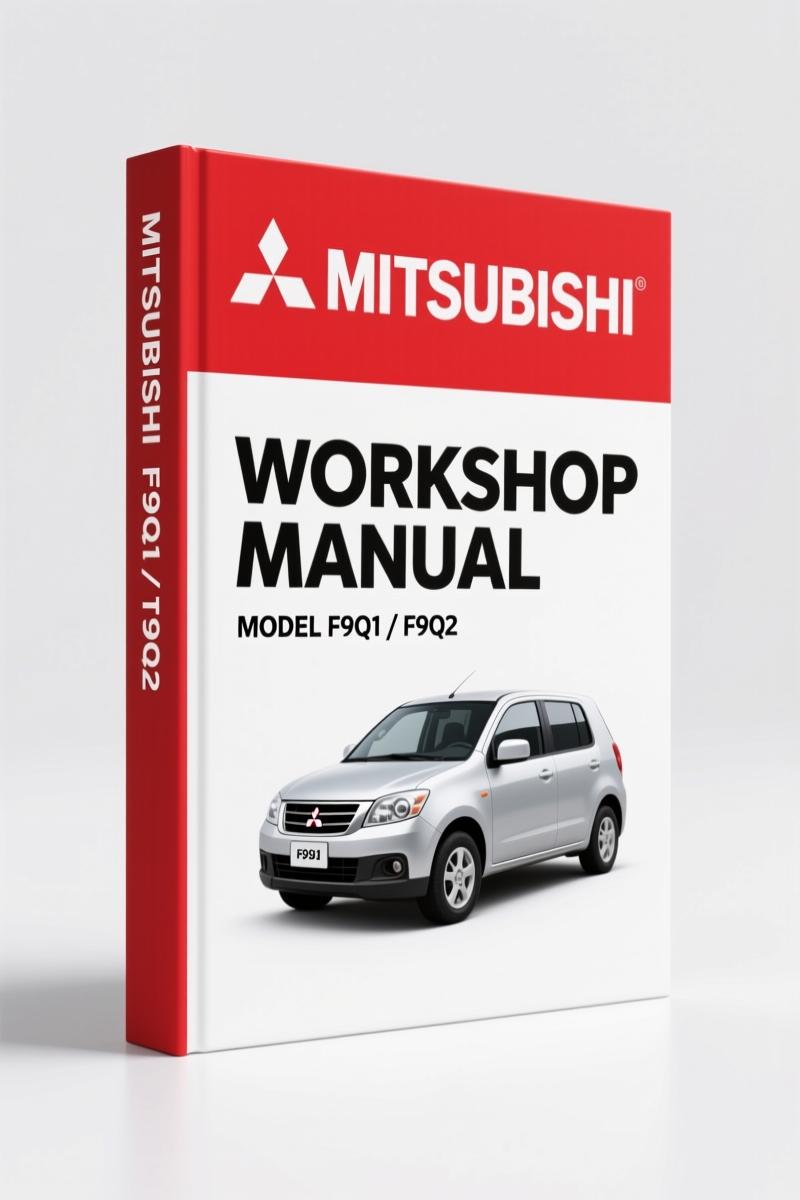
Mitsubishi F9Q1, F9Q2 2000 Workshop Manual – Factory Specs
Original price was: $24.60.$20.00Current price is: $20.00.
Factory-certified workshop manual for Mitsubishi F9Q1 and F9Q2 (2000). 42 pages of torque specs, valve data, and timing belt procedure. For professional engine work.
Description
Mitsubishi F9Q1, F9Q2 2000 Workshop Manual – OEM Factory Specs
If you have ever wasted half a Saturday trusting a third-party PDF that told you the timing belt tension was “snug” instead of giving you a frequency reading in Hz, you know why I do not trust aftermarket documentation. The Mitsubishi F9Q1, F9Q2 2000 Workshop Manual is a 42-page factory-issued document from Mitsubishi Motors Corporation. No guesswork, no generic illustrations that sort-of-fit three different engines. This is the same booklet the dealer tech had on his cart in 2000.
Timing Belt Replacement: Page 11A-4-1 Procedure
Most aftermarket guides skip the belt tension spec because it requires a frequency gauge. The factory procedure on page 11A-4-1 tells you to set the belt tension to 90 ± 15 Hz. That is the number. Not “tight enough” or “quarter turn past snug.” You measure it with a tension meter, you hit the range, you button it up. I have seen two F9Q engines lose their heads because a DIYer guessed the tension. The manual also includes the crankshaft pulley removal steps and special tool references. If you are planning a timing belt job, you need that page open on your bench.
Torque Specs: Why Factory Values Matter
The Especificaciones sobre los pares de apriete section on page 11A-1-2 lists every critical fastener – cylinder head bolts, injection pump, bearing caps. These are not suggestions. Mitsubishi engineers tested those numbers with the gasket material and bolt grade used in 2000. I have torqued enough heads to tell you that using a generic chart from a forum is a good way to measure a head gasket leak. Every spec in this manual is for the F9Q1 and F9Q2 specifically, not a “similar” engine. That alone saves you the cost of a replacement gasket set if you botch it.
Does This Manual Cover the Fuel Injection System?
Yes. Chapter 6 – Bomba de inyección e inyector de combustible – covers the high‑pressure injection pump and injectors. The F9Q uses a common‑rail direct injection system. The section includes removal, installation, and the vacuum hose routing (chapter 7). If you are cleaning injectors or replacing the pump, you need the exact fuel line torque values and the priming procedure. The manual also covers the oil separator and return tube (chapter 5), which many aftermarket guides combine into a vague “PCV system” drawing that does not match the Mitsubishi layout.
3 Reasons to Use the Original Factory Documentation
First, the service limits listed on page 11A-1-1 are per the official Mitsubishi manual. Things like piston protrusion (0.653–0.786 mm), valve stem diameter (6.98–6.99 mm), and camshaft end play (0.05–0.13 mm) come with a manufacturing tolerance. Second, the special tool list (chapter 2) tells you exactly which Mitsubishi tool number you need – not a generic “use a puller.” Third, the wiring and vacuum diagrams are original. Aftermarket reprints often re‑draw them and introduce errors. If you rely on a reprint, you might chase a vac line that does not exist.
Understand the Cylinder Head Section Before You Pull It
Chapter 11 (Culata de cilindros) and chapter 14 (Bloque de cilindros) walk through head removal, valve service, and piston/block inspection. The manual includes the valve seat angle (45°), valve spring free height (45.8 mm), and the head tightening sequence. Do not skip the section on piston protrusion measurement – it tells you whether the block needs decking. I have seen guys install a new head gasket on a warped deck because they did not check flatness (spec is 0.05 mm). That aftermarket manual that said “check for warpage” without giving the number? Worthless. This one gives the number.
Most aftermarket sources treat the F9Q1 and F9Q2 as identical. They are not. The F9Q2 has a different injection pump timing and a different vacuum pump setup. The factory manual separates the two variants in the specifications table. If you buy a generic “Mitsubishi 1.9” manual, you will get the wrong injection timing and wonder why it smokes. Save the headache.
A word on language: this manual is in Spanish, as issued by Mitsubishi for the Latin American market. The technical data (torque values, tolerances, diagrams) are universal, and most procedures rely on part numbers and illustrations. If you need a wiring diagram for the chassis, pair this manual with the Mitsubishi Wiring Diagram for the vehicle harness. If you work on the transmission, grab the Mitsubishi R4AW2-1, R4AW2-3, R4AW2-7 1996 Workshop Manual for the automatic, or the Mitsubishi 4D68 1996 Workshop Manual – 70 Pages of OEM Specs for a diesel engine reference. For a broader view of why OEM documentation matters across the industry, check Automotive Industry Overview and the Automotive Industry Overview comparison.
FAQ – Common Questions About This Manual
- What years and engines does this manual cover?
- This is the 2000 edition for the Mitsubishi F9Q1 and F9Q2 diesel engines only. It does not cover later variants like the F9Q3 or the 1.9 DI-D with different injection systems. If your engine code ends with 1 or 2 and your vehicle is around 2000, you are in the right place.
- Is the manual in English?
- No. The text is in Spanish. The illustrations, torque tables, and measurements are universal. If you need an English translation, you will have to interpret the technical terms, but most numbers are easy to read.
- How many pages and what is included?
- 42 pages. Covers general info, service specifications, torque specs, special tools, timing belt, injection pump, cylinder head, piston, block, oil pump, vacuum pump, and more. See the full table of contents on the product page.
- Does it include wiring diagrams?
- This engine manual does not include chassis wiring diagrams. It focuses on the engine mechanical and injection system. For vehicle electrical schematics, you need a separate wiring manual.
If you are serious about rebuilding or servicing a Mitsubishi F9Q engine without wasting time on bad data, Access the Factory Manual from AutoRepairManuals today. Keep it on your tablet or print it for the bench. Your torque wrench will thank you.
Additional information
| Brand | Mitsubishi |
|---|---|
| Language | English |
2 reviews for Mitsubishi F9Q1, F9Q2 2000 Workshop Manual – Factory Specs
You may also like…
-
Sale!

Mitsubishi FB16KT, FB18KT, FB20KT Service Manual – 300-Page Factory Specs
Original price was: $86.45.$65.00Current price is: $65.00. -
Sale!

Mitsubishi FB16NT, FB18NT, FB20NT Service Manual – 272 Pages of OEM Forklift Specs
Original price was: $79.30.$65.00Current price is: $65.00. -
Sale!

Mitsubishi FB16N, FB18N, FB20CN Service Manual – 219 Pages of Factory Forklift Diagnostics
Original price was: $89.05.$65.00Current price is: $65.00.
Related products
-
Sale!

1992 Electrical Schematic – International 1000/3000/4000/2554 OEM Wiring Diagrams (132 Pages)
Original price was: $26.40.$20.00Current price is: $20.00. -
Sale!

Service Manual – International HS 2.8L Engine – 130 Pages of Factory Specs
Original price was: $56.40.$40.00Current price is: $40.00. -
Sale!

2005 Parts Catalog – International NGD 3.0 L Engine (77 pages)
Original price was: $44.70.$30.00Current price is: $30.00. -
Sale!

Acura Integra 1998 Service Manual – 1891 Pages Factory OEM Documentation
Original price was: $31.75.$25.00Current price is: $25.00.
diy_master –
Excellent quality! It is very easy to read on my tablet without losing quality. Contains precise wiring diagrams for Mitsubishi. Saves me a lot of time.
David K. –
Highly recommended! Immediate link after payment. It assisted me to rebuild my Mitsubishi F9Q1, electrical system. I will definitely buy again.