
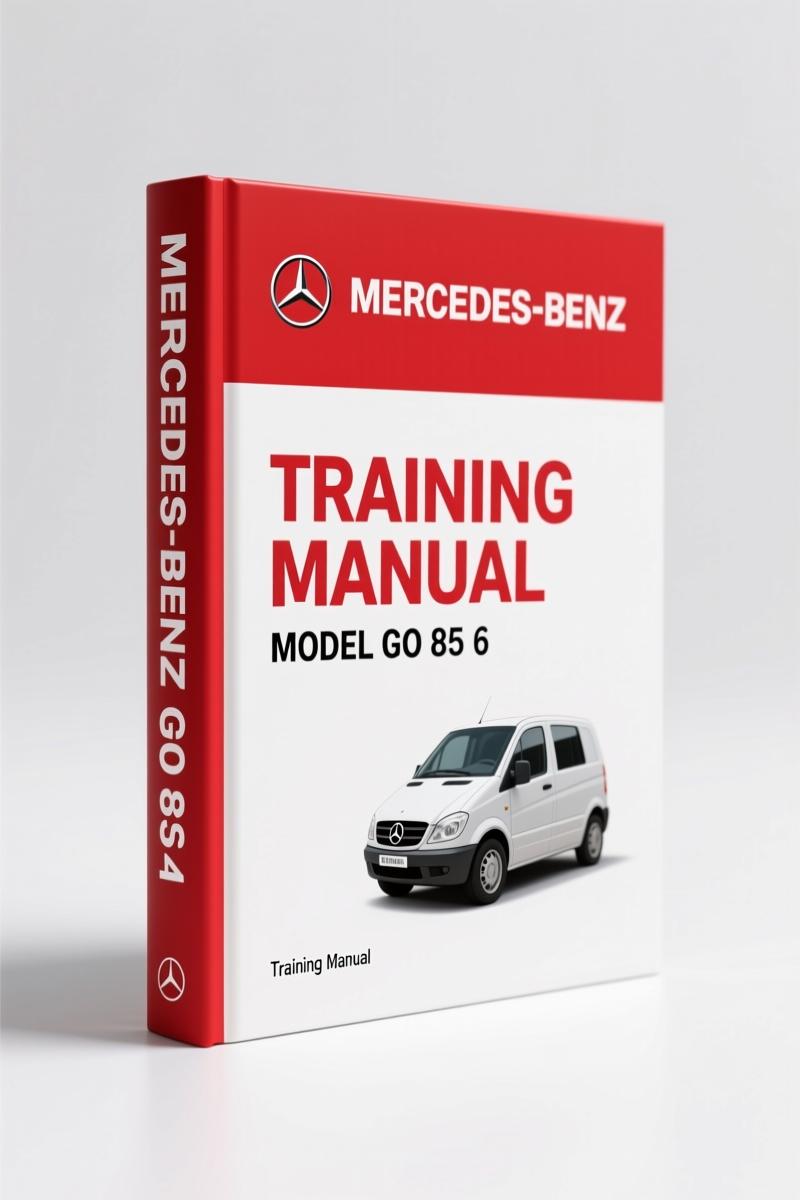
Mercedes-benz GO 60/6, GO 85/6, GO 110/6 Training Manual – Factory Transmission Specs
Original price was: $35.50.$25.00Current price is: $25.00.
Factory training manual for Mercedes-benz GO 60/6, GO 85/6, and GO 110/6 transmissions. 40 pages of torque tables, disassembly procedures, and synchronizer wear values.
Description
Mercedes-benz GO 60/6, GO 85/6, GO 110/6 Training Manual
If you’re tearing into a Mercedes-benz GO 60/6, GO 85/6, GO 110/6 Training Manual without the factory training material, you’re working blind. I’ve seen too many guys guess on syncro wear limits or skip the lube circuit check because they thought they knew better. That costs you a rebuilt unit and a pissed-off customer. This is not a aftermarket reprint — it’s a 40-page OEM training booklet used by Mercedes-Benz Global Training to teach technicians how these transmissions go together and come apart. It covers the G60-6, G85-6, and incorporates information for the GO 110/6 as well. Every spec comes from the factory floor, not from some guy typing into a forum at 2 AM.
Page 3 starts with Datos técnicos – G60-6 / G85-6, a technical data section that lists max input torque (in Nm and lb-ft), reduction ratios, installation length, weight without oil, and oil capacity in both liters and US pints. You get both metric and Imperial numbers, so you don’t have to convert. The manual also tells you whether the transmission uses a direct mechanical shift system or a remote mechanical system — critical knowledge when you’re diagnosing a sloppy shifter.
What’s Inside This 40-Page Training Manual?
The table of contents reads like a shop checklist. It starts with the G60/6 transmission: commercial designation, dimensions, lubrication process, and then jumps straight into disassembly. Page 9 covers Desmontar el selector y conector de marchas de la caja de cambios — removing the shift selector and connector. Page 11 tells you how to Desarmar la caja de cambios G60/6 (disassemble the transmission). Each section includes exploded views so you see exactly where every snap ring, synchro ring, and bearing lives. The same structure repeats for the G85-6 starting on page 19. You also get expanded views of the shift forks and selectors on pages 13 and 24. This is not a quick-reference card; it’s the step-by-step procedure that factory techs follow.
GO 60/6, GO 85/6, and GO 110/6: Transmission Differences
The training manual spends most of its pages on the G60-6 and G85-6, but the GO 110/6 shares the same architecture. Pay attention to the gear specifics: the primary shaft on the G60-6 has a 6th gear, while the G85-6 has a 5th gear on that shaft. The secondary shaft breakdowns are separated by gear pairs — 1st and 2nd on page 28, 3rd and 4th on page 29, and 5th/6th on page 30 depending on the model. If you’re mixing parts between these transmissions, you need the correct shaft layout. The manual lays it out with actual part numbers and orientation.
Torque Specs and Wear Limits – Pages 31 and 35
Page 31 lists Valores de desgaste de los anillos sincronizadores — synchro ring wear limits. This is the kind of number that separates a transmission that shifts butter-smooth from one that grinds after 500 miles. You don’t eyeball a synchro ring; you measure it against factory max wear. Page 32 gives primary shaft adjustment values, and page 35 is the Tabla de pares de apriete — the torque table. Every bolt, nut, and fastener has a specified torque in Nm and lb-ft. Use it. Do not trust your calibrated elbow.
Why OEM Documentation Beats Aftermarket
I’ll put it blunt: I don’t care how many YouTube videos a guy has watched — if a bearing clearance spec is wrong, you’re buying new gears. Aftermarket manuals often copy from earlier editions or lose conversion factors. This training manual came from Mercedes-Benz Global Training. It was written for classrooms, not for resale. The exploded views are scanned from factory drawings, not redrawn by an illustrator who’s never held a wrench. You get the same material that dealer techs study before they touch a GO series transmission. That’s the difference between a rebuild that lasts and a warranty claim.
Who Should Buy This Manual?
If you own a shop that services Mercedes-Benz medium-duty trucks, or if you’re a DIYer who bought a surplus GO 85/6 for a project, this manual will save you from making assumptions. The lubrication process on page 8 explains the oil circuit — where the oil goes and how it cools. Skip that step and you might starve the main shaft bearings. The disassembly sequence for the G60/6 on page 11 tells you which bolts to remove first and which to leave until later. That’s the kind of detail that prevents broken castings and stripped threads. Beginners should read the entire manual before cracking a case open; experienced techs will use it for torque specs and wear limits.
Verifying Source Authenticity
This is a direct scan of the official Mercedes-Benz Global Training document, 40 pages, in Spanish. I know some of you read Spanish, some don’t — the diagrams and numbers are universal. You can cross-reference the exploded views with actual parts. There are no watermarks, no third-party logos. If you want to check the authenticity, look at the page header: “Global Training – The finest automotive learning.” That’s Mercedes’ own training arm. Aftermarket dealers cannot legally reproduce this. When you access the factory manual, you get the real deal.
Frequently Asked Questions
- Does this manual include the GO 110/6 transmission data?
- Yes. The manual covers the GO 60/6, GO 85/6, and GO 110/6, though the main technical sections focus on the first two. The GO 110/6 shares the same design principles and many of the same parts. You’ll need to apply the same disassembly, shimming, and torque procedures. The wear limits and torque table apply across all three models where components are common.
- What language is the manual in?
- Spanish.
You need the right specs to keep a GO series transmission on the road. Whether you’re swapping a synchro ring or torquing the rear bearing carrier, the factory numbers are on these pages. Stop chasing aftermarket reprints. Access the Factory Manual Manual Transmission for the Mercedes-Benz GO 60/6, GO 85/6, and GO 110/6 and get back to work with real data.
- Mercedes-Benz Truck 2010 Training Manual – Air Brake & Suspension
- Mercedes-benz 327 2004 Training Manual – Brake Assist System
- Mercedes-benz 212 2009 Training Manual – Factory Systems Guide
External reference: Manual Transmission on Wikipedia provides general background on manual transmission operation, but for factory specs, stick with this training manual.
Additional information
| Brand | Mercedes-benz |
|---|---|
| Language | English |
4 reviews for Mercedes-benz GO 60/6, GO 85/6, GO 110/6 Training Manual – Factory Transmission Specs
You may also like…
-
Sale!
Mercedes-benz 380 SL Service Manual – 327 Pages OEM Specs
Original price was: $69.30.$45.00Current price is: $45.00. -
Sale!
Mercedes-Benz Actros Training Manual – Factory FR Module & Vehicle Control
Original price was: $84.70.$55.00Current price is: $55.00. -
Sale!
Mercedes-benz Actros 2011 Service Manual – 165 Pages
Original price was: $70.65.$45.00Current price is: $45.00. -
Sale!
Mercedes-benz 201 Wiring Diagram – 290-Page Factory Electrical Data
Original price was: $63.00.$45.00Current price is: $45.00.
Related products
-
Sale!

2011 Parts Catalog – International Truck OE Parts Documentation (1786 Pages)
Original price was: $34.50.$25.00Current price is: $25.00. -
Sale!

2006 Service Manual – International DT 466E, 530E Diesel Engine
Original price was: $67.50.$50.00Current price is: $50.00. -
Sale!

1993 Operators Manual – International Bus 1000-3000 OEM Specs
Original price was: $12.30.$7.99Current price is: $7.99. -
Sale!
1991 Electrical Schematic – 112-Page OEM Wiring Diagram for International 1000-3000 Series
Original price was: $22.75.$17.50Current price is: $17.50.
gearhead88 –
Great buy! The document quality is excellent. A must-have for any Mercedes-benz GO owner doing repairs. Great value for money.
Michael T. –
Excellent quality! Instant access after payment. A must-have for any Mercedes-benz GO DIYer doing repairs. Great value for money.
David K. –
Great OEM spec sheet. Instant access after checkout. Every torque spec is included for Mercedes-benz GO. I will definitely buy again.
workshop_guy –
This is exactly what I needed. The file quality is excellent. Contains detailed bolt torque specs for Mercedes-benz. Saved my weekend project! Thanks.