
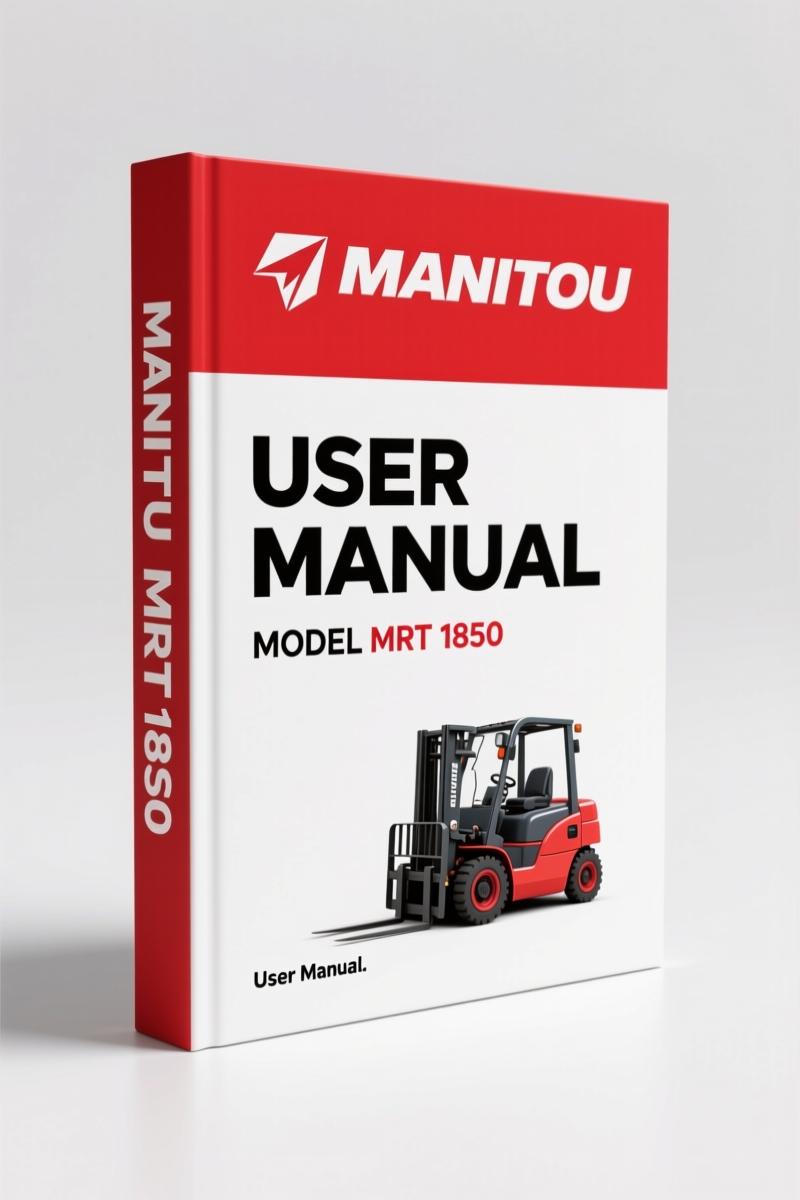
Manitou MRT 2150, MRT 1850, MRT 2540 2005 User Manual – Factory Specs
Original price was: $11.99.$9.99Current price is: $9.99.
281-page OEM user manual for Manitou MRT 1850, 2150, 2540 M Series (2005). Includes load charts, fluid capacities, safety system adjustments.
Description
Manitou MRT 2150, MRT 1850, MRT 2540 2005 User Manual
You get a machine in your bay with a load chart taped to the window that looks like it was photocopied three times and then run over. Or worse, the operator says he “guesses” the boom extension is fine because he always ran it that way. That’s how you bend a frame or drop a load. The Manitou MRT 2150, MRT 1850, MRT 2540 2005 User Manual is what keeps that from happening. I’ve torqued enough head bolts to know that skipping the factory spec is how you end up with a comebacks. This manual is the same deal – you need the real numbers, not a translation of a translation.
This is a factory OEM user manual, not some aftermarket rehash that leaves out the safety system adjustment table. It covers three models: MRT 1850, MRT 2150, MRT 2540 – all M Series, build year 2005. 281 pages, trilingual (French, English, Spanish), reference 648315. You open it and you get the identification plate layout (page 1), the load charts for every approved attachment, and the full procedure for setting the GSS anti-rollback system. You want to run a basket or a winch? The manual tells you which safety position to use and which chart to follow. No guesswork.
Load Charts: Page 5-1 to Page 5-27
This is where most DIY owners and even some shop guys screw up. They think a 2,500 kg capacity means you can lift 2,500 kg at any angle. The manual dedicates a full section – page 5-1 through 5-27 – to load capacity diagrams for every configuration. Forks, personnel baskets (ORH 2.25/4 m), winches (3T, 5T), and pallet forks. Each one has a different chart. The factory even lists the GSS safety position (A, B, C, D, E, O/P) that must be set for each attachment. Page 3 of the manual shows the machine identification plate with the max loads per axle and total weight. That’s the data you need to verify before you start modifying anything.
You want to use a basket rated for 365 kg? The manual says position B for the ORH 2.25/4 m basket. Miss that and the safety system won’t work. The manual also tells you the maximum load at the front and rear axle – 16,100 kg front, 8,500 kg rear for the MRT 2150 as an example. These numbers are metric, so have your conversion chart handy if you work in pounds. But the spec is the spec.
Safety System Adjustment – GSS Anti-Rollback
The GSS system is not something you can ignore or bypass. The user manual includes the adjustment parameters on page 5-1 (continued through to page 5-27 for the crane operation manual). It lists the exact positions for each attachment type. If you wire a new attachment without resetting the GSS, the machine may not detect an overload correctly. I’ve seen a machine tip because someone swapped forks for a winch and left the safety on the fork setting. This manual shows you the correct position – it’s a table, not a recommendation. Treat it like torque specs – non-negotiable.
Daily Checks and Recommended Lubricants
The manual includes a maintenance schedule for daily and periodic checks. It’s not a repair manual, so you won’t find engine overhaul steps. But it does list fluid capacities, grease points, and filter change intervals. If you’re working on the transmission, get the factory spec for the oil type. Don’t trust a generic hydraulic fluid that says “suitable for most applications.” The manual doesn’t list a torque spec for drain plugs, but it does tell you where the dipsticks are and what level to maintain. Use it as the baseline before you dig deeper into the Manual Transmission internals or the engine. For actual overhaul procedures, pair this user manual with the Manitou MRT 2150 Parts Catalog to get part numbers and torque specs for the drive train.
Who Needs This Manual?
Home garage enthusiasts who own a Manitou MRT 1850, 2150, or 2540 and need to know the safe operating limits. Beginners who think they can run a telescopic handler without reading the load chart. And shop owners who want to keep their operators from bending booms. If you’re doing any work that involves swapping attachments or adjusting the safety system, you need this manual open on the machine’s seat. The factory also released companion documents for basket operation – check the MANITOU MRT M Series Baskets Use Manual 2004 and MANITOU MRT M Series Baskets User Manual 2004 for dedicated personnel lifting procedures.
Source Authenticity – OEM vs Aftermarket
I don’t trust aftermarket documentation for anything involving safety systems or load capacities. A third-party PDF that says “compatible with” is not worth the pixels. This manual comes straight from Manitou’s factory – reference 648315, dated June 2005. The identification plate data, the safety system settings, the load charts – all verified by the manufacturer. If you’re reading a copy that someone scanned and left out the fold-out charts, you’re missing critical info. AutoRepairManuals stocks only OEM prints. No reprints, no generic versions.
Page 1 gives you the full machine identification layout – chassis number, serial number, year of manufacture, empty weight, axle loads. That’s the starting point for any repair or modification. Without it, you’re operating blind. The manual also includes the dealer contact page so you can source genuine parts if needed.
7 Systems Covered (But Not All Are Repair Procedures)
This is a user manual, so it covers operation, not teardown. But it does cover: safety system (GSS), load charts, daily checks, lubrication points, controls layout, towing capacities, and transport instructions. For engine or transmission repair, you’ll need the service manual. But for daily use – the stuff that prevents breakdowns – this is the document to have. The Manual Transmission section in the user manual is only about operation and fluid checks; the deep repair is elsewhere. That’s fine – you need both.
- Does this manual include torque values for head bolts?
- No. This is a user manual, not a service manual. It covers load charts, safety system adjustments, daily checks, and lubrication. For torque specs, get the factory service manual. The user manual does list hydraulic pressures on some models, but not engine fasteners.
- What languages are in this 281-page manual?
- French, English, and Spanish. The same content repeats in each language. The load charts are universal – they use metric units and diagrams. The safety tables are identical across all three sections.
- Can I use this manual for the MRT 2540 even though the cover says MRT 1850-2150-2540?
- Yes. The manual covers all three models. Each model has its own load ratings and identification plate data. The GSS adjustment table includes positions for all models. Page 1 shows the identification plate for the MRT 2150 as an example, but the same structure applies to the others.
- Does the manual include the orange ORH basket instructions?
- Yes. The load chart section (pages 5-1 to 5-27) includes diagrams for the ORH 2.25/4 m basket with capacities of 365 kg and 1,000 kg. The GSS position is listed as B for that attachment. There is also a separate crane operation section from page 5-1 to 5-135 in the crane manual, but this user manual covers the basket operation.
Access the Factory Manual. Stop relying on faded photocopies or forum posts. The load chart in your cab may be wrong. The safety system adjustment might have been changed. Get the original 2005 factory user manual for your Manitou MRT 1850, 2150, or 2540 and run the machine the way it was designed to run. It’s 281 pages of data you can trust. No fluff, no reprints – just the OEM document.
Additional information
| Brand | Manitou |
|---|---|
| Language | English |
3 reviews for Manitou MRT 2150, MRT 1850, MRT 2540 2005 User Manual – Factory Specs
You may also like…
-
Sale!
Manitou MT5519 Service Manual – 86 Pages of Factory Torque Specs
Original price was: $92.30.$65.00Current price is: $65.00. -
Sale!
Manitou MT6642XT, MT8044XT, MT10044XT, MT10055XT, MT12042XT Service Manual 114 Pages
Original price was: $87.10.$65.00Current price is: $65.00. -
Sale!
Manitou MRT 1432-1850 MS 2006 Repair Manual – 1948 Pages of Factory Specs
Original price was: $89.60.$70.00Current price is: $70.00. -
Sale!
Manitou MT6034T Service Manual – 102 Pages OEM Factory Specs
Original price was: $101.40.$65.00Current price is: $65.00.
Related products
-
Sale!

2011 Parts Catalog – International Truck OE Parts Documentation (1786 Pages)
Original price was: $34.50.$25.00Current price is: $25.00. -
Sale!

Acura Integra 1998 Service Manual – 1891 Pages Factory OEM Documentation
Original price was: $31.75.$25.00Current price is: $25.00. -
Sale!

1996 Operators Manual – International 1000-4000 Series (246 pages)
Original price was: $15.28.$9.99Current price is: $9.99. -
Sale!

2011 Parts Catalog – International 7400 SFA 6X6 – 1886 Pages of OEM Part Numbers
Original price was: $32.00.$25.00Current price is: $25.00.
diy_master –
Superb resource! Instant access after checkout. It guided me to repair my Manitou MRT electrical system. Saved my weekend project! Thanks.
pro_mechanic –
Great buy! Immediate link after checkout process. Every wiring layout is provided for Manitou MRT. I will definitely buy again.
Charles W. –
Superb resource! The pages are clean and easy to navigate. Contains clear bolt torque specs for Manitou. Saves me hundreds of money.