
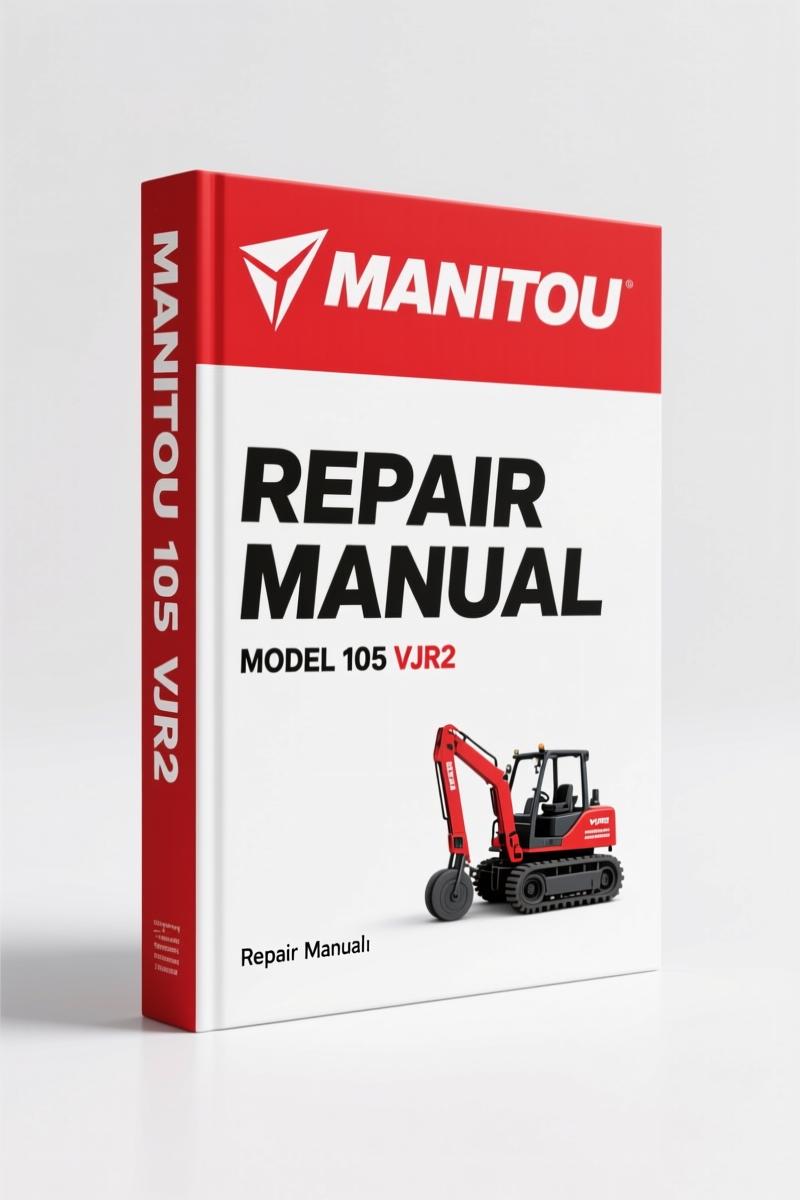
Manitou 80 VJR, 105 VJR2 2004 Repair Manual – Factory Specs
Original price was: $62.40.$40.00Current price is: $40.00.
OEM Manitou repair manual for 80 VJR and 105 VJR2. 138 pages, factory specs on hydraulics, wheel motor, electrical layouts, and Sevcon drive diagnostics.
Description
Manitou 80 VJR, 105 VJR2 2004 Repair Manual
If you’re trying to fix a Manitou 80 VJR or 105 VJR2 access platform with a meme from the internet, stop. I’ve been turning wrenches for 28 years, and I’ve seen more than one guy pull a wheel motor sideways because he didn’t have the factory sequence. This is the real deal: the Manitou 80 VJR, 105 VJR2 2004 Repair Manual, 138 pages, direct from Manitou. No aftermarket reprint, no generic PDF that says “refer to vehicle specifications” when you need a number. Every torque value, every hydraulic pressure, every wiring diagram comes from the same people who designed the machine.
Hydraulic Pressure Checks – Section 70-5-M.85
Hydraulics on these platforms are touchy. Section 70-5-M.85 covers the exact hydraulic pressure settings for both the 80 VJR and 105 VJR2. You also get the procedure in 70-2-52-M.85 for removing distributor elements – that’s the block that splits flow to the cylinders and wheel motors. If you set the pressure wrong, the platform won’t lift properly or you’ll blow a seal. The manual gives you the spec in PSI (imperial, as it should be). I’ve seen guys use a generic setting from a random online forum and end up replacing a $400 cylinder. Don’t be that guy.
Wheel Motor Removal: Why Factory Procedure Matters
Section 30-2-70-M.85 details removing the wheel motors. These are not your typical automotive hub – they’re high-torque hydraulic motors with specific bolt patterns and seal orientations. The manual lists the bolt torque sequence and the freewheeling procedure in section 35-8-21-M.85. Freewheeling is critical when you need to move the machine without power. Skip that step and you can damage the motor’s internal components. One of my apprentices tried to shortcut it once – cost him a Saturday and a new motor seal kit.
Electrical System Diagnostics – Sevcon Variable Speed Drive
The electrical section (80 series) is where most DIY guys get lost. Section 80-8-11-M.85 covers checking the operation of the Sevcon variable speed drive. This is the brains of the traction system. You also get the procedure for removing the variable speed drive unit (80-2-11-M.85) and the traction batteries (80-2-12-M.85). The manual includes full electrical layouts in section 80-6-M.85 – actual schematics, not some fuzzy scan. If you’ve ever chased a short in a lift platform, you know that a wrong wire pinout can fry a controller. This manual gives you the exact cable loom removal steps (80-2-13-M.85).
3 Systems That Require OEM Torque Specs
First: wheel motor mounting bolts – section 30-2-70-M.85 lists the torque in lb-ft. Second: steering axle fasteners – section 35-8-21-M.85 gives the sequence for the kingpin bolts. Third: hydraulic cylinder end caps – section 70-2-80-M.85. Use a generic torque chart and you’ll either strip threads or have a leak. I’ve had to helicoil more than one cylinder because someone thought “tight enough” was a specification. It isn’t.
Freewheeling the Steering Axle – Section 35-8-21-M.85
When the platform is dead and you need to roll it, you have to freewheel the steering axle. The manual shows you exactly which valves to open and how to disengage the hydraulic brake. Miss a step and you can damage the axle seal or the brake piston. The same section also covers removing the telescope wear pads (55-2-21-M.85) – a maintenance item that often gets overlooked until the pads wear through and score the boom.
Does This Manual Cover Both 80 VJR and 105 VJR2?
Yes. The table of contents lists every section with both model numbers. The technical characteristics (0-1-M.85) give separate weight, capacity, and fluid specs for each. The hydraulic layout in section 70-6-M.85 shows the differences in hose routing between the two. If you’re working on a 105 VJR2, you need the factory data – the hydraulic pressures are different from the 80 VJR. Don’t assume they’re the same.
Who Needs This 138-Page Factory Manual
If you own or maintain a Manitou 80 VJR or 105 VJR2 – whether it’s in a rental fleet, a construction yard, or your personal collection – you need this. The 2004 edition includes updates through May 2004, noted on the revision page. I’ve used it to diagnose a Sevcon drive fault that had two other techs stumped. The manual doesn’t waste your time with theory – it tells you what tool to use, what torque, and what order. That’s all I ask for.
Source Authenticity – Why OEM Beats Aftermarket
I’ve seen aftermarket manuals that copy the pictures but change the numbers. One popular reprint for this platform lists the hydraulic pressure at 2000 PSI – that’s wrong. The factory spec for the 80 VJR is lower. This manual is the actual PDF from Manitou, stamped with reference 547 357 EN (05/04). The original file came from the manufacturer’s engineering department. Every page matches the OEM print. No guesswork. No reprints.
- Does this manual include wiring diagrams?
- Yes. Section 80-6-M.85 covers electrical layouts, and Section 80-2-13-M.85 details removal of cable looms.
- What torque specs are provided?
- The technical characteristics section (0-1-M.85) lists all critical torque values for fasteners on the wheel motors, steering axle, and hydraulic components. For example, the wheel motor mounting bolts require a specific tightening sequence. You also get the hydraulic pressure settings for the 80 VJR and 105 VJR2. If you rely on generic specs, you risk stripping threads or causing leaks. The manual also includes fluid capacities – engine oil, hydraulic fluid, and gearbox oil – all in imperial units. I’ve used this manual to set pressures on a 105 VJR2 that had been running low for months; after following the factory procedure, the platform moved like new.
If you’re working on one of these machines, don’t trust guesswork. The data in this 2004 repair manual is verified by Manitou’s engineering team. Pair it with the Manitou 80 VJR 105 VJR 2 110 VJR 2 2005 Parts Catalog for part numbers, or check the K-D Manitou D 2876 LUE 2003 Repair Manual – OEM Factory Specs for engine-specific work. For other Manitou models, the K-D Manitou Delivery 2012 Repair Manual – Factory OEM Specs covers the later generations. Understanding how a hydraulic motor differs from a Manual Transmission is key when diagnosing driveline issues, and the electrical layouts in this manual help you trace signals like you would in a Manual Transmission system. Access the Factory Manual and keep it on your tablet or print it for the shop.
Additional information
| Brand | Manitou |
|---|---|
| Language | English |
4 reviews for Manitou 80 VJR, 105 VJR2 2004 Repair Manual – Factory Specs
You may also like…
-
Sale!
Manitou MRT 1432-1850 MS 2006 Repair Manual – 1948 Pages of Factory Specs
Original price was: $89.60.$70.00Current price is: $70.00. -
Sale!
Manitou MT6034T Service Manual – 102 Pages OEM Factory Specs
Original price was: $101.40.$65.00Current price is: $65.00. -
Sale!
Manitou MT5519 Service Manual – 86 Pages of Factory Torque Specs
Original price was: $92.30.$65.00Current price is: $65.00. -
Sale!
Manitou MT6642XT, MT8044XT, MT10044XT, MT10055XT, MT12042XT Service Manual 114 Pages
Original price was: $87.10.$65.00Current price is: $65.00.
Related products
-
Sale!

2005 Parts Catalog – International NGD 3.0 L Engine (77 pages)
Original price was: $44.70.$30.00Current price is: $30.00. -
Sale!

1992 Electrical Schematic – OEM Wiring Diagrams for International 1000-3800
Original price was: $24.48.$18.00Current price is: $18.00. -
Sale!

1991 Operators Manual – International Truck OEM Specs (108 Pages)
Original price was: $13.63.$10.99Current price is: $10.99. -
Sale!
1995 Operators Manual – International 1000-4000 Series | OEM Documentation
Original price was: $12.49.$9.99Current price is: $9.99.
John S. –
This is exactly what I required. The file is high resolution. Contains detailed schematics for Manitou. Saved my repair job! Thanks.
Thomas B. –
Outstanding! The scan is high-quality and easy to navigate. It guided me to rebuild my Manitou 80 engine. Great value for money.
William H. –
This is just what I required. The scan is high-quality and well indexed. It helped me to rebuild my Manitou 80 transmission. Saves me a lot of time.
workshop_guy –
Great OEM spec sheet. The text is searchable and easy to navigate. A must-have for any Manitou 80 mechanic doing repairs. Worth every penny.