
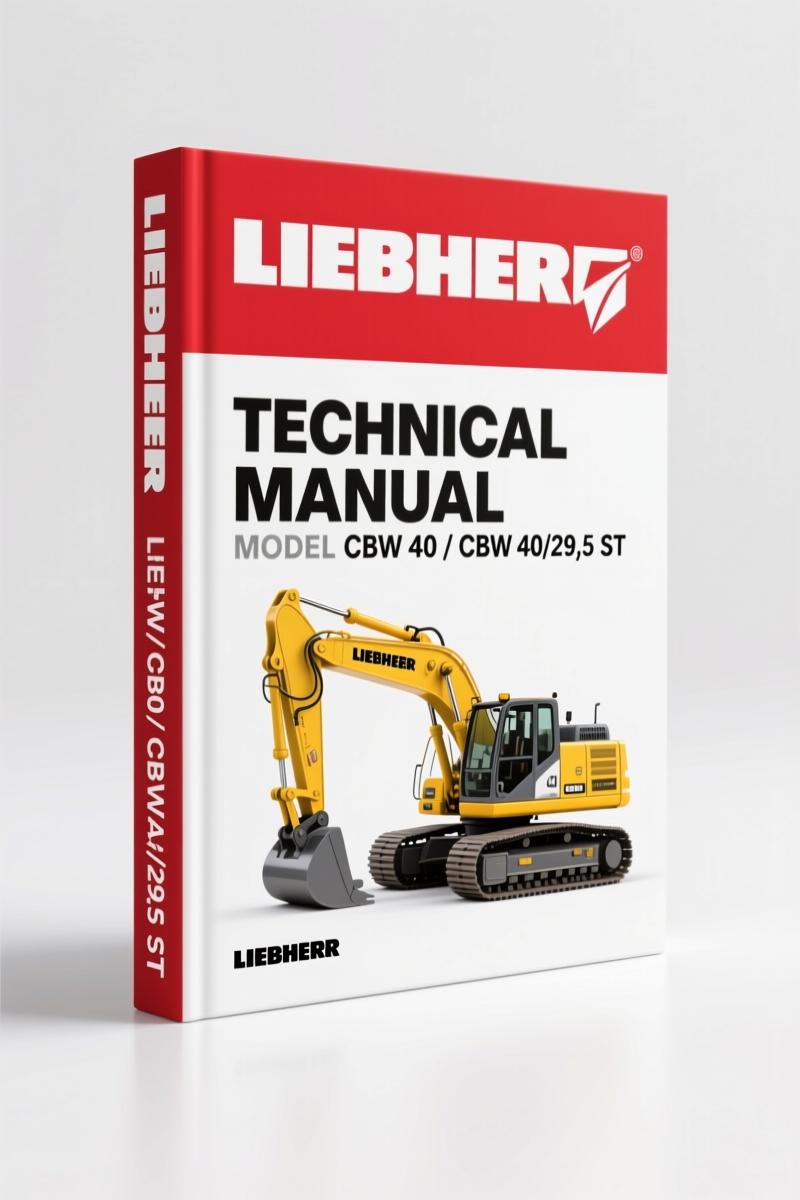
Liebherr CBW 40, CBW 40/29,5 ST Technical Manual – 2000, 209 Pages
Original price was: $76.00.$50.00Current price is: $50.00.
Factory technical manual for Liebherr CBW 40 and CBW 40/29,5 ST cargo deck cranes. 209 pages of hydraulic schematics, emergency procedures, and LUDV control system data.
Description
Liebherr CBW 40, CBW 40/29,5 ST 2000 Technical Manual
I’ve seen more than a few techs try to rebuild a variable-displacement motor using a photocopied aftermarket schematic. That ends with a phone call to the owner and a crane that won’t swing. You need the real thing. This Liebherr CBW 40, CBW 40/29,5 ST 2000 Technical Manual is the factory original – 209 pages of what Liebherr put together for their trained service personnel. If you’re working on a cargo deck crane and don’t have this, you’re working blind. The aftermarket reprints get the oil specs wrong, skip safety steps, and leave out the LUDV control logic. That’s not opinion; that’s what I’ve seen come across my bench.
Technical Data: General Specs for the CBW 40
Section 4.1 breaks down the crane’s DNA – general data, working speeds, hydraulic oil requirements, drive system, lighting, heating. Need the charge pressure? It’s in the oil pressure table in section 5.8. The manual tells you the exact fluid type for the hydraulic system, not “hydraulic oil 10W” like some generic book. Page 1 shows the edition date (14.07.2000 – second edition 29.08.2000) so you know you’re getting the production-level specs, not a draft. This matters when you’re chasing a weird oil temperature issue. If the manual says use ISO VG 46, you use ISO VG 46, not 32 because it’s cheaper. I’ve had to replace a swash plate pump because some shortcut artist used the wrong viscosity. Don’t be that guy.
Hydraulic Functions: LUDV Control System and Why It Matters
Chapter 5 is the heart of this manual. Section 5.2 describes the main hydraulic components: the variable swash plate pump A11VO LRDS, the variable displacement motor A6V, and the control block type LUDV for open hydraulic circuits. Section 5.3 explains how that LUDV system works – with one user (main hoist lifting) and with two users (main hoist plus slewing). If you don’t understand load-independent flow control, you’ll chase ghosts in the hydraulics. The manual includes the function of the hydraulic operated joystick TH6, the slewing safety block valve, and the lowering brake valve. You get the textbook explanation from the engineers who designed it. That’s not in any third-party reprint.
Emergency Operations: Have You Practiced Lowering the Load?
Section 6 is the part that separates this manual from a parts list. It covers emergency hand pump layout (6.1.2), the procedure to lower the load for the hoisting gear (6.2), lowering the jib with hook block in parking position or with empty hook (6.3.2 and 6.3.3), and releasing the slewing brakes (6.4). These are step-by-step instructions with layout drawings. If you’ve never had to hand-pump a crane down when the main engine quits, you don’t want to learn on the job. This manual gives you the sequence – including which valves to open and in what order. Page 2 carries the warning that non-observance can result in personal injury and structural damage. That’s not a suggestion. That’s a fact I’ve seen play out.
3 Reasons to Use the OEM Technical Manual Instead of a Reprint
First, torque specs. The manual gives you clamping forces and pressure settings for every critical joint. Second, wiring. Section 4.2 covers the electric system – power supply, installed power ratings, switch cabinet X1, main breaker operation, emergency stop function, main motor hydraulic drive, and ventilation. A reprint usually jumbles the pinouts or omits the emergency stop logic. Third, safety devices. The manual tells you to test them at regular intervals. Aftermarket books skip that because they’re copying old copies. This is the real factory document – scanned from the original print. You can check the authenticity by the page numbers and the Liebherr part number (162 001 – 040).
Get the Right Torque Data – Don’t Guess
When you’re tightening the flange bolts on a LUDV control block, you need the exact torque in pound‑feet. This manual doesn’t leave that to chance. The oil pressure table in section 5.8 gives you the working pressures for each circuit – hoist, slew, jib. The drive system section (4.1.4) lists the transmission specs. If you’re swapping out the variable displacement motor, you’ll need the displacement data and pressure limits. All in this one book. And because it’s a factory manual, the info is consistent front to back. No contradictions between the schematic and the text. That’s worth the price of admission alone.
If you work on these cranes, especially the CBW 40 or the CBW 40/29,5 ST, this technical manual is the difference between a job done right and a crane down for a week. For related machines, check out Liebherr R 9350 Technical Manual – Specs for Big Iron or Liebherr R 934 C Technical Manual – Factory Specs for Excavator Repairs and Liebherr R 956 2013 Technical Manual – Factory Specs for Crawler Excavator. Need a refresher on how hydraulic motors transmit power? Read about Manual Transmission principles; the variable displacement motor works on similar displacement control. Also, the drive system chapter references the same Manual Transmission concepts for the gearbox side. Access the Factory Manual and keep it on your bench – right next to your torque wrench.
- Does this manual include wiring diagrams for the switch cabinet?
- No. The manual includes a technical description of the electrics (section 4.2) but not full schematic diagrams. It covers power supply, installed power ratings, switch cabinet X1, main breaker operation, and emergency stop function.
- Where can I find the hydraulic oil pressure specs for the hoist circuit?
- Section 5.8 contains the oil pressure table that lists pressures for hoist, slew, and jib circuits. That table also gives the feed pressure safety limits (section 5.4.2) and control pressure limitation (5.4.5). The pressures are referenced in bar and also in psi if you look at the conversion notes. Don’t trust a generic pressure chart – use the factory table because the CBW 40 and CBW 40/29,5 ST have different displacement motors that affect system pressure.
Additional information
| Brand | Liebherr |
|---|---|
| Language | English |
3 reviews for Liebherr CBW 40, CBW 40/29,5 ST Technical Manual – 2000, 209 Pages
You may also like…
-
Sale!
Liebherr LR 636-1275 Service Manual – Factory Specs for Crawler Loader Maintenance
Original price was: $80.60.$65.00Current price is: $65.00. -
Sale!

Liebherr PR 776 Service Manual – Factory Specs for Crawler Dozer
Original price was: $102.05.$65.00Current price is: $65.00. -
Sale!
Liebherr D9306, D9308, D9406, D9408 2002 Service Manual – Factory Specs
Original price was: $83.20.$65.00Current price is: $65.00. -
Sale!

Liebherr PR 712, PR 752 Service Manual – 1426 Pages of Factory Specs
Original price was: $96.85.$65.00Current price is: $65.00.
Related products
-
Sale!

2006 Service Manual – International DT 466E, 530E Diesel Engine
Original price was: $67.50.$50.00Current price is: $50.00. -
Sale!

1989 Service Manual – International 2000-8000 Electrical Systems
Original price was: $72.00.$50.00Current price is: $50.00. -
Sale!

1995 Operators Manual – International 1000-4000 Series | OEM Documentation
Original price was: $12.49.$9.99Current price is: $9.99. -
Sale!

2005 Parts Catalog – International NGD 3.0 L Engine (77 pages)
Original price was: $44.70.$30.00Current price is: $30.00.
William H. –
I am so happy with this manual. It is easily zoomable on my iPad without losing quality. A must-have for any Liebherr CBW DIYer doing repairs. Saves me hundreds of money.
John S. –
This is exactly what I was looking for. Instant access after checkout process. A must-have for any Liebherr CBW DIYer doing maintenance. Saved my weekend project! Thank you.
Charles W. –
Great OEM spec sheet. The PDF is very clear. A must-have for any Liebherr CBW mechanic doing repairs. Saved my repair job! Thank you.