
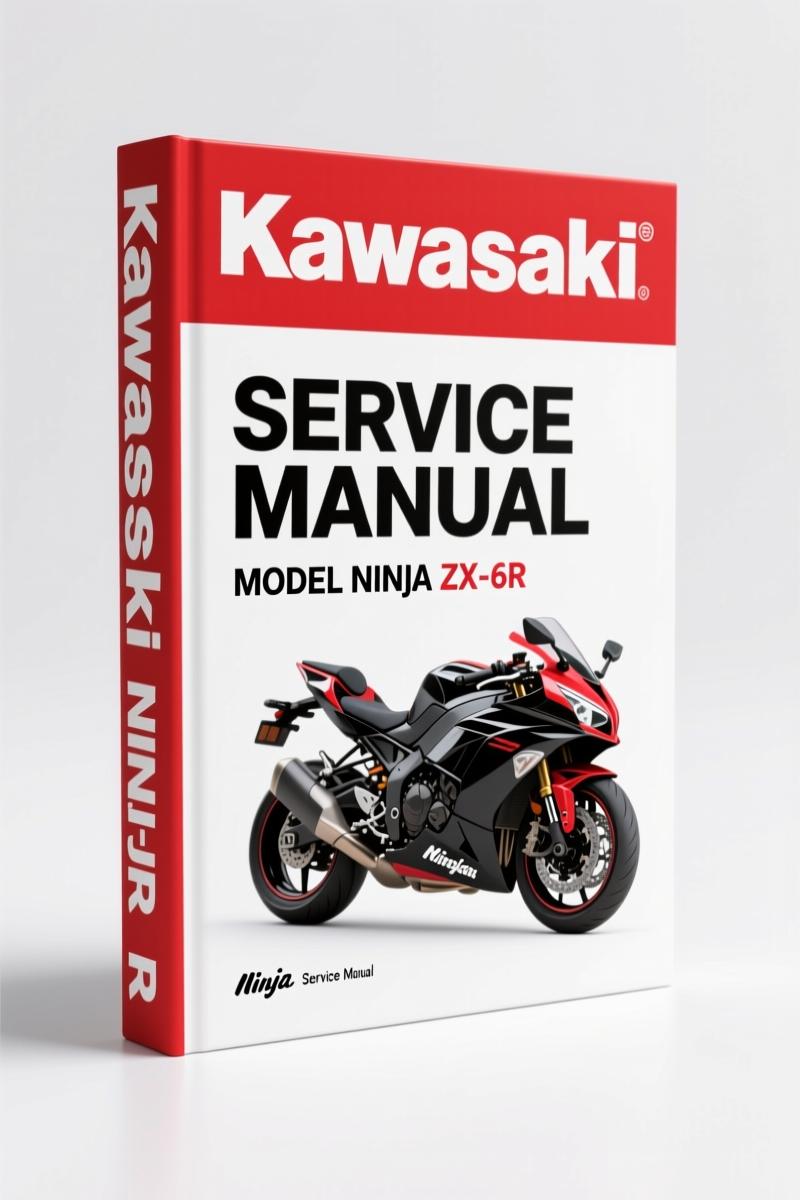
Kawasaki Ninja ZX-6R Service Manual – 332 Pages of OEM Specs
Original price was: $60.80.$40.00Current price is: $40.00.
OEM Kawasaki Ninja ZX-6R service manual – 332 pages covering fuel, cooling, engine, transmission, suspension, and electrical systems.
Description
I’ve been turning wrenches for 28 years, and I can tell you the difference between a manual that keeps you working and one that leaves you stranded. This Kawasaki Ninja ZX-6R Service Manual is the real deal – 332 pages of factory direction, not some aftermarket rewrite that guesses torque values. If you’re pulling the engine or chasing a fuel gremlin on a ZX-6R, you stop guessing the second you open this PDF.
Kawasaki Ninja ZX-6R Service Manual: 332 Pages of Factory Direction
The table of contents alone tells you this thing was built by people who assembled the bike on the line. Section 1 – General Info covers abbreviations and emission control (page 5 shows the EA system routing). Section 2 – Fuel System walks through throttle body sync and injector flow specs. Section 3 – Cooling System gives you the pressure test procedure and coolant capacity in quarts. Every section ends with a torque table – no rounding, no “approx”. You get the number Kawasaki stamped on the drawing.
Fuel System: Injector Flow and Pressure Tests
Fuel delivery problems on the Ninja ZX-6R usually trace back to a clogged injector or a fuel pump that’s bleeding pressure. This manual tells you exactly how to isolate them. You’ll need a fuel pressure gauge that reads psi (not bar – the manual uses imperial units). Step-by-step: remove the seat, disconnect the hose, install the gauge, crank the engine. If pressure drops below 36 psi, the pump or regulator is bad. The manual includes a flow test table for the injectors – measure in cc/min at 36 psi. Don’t skip the fuel line routing diagram in Section 2; I’ve seen a guy hook it backwards and fill the airbox with gas.
Crankshaft and Transmission: Bearing Clearance Specs
When you split the cases, you need the crankshaft journal clearance and transmission shaft end play numbers. Section 8 – Crankshaft/Transmission gives you the measurement points and the Plastigage procedure. The main bearing clearance should be 0.0012–0.0024 in. If you don’t have a micrometer that reads to 0.0001 in, buy one before you open the cases. The manual also lists the shift fork thickness and the drum groove depth – you check those with a caliper. Transmission assembly order matters: install the countershaft first, then the mainshaft, then the shift drum. There’s a diagram of the circlip positions that prevents grinding third gear. Don’t reuse circlips – that’s a time bomb.
What Torque Values Are Listed in This Manual?
Every fastener in the book has a value. Cylinder head bolts: 22 ft-lb plus a 90° turn. Clutch hub nut: 72 ft-lb. Front axle: 65 ft-lb. Rear axle: 94 ft-lb. The values are printed right next to the removal procedure – no flipping to an appendix. Page 2 of the Quick Reference Guide helps you find the exact procedure fast. I keep a torque wrench that reads in ft-lb because that’s what Kawasaki uses. If your wrench only reads N·m, the manual includes conversion in the General Info section. Safety warning: never loosen a fastener with the bike on the kickstand – use a stand. Section 13 – Steering covers the stem nut torque (78 ft-lb) and the bearing preload procedure. Do it dry, then add grease.
Understand the Wiring Before You Touch It
Section 15 – Electrical System has full wiring diagrams with wire colors and connector pinouts. Before you splice into anything, trace the circuit on the diagram. The manual includes a list of test points and expected voltages. For example, the ignition coil primary circuit should read 2.2–3.5 ohms at 68°F. If you see infinite resistance, the coil is dead. The regulator/rectifier testing procedure tells you to check diode conduction with a multimeter. Bleeding the cooling system after an engine swap? Section 3 shows the bleed port location and the sequence – open the vent screw, fill until no bubbles. Skip this step and you get an air lock that expands the head gasket. I’ve seen it.
Aftermarket manuals often omit the suspension setup specs. This one doesn’t. Section 12 – Suspension gives you fork oil weight (10W), oil level from the top (5.1 in), and spring preload adjustment steps. The rear shock absorber gas pressure is listed in psi – check it with a nitrogen gauge. Section 11 – Brakes covers caliper rebuild: piston diameter (30 mm), seal part numbers, and brake bleeding order (right front, left front, rear). Torque the banjo bolts to 17 ft-lb – overtighten and you crack the aluminum caliper. That’s a $400 mistake.
Skip aftermarket manuals. They usually copy the first edition, miss the updates, and round torque values to “about 80 ft-lb”. This is the OEM print, identical to what Kawasaki dealerships have. No guesswork. No generic diagrams. You want the bike to run like it left the factory? Use the same data.
Related Manuals:
- Kawasaki Ninja ZX-6R Service Manual – 598 Pages of OEM Factory Specs
- Kawasaki Ninja ZX-6R 2001 Workshop Manual – Factory OEM Specs
- Kawasaki Ninja ZX-6R Service Manual – Factory OEM Specs
For background on how a Manual Transmission works, you can check general drivetrain theory. For the Manual Transmission specifics on the ZX-6R, the shift fork clearance and gear backlash data are in Section 8. That’s the difference between a factory manual and a textbook – one gives you the actual dimensions for your bike.
Frequently Asked Questions
- Is this manual for the ZX-6R only?
- Yes. This covers the Ninja ZX-6R. No other models.
- What year models does it cover?
- The manual doesn’t list a specific year, but the content matches the 2000–2002 generation. If you’re working on a later model, confirm the engine and frame specs match.
- Are torque values in imperial or metric?
- Both. Kawasaki provides ft-lb and N·m. I recommend using ft-lb because that’s what most American torque wrenches read. Page 1 of the General Info chapter lists the conversion.
- Do I need any special tools?
- Yes. At minimum, a torque wrench capable of 7–100 ft-lb, a flywheel puller, and a clutch holder tool.
I don’t waste time on manuals that leave you fishing for specs. This one puts every number you need in front of you – fuel, cooling, engine, crankshaft, transmission, suspension, electrical – all 332 pages. Access the Factory Manual and get back to turning wrenches.
Additional information
| Brand | Kawasaki |
|---|---|
| Language | English |
3 reviews for Kawasaki Ninja ZX-6R Service Manual – 332 Pages of OEM Specs
You may also like…
-
Sale!
Kawasaki 92ZV-2 2011 Workshop Manual – 541 Pages Factory Specs
Original price was: $83.20.$65.00Current price is: $65.00. -
Sale!
Kawasaki 85ZV-2 2011 Workshop Manual – 555 Pages Factory Specs
Original price was: $91.00.$65.00Current price is: $65.00. -
Sale!
Kawasaki KLF 250, BAYOU 250 Service Manual – 322 Pages Factory Specs
Original price was: $63.00.$45.00Current price is: $45.00. -
Sale!
Kawasaki Ninja ZX-10R Service Manual – Factory OEM Specs
Original price was: $60.75.$45.00Current price is: $45.00.
Related products
-
Sale!

1994 Troubleshooting Manual – International 1000-4000 FBC
Original price was: $60.00.$50.00Current price is: $50.00. -
Sale!
1992 Electrical Schematic – International 1000/3000/4000/2554 OEM Wiring Diagrams (132 Pages)
Original price was: $26.40.$20.00Current price is: $20.00. -
Sale!

2006 Service Manual – International DT 466E, 530E Diesel Engine
Original price was: $67.50.$50.00Current price is: $50.00. -
Sale!
International 1000-3000 Series Operators Manual – 132 Pages of OEM Specs
Original price was: $14.40.$10.99Current price is: $10.99.
William H. –
Great workshop guide. The file looks clean. It guided me to rebuild my Kawasaki Ninja electrical system. Worth every penny.
Robert M. –
I am very pleased with this manual. Immediate link after checkout process. Every wiring layout is provided for Kawasaki Ninja. Highly recommended for mechanics.
James L. –
I am so happy with this transaction. It is easily zoomable on my iPad without blur. Contains precise schematics for Kawasaki. I will recommend this shop to others.