
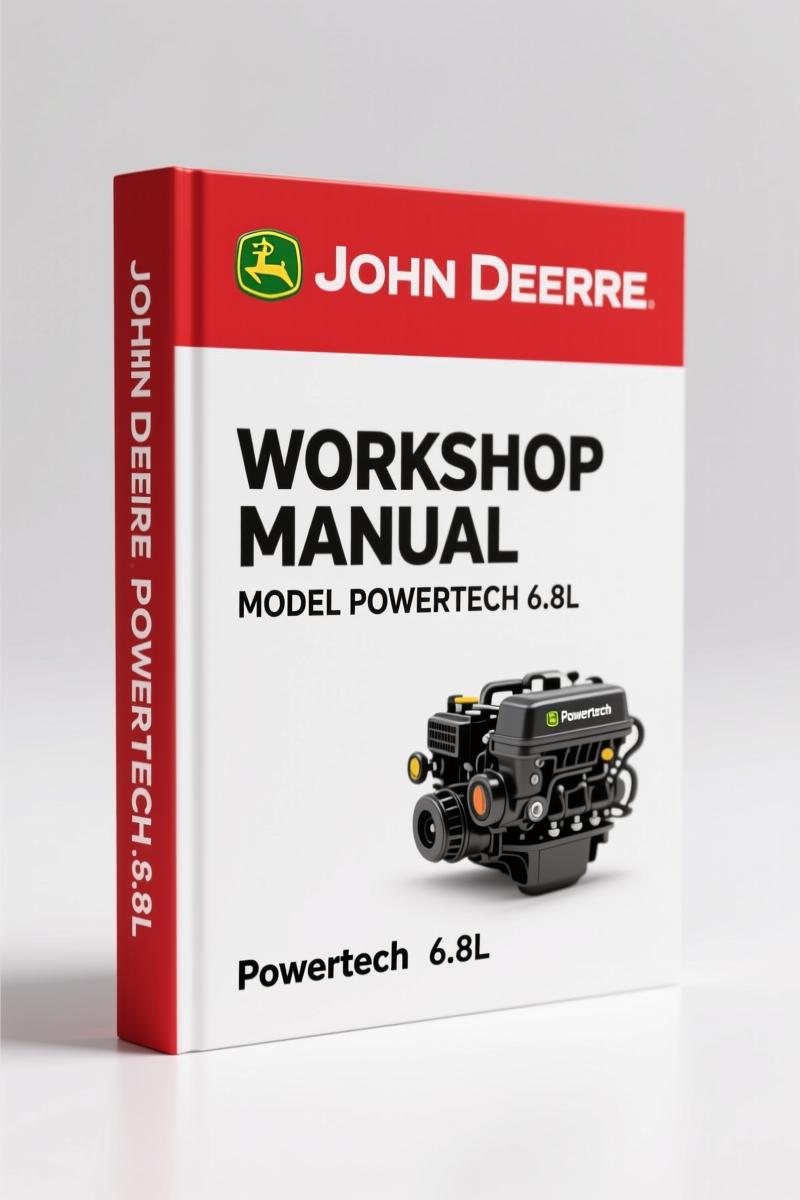
John Deere Powertech 4.5L, Powertech 6.8L 2004 Workshop Manual – OEM Specs
Original price was: $59.60.$40.00Current price is: $40.00.
Factory workshop manual for John Deere Powertech 4.5L and 6.8L diesel engines (2004). Covers HPCR fuel system, diagnostics, and repair. 678 pages of OEM specifications.
Description
John Deere Powertech 4.5L, Powertech 6.8L 2004 Workshop Manual
Original OEM print – 678 pages.
If you’re working on a Powertech 4.5L or 6.8L with a Denso HPCR fuel system, you need the actual factory specs. Aftermarket manuals will tell you to ‘tighten the injector to spec’ without telling you what that spec is. That’s how you get leaks. That’s how you blow a rail. That’s how you waste a Saturday because you trusted a third-party PDF that got the torque values from a forum post. This John Deere Powertech 4.5L, Powertech 6.8L 2004 Workshop Manual is the real thing. 678 pages, printed from John Deere’s own CTM220 publication, covering only the Level 11 Electronic Fuel System with Denso HPCR. No fluff. No generic advice. Just the procedures you need to do the job without rework.
Service Cooling System Safely – Because Runtime Depends on It
Safety procedures come first in this manual because John Deere knows what happens when you skip them. The “Service Cooling System Safely” section is right in the General chapter. You’ve got a pressurized system at operating temperature—crack that cap wrong and you get steam burns. The manual tells you to let the engine cool, wrap the cap with a rag, and turn it slowly to release pressure. That’s not the kind of detail you get from a Haynes manual. If you’ve ever replaced a water pump on one of these engines without checking the OEM procedure, you might have overtightened the bolts or used the wrong coolant. This manual gives you the coolant type (the Diesel Fuel section also covers Bio-Diesel and Dieselscan analysis) and the fill procedure. Don’t skip it.
Electronic Fuel System Repair: What This Manual Covers
The Repair and Adjustments section is the meat of this book. It walks you through the entire Denso HPCR system: fuel transfer pump removal and installation, high pressure common rail removal, flow dampers, pressure limiter, and the Electronic Injectors (EIs). Each procedure includes required tool lists and torque values. For example, “Remove and Install High Pressure Common Rail” gives you the exact sequence to depressurize the system before you touch any lines. You’ll also find procedures for cleaning and inspecting injector bores and orifices—critical steps if you’re chasing a misfire. The manual lists the part numbers for seals and o-rings, so you can order the right parts before you start. If you skip the depressurization step, you risk spraying diesel fuel at high pressure into your skin – that’s a trip to the ER. The manual warns you about high-pressure fluids on page 3. Do not ignore it. Understanding the HPCR’s pump control valve is like understanding the synchronizer rings in a Manual Transmission – both require precise tolerances to function.
3 Reasons to Choose OEM Documentation Over Aftermarket PDFs
First, the torque specs. Aftermarket manuals often list generic values or leave them out entirely. This manual has OEM torque specs for every fastener in the fuel system—pump mounting, injector hold-downs, rail brackets. Second, the electrical diagnostics. The “Electronic Engine Control Repair and Adjustment” section covers the ECU, fuel system sensors, and connector repair. It tells you how to test the Engine Coolant Temperature Sensor, Fuel Rail Pressure Sensor, and Crank Position Sensor with the correct resistance values. Third, the theory of operation. Aftermarket manuals skip this. Here you get fuel system operation diagrams and electronic control system terminology. Understanding how the Pump Control Valve (PCV) works helps you diagnose a no-start faster.
Engine Control Unit (ECU) Diagnostics: Factory Procedure
The ECU section is not a generic “check power and ground” guide. It covers the specific connectors on the Powertech 4.5L and 6.8L: WEATHERPACK, METRI-PACK, DEUTSCH, SUMITOMO, YAZAKI. Each connector type has a repair procedure with the correct crimp tools and insulating compound. If you’ve ever had an intermittent fault due to a corroded terminal, you know why this matters. The manual also includes glow plug removal and installation, and pump position sensor diagnostics. You get the pinout diagrams from the actual factory wiring harness. If you’ve ever rebuilt a Manual Transmission, you know the value of a genuine shop manual versus a generic guide. This is no different.
High Pressure Common Rail (HPCR) Removal and Installation
This is a job that requires precision. The manual lists the tools you need—including a high-pressure fuel line wrench to avoid rounding the nuts. It tells you to remove the flow dampers and pressure limiter before unbolting the rail. Torque sequence is given for the rail mounting bolts. If you skip the sequence or overtorque, you can warp the rail. That’s a $1,000 mistake. The manual also covers cleaning the rail bores and inspecting for scoring. Page 26 has the torque values for the rail and injector connections. Use them. This manual (CTM220) is one of six volumes. If you need base engine data, get the John Deere Powertech 4.5L & 6.8L 2002 Technical Manual – 552 Pages alongside this one.
FAQ on the Powertech 4.5L and 6.8L Workshop Manual
- Does this manual cover the base engine?
- No. That’s CTM104. This manual covers only the Level 11 Electronic Fuel System with Denso HPCR.
- What torque specs are included?
- Every fastener in the electronic fuel system—high pressure pump mounting bolts, injector hold-downs, rail mounting brackets, fuel line fittings. See page 26 for HPCR fasteners. The manual gives OEM values in both metric and imperial. Do not guess. If you use a generic spec from the internet, you risk leaks or component damage. The factory specs account for lubrication, thread pitch, and material. This manual lists them for a reason. The high pressure pump mounting bolts, for instance, require a specific value that differs from the injector hold-downs. Without the manual, you’re gambling with a $3,000 fuel system.
- Is this manual suitable for a DIY mechanic?
- Yes, if you have mechanical experience and the right tools—torque wrench, injector socket, fuel pressure gauge. You should be comfortable with electrical diagnostics and high-pressure fuel systems. The manual assumes you’re an experienced technician, but the step-by-step procedures are explicit enough for a serious home garage enthusiast. Just don’t skip the safety warnings.
- How many pages and what year?
- 678 pages, published 2004.
For older tractor models, the John Deere 4050 4250 4450 4650 4850 Shop Manual or the JOHN DEERE 4050-4850 Series Tractor Workshop Manual cover those drivetrains, but for the Powertech engine fuel system, you need this manual.
Stop relying on incomplete information. Get the full factory procedures. Access the Factory Manual from AutoRepairManuals and keep it on your workbench.
Additional information
| Brand | John Deere |
|---|---|
| Language | English |
4 reviews for John Deere Powertech 4.5L, Powertech 6.8L 2004 Workshop Manual – OEM Specs
You may also like…
-
Sale!
John Deere 325J 2011 Repair Manual — Factory Specs for Backhoe Loader
Original price was: $109.60.$80.00Current price is: $80.00. -
Sale!
John Deere 400 1974 Service Manual – Factory Specs for Technicians
Original price was: $92.30.$65.00Current price is: $65.00. -
Sale!
John Deere JD450 1987 Service Manual – OEM Factory Specifications
Original price was: $79.95.$65.00Current price is: $65.00. -
Sale!
John Deere JD450 1987 Service Manual – OEM Factory Specs
Original price was: $97.50.$65.00Current price is: $65.00.
Related products
-
Sale!

1993 Electrical Schematic – International 1000/3000/4000 Bus Chassis OEM Wiring Diagrams
Original price was: $29.26.$22.00Current price is: $22.00. -
Sale!

2012 Service Manual – Body Builder Electrical Systems 480 Pages
Original price was: $48.28.$34.00Current price is: $34.00. -
Sale!

2006 Service Manual – International DT 466E, 530E Diesel Engine
Original price was: $67.50.$50.00Current price is: $50.00. -
Sale!
1996 Operators Manual – International 1000-4000 Series (246 pages)
Original price was: $15.28.$9.99Current price is: $9.99.
Richard G. –
I am extremely satisfied with this transaction. It is very easy to read on my tablet without blur. Contains detailed wiring diagrams for John Deere. Worth every penny.
Robert M. –
Highly recommended! The document quality is excellent. A must-have for any John Deere Deere owner doing repairs. Saves me hundreds of money.
workshop_guy –
I am extremely satisfied with this manual. Instant access after checkout. A must-have for any John Deere Deere DIYer doing maintenance. I will recommend this shop to others.
Charles W. –
Superb resource! The file is very clear. It guided me to troubleshoot my John Deere Deere electrical system. Saved my repair job! Thank you.