
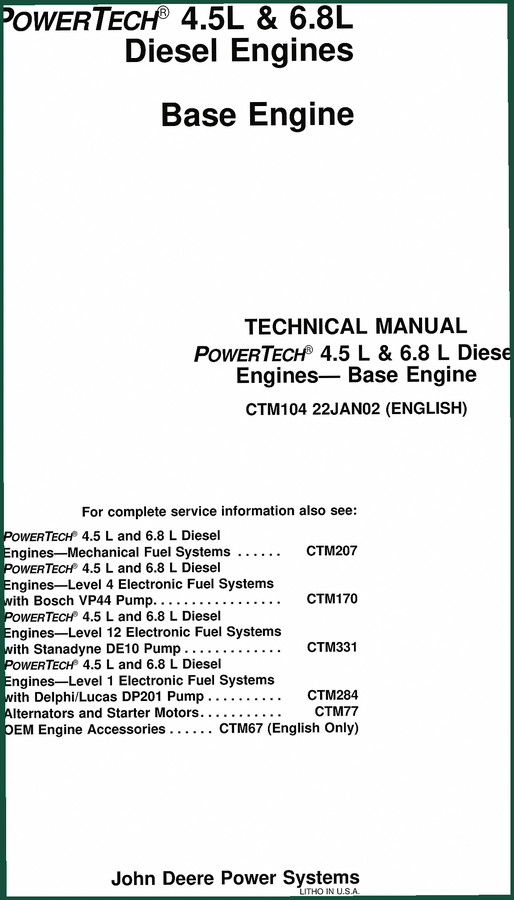
John Deere Powertech 4.5L, Powertech 6.8L 2002 Technical Manual
Original price was: $33.98.$22.50Current price is: $22.50.
Factory John Deere technical manual for Powertech 4.5L and 6.8L diesel engines (2002). 552 pages: torque specs, cooling data, rebuild procedures.
Description
John Deere Powertech 4.5L, Powertech 6.8L 2002 Technical Manual
I’m Mike Callahan, 28-year ASE Master. I’ve lost count of the engines I’ve rebuilt, but I know one thing: you screw up the torque sequence on a Powertech 6.8L head and you’re buying a new block. This manual – the real OEM factory print from 2002 – is what you need on your bench if you’re touching a John Deere Powertech 4.5L, Powertech 6.8L 2002 Technical Manual job. Aftermarket garbage will steer you into a leaky head gasket and a lot of cuss words. Stick with the source.
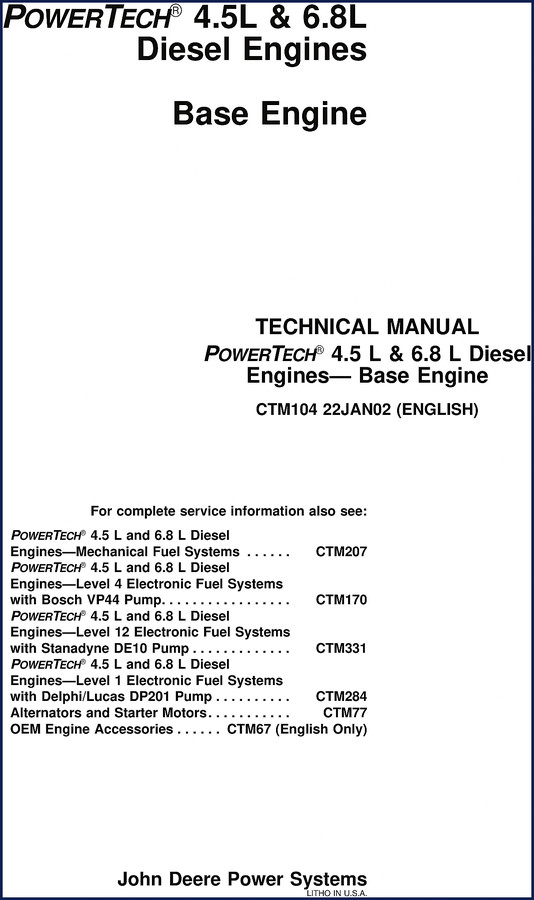
This isn’t a condensed rewrite. It’s the full 552 pages of CTM104, dated 22JAN02, covering only the base engine. Fuel systems live in separate companion volumes (CTM207, CTM170, CTM331, CTM284). If you need to tear down the bottom end, check valve clearance, or figure out why your coolant is turning into chocolate milk, this is the binder that keeps you from guessing.
Cooling System Safety – Page 1 of the Manual
Before you even pull a radiator cap, read the “Service Cooling System Safely” section. John Deere spells out exactly how to handle hot coolant under pressure – 15 psi can turn a cap into a projectile. The manual also covers flushing and disposal procedures. I’ve seen guys skip the depressurization step and end up in the ER. Don’t be that guy. The cooling chapter alone makes this manual worth the price of admission.
Torque-Turn Method for Proper Torque
This isn’t a simple foot-pound number. The cylinder head section (part of Repair and Adjustments) walks you through the torque-turn method – angle tightening after initial torque. You need to know the exact sequence and the turn angle in degrees. Aftermarket manuals often skip the turn step. That’s how head gaskets fail at 10,000 miles. Page references in the manual guide you through each fastener group. Use the factory spec.
Engine Identification – What the Serial Number Plate Tells You
Every Powertech engine has a model designation and serial number plate. The manual dedicates a full group to decoding that plate – engine model, option codes, emissions level. If you order parts based on a partial number, you’ll get the wrong injector or gasket set. The manual includes engine application charts so you know exactly which machine this engine came out of. No guessing.
Cylinder Liner Standout – Why You Measure It
In the cylinder block section, you’ll find the procedure to measure cylinder liner standout above the block deck. Spec is in thousandths of an inch. If you don’t check it before dropping in new liners, you risk piston-to-head clearance issues that bend rods. The manual gives you the tolerance and the tool list needed to do it right. I keep a machinist’s rule and a depth mic because of this section.
Lubricants and Coolants – Don’t Guess the Specs
There’s a full chapter on fuels, lubricants, and coolants – including bio-diesel compatibility, break-in oil requirements, and coolant test procedures. John Deere even explains COOLSCAN analysis. Using the wrong coolant additive can gel the cooling system on a Tier II engine. The manual lists the correct SCA levels and how to test them. Ignore that and you’ll be flushing a clogged radiator. Trust me.
FAQs
- Does this manual cover the fuel system?
- No. This is the base engine manual (CTM104). Fuel systems are covered in separate companion manuals (CTM207, CTM170, CTM331, CTM284). You need those if you’re diagnosing injection or pump issues.
- What torque values are listed?
- All of them – cylinder head cap screws, connecting rods, main bearings, flywheel, and more. Specs are given in lb-ft and N·m with angle-turn degrees where required. The manual also lists wear tolerances and clearance limits.
- Can I use this for a Tier III engine?
- This manual is for Tier I and Tier II certified engines. For Tier III emissions levels, you need later documentation. The engine identification section helps you determine your engine’s regulation level.
- Is there a table of contents?
- Yes, starting on page 2. Sections cover Safety, Engine Identification, Fuels/Lubricants/Coolants, Repair and Adjustments (including engine rebuild, cylinder head, block, liners, pistons, rods), and a specifications summary in Section 06.
This manual belongs in every shop that touches John Deere Powertech engines. It’s the foundation for serious repair – not a skim-through reference. Before you order parts, before you pull a wrench, get the factory data. Access the Factory Manual now and keep it on your tablet or print the sections you need. Your engine – and your wallet – will thank you.
Related Manuals
- John Deere Powertech 4.5L 6.8L Workshop Manual
- John Deere 220 1993 Technical Manual – 718 Pages of Factory Specs
- John Deere 240, 250 2000 Technical Manual – Factory Specs
If you’re working on equipment that also uses a Manual Transmission, you’ll need the separate transmission manual for that machine. The same goes for Manual Transmission models – don’t assume the engine manual covers the driveline.
Additional information
| Brand | John Deere |
|---|---|
| Language | English |
4 reviews for John Deere Powertech 4.5L, Powertech 6.8L 2002 Technical Manual
You may also like…
-
Sale!
John Deere 400 1974 Service Manual – Factory Specs for Technicians
Original price was: $92.30.$65.00Current price is: $65.00. -
Sale!
John Deere 325J 2011 Repair Manual — Factory Specs for Backhoe Loader
Original price was: $109.60.$80.00Current price is: $80.00. -
Sale!
John Deere JD450 1987 Service Manual – OEM Factory Specifications
Original price was: $79.95.$65.00Current price is: $65.00. -
Sale!
John Deere JD450 1987 Service Manual – OEM Factory Specs
Original price was: $97.50.$65.00Current price is: $65.00.
Related products
-
Sale!

1991 Operators Manual – International Truck OEM Specs (108 Pages)
Original price was: $13.63.$10.99Current price is: $10.99. -
Sale!

1996 Operators Manual – International 1000-4000 Series (246 pages)
Original price was: $15.28.$9.99Current price is: $9.99. -
Sale!

2005 Parts Catalog – International NGD 3.0 L Engine (77 pages)
Original price was: $44.70.$30.00Current price is: $30.00. -
Sale!
1994 Troubleshooting Manual – International 1000-4000 FBC
Original price was: $60.00.$50.00Current price is: $50.00.
John S. –
Perfect OEM spec sheet. The scan is high-quality and easy to navigate. Every wiring layout is provided for John Deere Deere. Saves me hundreds of time.
William H. –
Perfect OEM spec sheet. The text is searchable and easy to navigate. It helped me to fix my John Deere Deere engine. Saves me a lot of money.
diy_master –
This is just what I needed. The scan is high-quality and well indexed. Every torque spec is provided for John Deere Deere. Great value for money.
David K. –
Excellent workshop guide. It is very easy to read on my tablet without losing quality. Every torque spec is provided for John Deere Deere. Great value for money.