
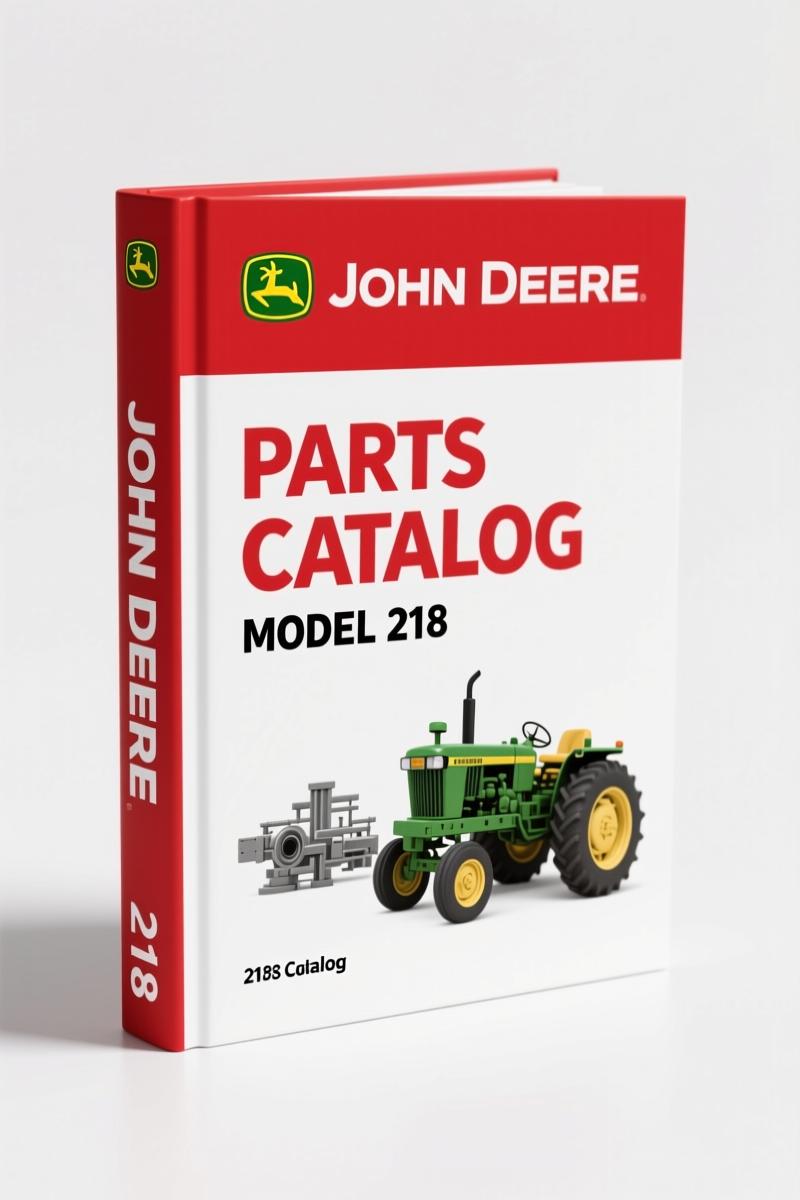
John Deere 218 1982 Parts Catalog – OEM Exploded Views & Part Numbers
Original price was: $30.75.$25.00Current price is: $25.00.
68-page OEM parts catalog for John Deere 218 (1982) with exploded diagrams, serial number breaks, and bolt strength specs.
Description
John Deere 218 1982 Parts Catalog
You’ve got a John Deere 218 1982 Parts Catalog in your hands — or you should. Misordering parts because some aftermarket site didn’t bother to split serial number ranges? I’ve seen it cost a shop a full day and a customer a whole row of ripe wheat. This is the original factory print, 68 pages, straight from Deere’s Harvester Works. No reprint, no generic index, no guessing which bolt is SAE Grade 8 vs Grade 5. That information is right there in the front matter.
Let’s walk through what you actually get.
Grid Index A: Platform Structure and Frame
The manual is broken into four main grids — A, B, C, and L. Grid A covers the draper platform itself: the frame, serial number plate location (left-hand side of the frame), and the base structure. You’ll find the part numbers for the main frame weldment, the floor stripper, and the feed plates. If you’ve ever had a frame crack from overloading, you know how critical it is to get the correct replacement. This grid shows the exact part numbers broken out by serial number range — for units up to -579900 and from 579901 onward.
Every part in this catalog is keyed to serial numbers. Look at page 2 of the manual: the serial number plate example shows E0018579900 for early models, H00218D579901 for later. Use the wrong one and you’ll be waiting on a return.
Alphabetical Index: Find Any Part in Seconds
You don’t have to flip through all 68 pages guessing which grid holds your part. The alphabetical index starts with ARM, REEL and goes through CROSS AUGER, DRAPER BELT, CUTTERBAR DRIVE, CYLINDER ROD EXTENSION, DIVIDER POINTS, FEED PLATES, and more. Need a DECALS, R.H. AND L.H.? It’s right there. This index is a time-saver when you’re standing in the shop with a broken part in your hand and the customer is waiting.
I’ve seen techs try to use the John Deere 200 Series Cutting Platforms Parts Catalog for a 218 and wonder why the belt lengths are off. Different platform, different grid. Stick to the 218 catalog.
Serial Number Ranges: Why They Matter
The manual dedicates an entire page to explaining how serial number ranges work. A dash like “-579900” means the part fits all machines up to and including that serial. “000000-” means from that serial onward. If you see “XXXXXX” listed, it’s a known change but the exact break wasn’t reported when the catalog was printed. You still need to verify with your machine’s plate. That’s the difference between a factory document and a third-party compilation. The factory expects you to read the serial number and match it. No shortcuts.
For example, the 218 draper platform serial number plate moved from the left-hand frame to the same location but with a different format after 579901. If you order a frame bracket for an early machine and you have a late one, it won’t line up. The catalog tells you that. Respect the range.
Bolt Strength Identification: SAE Grade 8 vs Grade 5
Every bolt that requires high-strength steel equivalent to SAE Grade 8 is labeled “HS SAE 8” in the parts listing. Everything else is Grade 5 or lower. Why does that matter? Because a cutterbar drive bolt that snaps under load can send a knife flying through the draper belt. The catalog flags those bolts clearly. If you’re rebuilding a cross auger drive assembly, check the description. Don’t substitute a standard Grade 5 where Grade 8 is called out. The manual saves you from that guesswork. And if you’re curious about the diesel engine that might power the tractor pulling this platform, look at this Wikipedia article on diesel engines for background on how the power gets to the PTO.
Complete Goods Listings and Remanufactured Components
Parts that are sold as complete assemblies are printed in bold face type. According to the manual, those are to be ordered separately and not included on replacement parts orders. Also, the catalog notes that remanufactured components from John Deere may have design changes that make service parts from this catalog inadequate. That’s a real-world trap — you get a reman unit, order the original service part, and it doesn’t fit. The manual warns you. It’s not just a list of numbers; it’s a set of instructions. Follow them.
If you need a broader view of Deere’s equipment from the same era, check the John Deere 2130 Parts Catalog – Factory Specs for Correct Part Identification for tractor-side parts. For utility tractors, the John Deere 4500, 4600, 4700 2000 Parts Catalog – OEM Grid Index covers the later models.
Why OEM Documentation Beats Aftermarket Copies
I’ve had techs walk in with a printed PDF from some online forum. The bolt torque was wrong, the part number was superseded, and the diagram was for a different year. This catalog — 1982, OEM, John Deere publication PC1664 — is the original microfiche master. The grids align with the factory’s own service parts system. The bolt strength identification, the SI units of measure (metric dimensions are given where applicable), the change indicator lines for updates — all of it is designed for a mechanic who uses a torque wrench and reads the manual before turning a bolt. Aftermarket sites don’t include that vertical change line that tells you a part was revised mid-production.
For an authoritative look at how diesel engines (which power most of the tractors hooked to these platforms) operate, you can read this Wikipedia article on diesel engines. It’s not a substitute for your Deere manual, but it gives context on combustion cycles and fuel injection timing that can help you understand driveline loads.
FAQ
- Does this catalog include torque specifications for the bolts?
- No. This is a parts catalog, not a service manual. It lists part numbers and assembly breakdowns. Torque specs are in the corresponding service manual.
- How do I know if a part fits my specific 218 serial number?
- Find your machine’s serial number plate — located on the left-hand side of the frame. Cross-reference with the catalog’s serial number ranges (e.g., -579900 or 579901-). Each part listing indicates which serial numbers it covers. If XXXXXX appears, a change was made but the exact break wasn’t recorded; contact a dealer with your serial number.
- Are the diagrams in this catalog accurate for all 218 models?
- This 1982 catalog covers two serial number groupings: up to 579900 and from 579901 onward. There are structural differences (e.g., frame brackets, belt routing) between them. Use the correct range. The grids A, B, C, L are specific to the 218 draper platform only — not the 200 series or other platforms.
- Can I use this catalog to order parts for a remanufactured component?
- The manual warns that remanufactured components may have design changes that make original service parts inadequate or unusable. Always verify the part against the reman unit’s serial ID before ordering. The catalog lists only original-equipment service parts.
Sixty-eight pages. OEM factory format. Grid A through L with full alphabetical index. Stop wasting time on aftermarket catalogs that skip serial number breaks and bolt strength specs. Access the Factory Manual and keep it on your workbench.
Additional information
| Brand | John Deere |
|---|---|
| Language | English |
4 reviews for John Deere 218 1982 Parts Catalog – OEM Exploded Views & Part Numbers
You may also like…
-
Sale!
John Deere JD450 1987 Service Manual – OEM Factory Specifications
Original price was: $79.95.$65.00Current price is: $65.00. -
Sale!
John Deere JD450 1987 Service Manual – OEM Factory Specs
Original price was: $97.50.$65.00Current price is: $65.00. -
Sale!
John Deere 400 1974 Service Manual – Factory Specs for Technicians
Original price was: $92.30.$65.00Current price is: $65.00. -
Sale!
John Deere 325J 2011 Repair Manual — Factory Specs for Backhoe Loader
Original price was: $109.60.$80.00Current price is: $80.00.
Related products
-
Sale!

1992 Electrical Schematic – International 1000/3000/4000/2554 OEM Wiring Diagrams (132 Pages)
Original price was: $26.40.$20.00Current price is: $20.00. -
Sale!
2004 Acura TSX Wiring Diagram – 73-Page Factory Electrical Schematics
Original price was: $15.88.$9.99Current price is: $9.99. -
Sale!

2011 Parts Catalog – International Truck OE Parts Documentation (1786 Pages)
Original price was: $34.50.$25.00Current price is: $25.00. -
Sale!
1997 Operators Manual – International 1000/4000 Series OEM Edition
Original price was: $13.49.$9.99Current price is: $9.99.
Thomas B. –
This is just what I was looking for. Instant access after checkout process. It guided me to rebuild my John Deere Deere engine. Great value for money.
Charles W. –
This is just what I was looking for. Immediate link after checkout process. Every wiring layout is included for John Deere Deere. Saves me so much dollars.
John S. –
I am so happy with this transaction. The pages are clean and well indexed. Contains clear bolt torque specs for John Deere. Saved my repair job! Thanks.
pro_mechanic –
Great buy! The scan is high-quality and easy to navigate. Contains precise schematics for John Deere. Highly recommended for mechanics.