
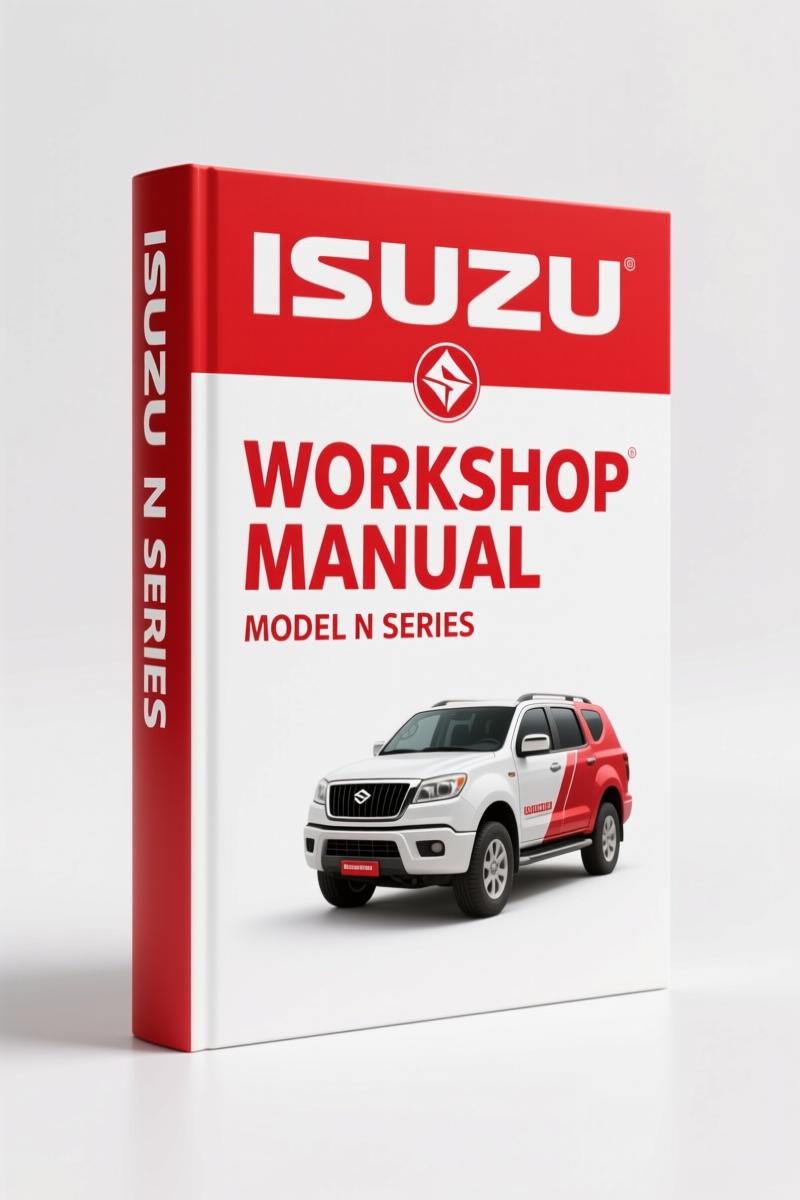
Isuzu N Series 2008 Workshop Manual – OEM Brake & ABS Specs
Original price was: $66.15.$45.00Current price is: $45.00.
OEM brake system diagnostics, torque tables, and ABS/ASR troubleshooting for Isuzu N Series 2008. 388 pages of factory-sourced data.
Description
Isuzu N Series 2008 Workshop Manual
I’ve been turning wrenches since before some of you were born, and I’ve seen more hacked-together brake jobs than I care to count. If you’re working on an Isuzu N Series 2008, you need the actual factory data—not some aftermarket paperback that guesses at torque values. This Workshop Manual is what the dealers used. It’s 388 pages of straight-from-the-engineer specs, covering the entire brake system and ABS/ASR diagnostics. You pull a master cylinder on this truck without the right tightening sequence, you are coming back to a pedal that sinks to the floor. Period.
The section on the brake master cylinder alone is worth the price of entry. Page 36 (the actual manual page numbering) walks you through components, removal, disassembly, reassembly, installation, and a proper list of tightening torques. I don’t care if you’ve done a hundred brake jobs—each vehicle has its own sequence. The Isuzu engineers put that in for a reason. And if you’re thinking about skipping the functional inspection before you start pulling parts? Don’t. That’s on page 21 of the hydraulic brake system sub-section. They describe exactly how to test the system before you break a single line. That’s the kind of step that saves you from having to buy a new booster because you missed a pre-load check.
Brake Master Cylinder: From Removal to Torque Specs
This manual gives you the full breakdown for the brake master cylinder. You get component diagrams, removal sequence, disassembly steps, reassembly order, installation instructions, and a dedicated list of tightening torques. The cylinder bore, the piston return spring, the reservoir seals—everything is documented. The torque values are in lb-ft and N·m, so you don’t have to convert anything. The manual even tells you which special tools are required. If you’re used to Haynes diagrams that skip half the clips, you’ll see the difference immediately.
One thing that catches guys out: the reassembly order for the master cylinder. The manual explicitly states the sequence for installing the secondary piston, primary piston, and snap ring. Do it backwards and you’ll have a leak you can’t trace. I’ve seen it. This manual prevents that hour of head-scratching.
ABS/ASR System: Full Diagnostic Trouble Codes
The ABS/ASR section is a whole separate part of the book (Section 4C1). It starts with precautions for servicing—because ABS systems store pressure and you don’t want to be the guy who cracks a line without de-pressurizing. Then it lists every diagnostic trouble code from C0213 to C0264, with flash codes, scan tool procedures, and symptom-based troubleshooting. For example, DTC C0235 (flash code 35) points to a wheel speed sensor circuit malfunction. The manual tells you exactly what to test: resistance, voltage, and continuity to the EHCU connector. No guesswork.
If you’re chasing an intermittent problem—like ABS working too frequently but brakes feel fine—there’s a symptom table that lists causes and corrective actions. The scan tool communication check is also covered, including what to do if the tool doesn’t talk to the Class 2 device. You need OEM data for that; aftermarket books rarely explain the CAN bus handshake sequence. This manual does.
Hydraulic Brake Booster: Function and Maintenance Precautions
The hydraulic brake booster section includes a description of function and operation, plus maintenance precautions. That’s critical because the booster uses power steering fluid, and mixing the wrong fluid or ignoring the filter results in seal failure. The manual shows the component location diagram for the booster fluid and filter, and then walks through removal, disassembly, reassembly, installation, and adjustment. There’s even a list of tightening torques for the booster mounting bolts. If you’ve ever had a booster come loose because you guessed the torque, you’ll appreciate having the exact number.
Adjustment procedure is on page 50-something (the actual page numbers are in the PDF). It tells you how to set the pushrod clearance so the booster doesn’t apply residual pressure. That kind of spec is what separates a safe stop from a dragging brake that warps rotors.
Rear Drum Brake Variations: 240mm to 370mm
This manual doesn’t give you one generic rear drum brake procedure and call it done. It covers multiple variants: with A/AJ φ240/290mm (9.45/11.42in), φ320mm (12.60in), φ370mm (14.57in), and with M/AJ. Each has its own components, removal, disassembly, inspection, reassembly, and installation steps. The φ370mm rear drum brake section even includes primary specifications like shoe clearance and wheel cylinder bore size. If you’re swapping axles or converting from drum to disc, you need these specific measurements. The list of tightening torques at the end of each sub-section keeps you from overtightening the backing plate bolts—common mistake that leads to distorted flanges.
The Load Sensing Proportioning Valve (LSPV) adjustment is also documented. That valve is responsible for brake proportioning based on rear axle load. If you don’t adjust it correctly, you’ll get rear wheel lockup under heavy braking. The manual gives the adjustment procedure step by step. I’ve seen guys set it by eye and then wonder why the truck swaps ends on a wet road. Don’t be that guy.
Why Factory OEM Beats Aftermarket Manuals
I’ve said it a hundred times: aftermarket manuals are fine for changing oil, but when you’re dealing with systems that can kill someone—brakes, steering, suspension—you go OEM. This is a genuine Isuzu factory publication. The wiring diagrams are correct. The torque tables match what the assembly line used. There are no “typical” torque values or “reference” illustrations. Every spec is verified. The OCR excerpt from the manual shows the actual page layout—clean, professional, no ads. If you’re tired of chasing ghost specs from third-party documents, this is your last stop.
Check out related manuals for your Isuzu platform: ISUZU N SERIES 2008 Workshop Manual is the one you’re looking at. For deeper diagnostics, the Isuzu N Series Training Manual – 1640 Pages OEM Brake & Torque Specs covers the same platform with more classroom-level detail. If you’ve got a 4JJ1 engine, the Isuzu AI-4JJ1X, AJ-4JJ1T, BJ-4JJ1X, BU-4JJ1T Workshop Manual – 278 Pages pairs with this brake book. For industry context on why factory manuals matter, see Automotive Industry Overview and Automotive Industry Overview.
- What torque specs are included for the brake master cylinder?
- The manual lists tightening torques for the master cylinder mounting nuts and brake line fittings. Exact values are on the List of Tightening Torques page in the brake master cylinder sub-section. Use a torque wrench—don’t guess.
- Does this manual cover ABS trouble codes?
- Yes.
- How many pages does the brake section alone cover?
- The brake section (Section 4B and 4C1) is roughly 150 pages out of the total 388. It includes every procedure for the hydraulic brake system, master cylinder, boosters, disc/drum brakes, LSPV adjustment, ABS/ASR diagnostics with DTC tables, and wheel speed sensor tests. That’s enough to rebuild the entire braking system from scratch with factory precision.
- Is this manual the same as a Chilton or Haynes?
- No. Chilton and Haynes condense multiple vehicle models into one book, often omitting variant-specific data like the φ370mm drum brake or hydraulic booster adjustment. This Isuzu factory manual covers one model line only, with full part numbers, special tool lists, and wiring schematics. There’s no comparison.
You need the right information before you touch a wrench. Don’t rely on forum posts or outdated PDFs. Get the data that the factory put together. Access the Factory Manual from AutoRepairManuals and put it on your tablet or print the pages you need. I guarantee you’ll reference it every time you open a brake line on an N Series.
Additional information
| Brand | Isuzu |
|---|---|
| Language | English |
4 reviews for Isuzu N Series 2008 Workshop Manual – OEM Brake & ABS Specs
You may also like…
-
Sale!
Isuzu FRR 1997 Service Manual – 755 Pages of Factory Specs
Original price was: $85.80.$65.00Current price is: $65.00. -
Sale!
Isuzu NPR, W3500, NQR, NPR-HD, NRR 2006 Service Manual – 37 Pages
Original price was: $93.00.$60.00Current price is: $60.00. -
Sale!
Isuzu AA-6SD1T Workshop Manual – 243 Pages of OEM Engine Service Data
Original price was: $89.70.$65.00Current price is: $65.00. -
Sale!
Isuzu FRR WT5500 2002 Service Manual | Factory Specs
Original price was: $92.40.$60.00Current price is: $60.00.
Related products
-
Sale!
Acura NSX 1991 Service Manual – 1420 Pages OEM
Original price was: $102.05.$65.00Current price is: $65.00. -
Sale!

2011 Parts Catalog – International Truck OE Parts Documentation (1786 Pages)
Original price was: $34.50.$25.00Current price is: $25.00. -
Sale!

1989 Service Manual – International 1000-4000, 7000, 8000 Instruments
Original price was: $58.80.$40.00Current price is: $40.00. -
Sale!

Service Manual – International HS 2.8L Engine – 130 Pages of Factory Specs
Original price was: $56.40.$40.00Current price is: $40.00.
diy_master –
This is just what I was looking for. The document is very clear. Contains precise bolt torque specs for Isuzu. Great value for money.
James L. –
This is just what I required. It is easily zoomable on my phone without losing quality. Every wiring layout is provided for Isuzu N. Great value for money.
gearhead88 –
I am very pleased with this purchase. The file is high resolution. It helped me to repair my Isuzu N electrical system. Worth every penny.
John S. –
This is exactly what I needed. The text is searchable and well indexed. A must-have for any Isuzu N DIYer doing repairs. Worth every penny.