
Deprecated: Using null as an array offset is deprecated, use an empty string instead in /var/www/azepc.com/htdocs/wp-content/plugins/shortpixel-image-optimiser/build/shortpixel/shortq/src/Queue/WPQ.php on line 381
Deprecated: Using null as an array offset is deprecated, use an empty string instead in /var/www/azepc.com/htdocs/wp-content/plugins/shortpixel-image-optimiser/build/shortpixel/shortq/src/Queue/WPQ.php on line 381
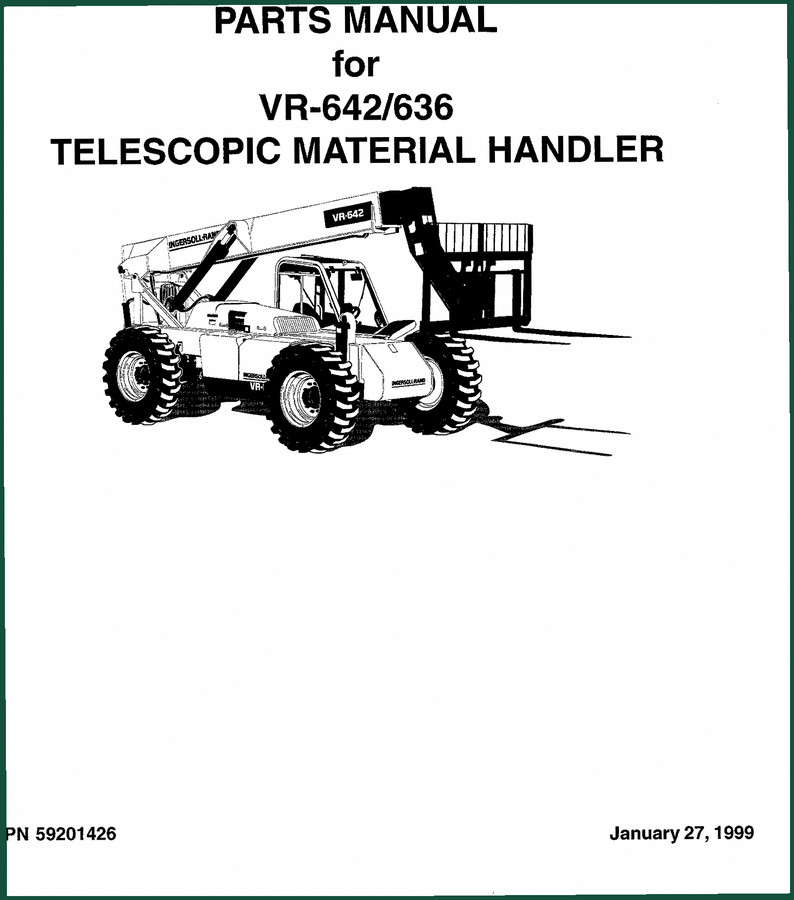
Ingersoll Rand VR-642, VR-636 1999 Parts Catalog – OEM Specs
Original price was: $38.16.$24.00Current price is: $24.00.
Factory-issued parts catalog for VR-642/636 telehandlers. 294 pages of OEM part numbers, exploded views, and warranty coverage.
Description
Ingersoll Rand VR-642, VR-636 1999 Parts Catalog
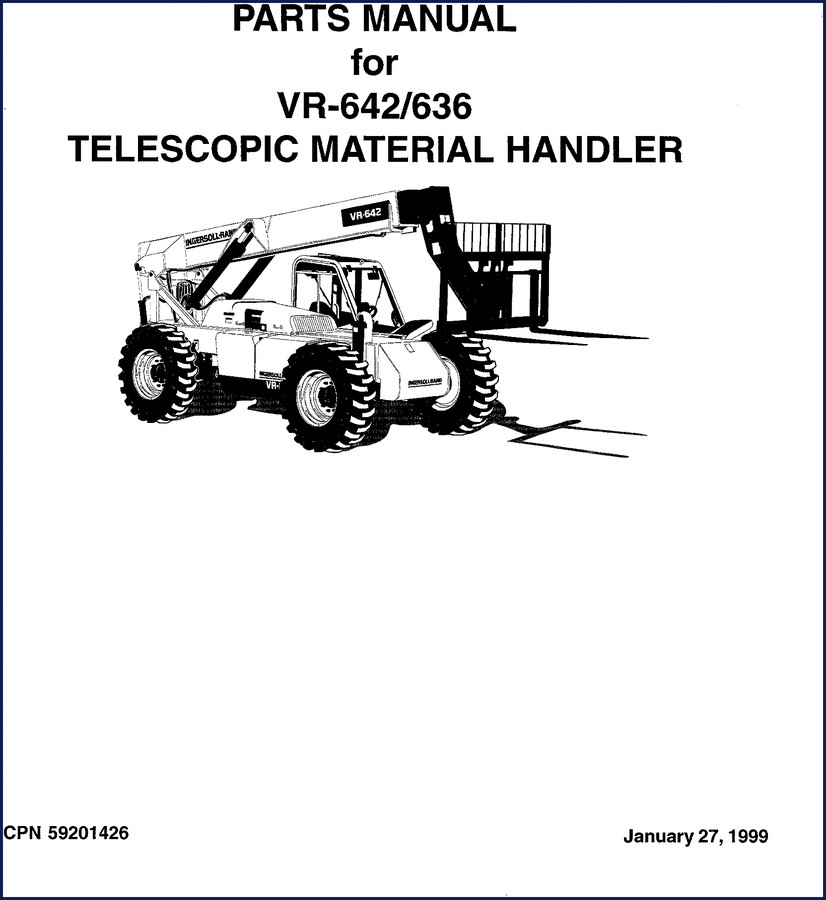
You’ve got a VR-642 in the bay, boom not lifting, and you need a hydraulic seal kit. You pull up some third-party site, see a blurry JPEG and a part number that doesn’t match anything on the machine. Now you’re three days behind and the customer’s calling. That’s the pain I see every week in San Antonio. Guys ordering the wrong element because they guessed between turbo and naturally aspirated. This is where the Ingersoll Rand VR-642, VR-636 1999 Parts Catalog earns its space on your bench. It’s the original factory documents, scanned from the 294-page binder Ingersoll Rand shipped in ’99. No aftermarket cross-references, no re‑typed lists that drop a digit. Every part is drawn and numbered by the guys who built the machine.
Ingersoll Rand VR-642/636 Parts Catalog: 294 Pages of Factory Data
This catalog covers both the VR-642 and VR-636 telescopic material handlers. The Table of Contents splits the machine into twelve sections starting with Section A – Main Frame and running through Section P – Publications and Training. Section C covers the Engine and Transmission assembly. Section E handles the Electrical system. Section H gets into Hydraulics. Every section has an illustration on the even page and the corresponding parts list on the odd page. That’s the same layout Ingersoll Rand used in their own service bays. You flip to Section F – Boom and Carriage to see the extendable boom components or Section G – Operator’s Compartment for joystick and panel parts. The page numbering is alphanumeric: C.2.3 for the air cleaner installation, for example. That system keeps related parts grouped together even if the manual grows during production.
Section C – Engine/Transmission: Where Most Problems Start
Engine and transmission parts eat up a solid chunk of this manual. The section splits naturally aspirated and turbocharged engines into separate sub‑sections. Page C.2.3 lists the air cleaner primary element (Comm. No. 59144170) for the naturally aspirated setup. Page C.8.3 covers the turbocharged version. If your machine has a boost line running to the intake, you need the turbo section. The transmission parts are drawn out in the same sub‑section, showing the bellhousing bolts, the shift linkages, and the coupler to the drive axle. I’ve used this catalog to identify a mis‑ordered clutch pack — the illustration saved me from pulling the wrong unit. Part numbers are genuine Ingersoll Rand OEM numbers, not aftermarket substitutes. You call your dealer with that number, and the part shows up correct.
Using the Word Index to Find Any Part in Under 30 Seconds
Ingersoll Rand put a Word Index in the back of this catalog. It’s an alphabetical list of every functional description in the book. Need a back‑up alarm? Look under Alarm, Back‑up — it points to Section E, page E.4.3. The index also lists items under multiple names: “Air Cleaner Primary Element” appears as both “Air Cleaner Primary Element” and “Element, Primary Air Cleaner.” That’s a small detail that saves you from flipping through 294 pages guessing. Once you find the page reference, the parts illustration on the even page shows the item number. The odd page lists the Comm. Number, description, quantity, and any notes. The Numerical Index in the back runs the other direction — you have a Comm. Number in hand and need to know where it lives. That index gives you the section page. It’s built for a mechanic who doesn’t have time to play detective.
What Makes This OEM Catalog Different from a Third-Party Parts List?
I’ve got a stack of aftermarket parts catalogs from shows. Half of them use generic part numbers that map to a dozen different machines. One wrong digit and you get the wrong length hose or the wrong filter thread. This is an OEM factory document printed by Ingersoll Rand in 1999. The illustrations are engineering drawings, not photographs taken with a phone. The part numbers are the same ones stamped on the original castings. If the Comm. Number says 59144170, that air cleaner element fits the VR-642 naturally aspirated, period. Aftermarket catalogs often leave out variations like whether the machine has a turbo or a cold‑start option. This manual accounts for those variations because the factory knew every option when they printed it. You also get the Parts Warranty pages at the end — that’s the official Ingersoll Rand warranty policy on replacement parts. Something a third‑party won’t give you.
Section E – Electrical: Wiring Beyond the Battery
Electrical systems on telescopic handlers take a beating. Boom harnesses chafe, connectors corrode, and the back‑up alarm goes intermittent. Section E of this catalog covers the entire electrical system — from the battery cables to the instrument panel, the start circuit, the lighting, and the warning lamps. Each harness is drawn separately with connector callouts and wire color specs. If you need the alternator mounting bracket or the starter solenoid, the part number is right there on the illustration. The section also includes decals in Section D — not strictly electrical but tied into switch identification. I’ve seen guys replace a whole joystick because they didn’t have the electrical parts breakdown. This catalog shows you the individual switches and connector shells so you can repair instead of replace whole assemblies.
Section M – Maintenance Interval Kits: Schedule Your PMs Right
Section M lists Maintenance Interval Kits. These are pre‑assembled groups of parts for common service intervals — 1,000 hours, 2,000 hours, and so on. Each kit contains filters, seals, gaskets, and wear items that need changing at that hour mark. Ordering the kit instead of individual parts reduces the chance of missing a gasket or getting the wrong oil filter. The kit Comm. Numbers are listed alongside the individual breakdowns. If you’re running a fleet of VR‑642s and VR‑636s, these kits keep your PMs consistent. I keep a copy of this section laminated and bolted to my service truck door so I can call in orders without dragging the whole catalog through the mud.
Now, if you need additional factory documents for other Ingersoll Rand equipment, check these related manuals:
- Ingersoll Rand T-708H Tow Tractor Parts Manual 2000
- Ingersoll-Rand RT-706H/708H Rough Terrain Forklift Parts Manual
- Ingersoll Rand SD 70, 77TF Vibratory Compactors Parts Manual
For broader context on the construction equipment industry, see Automotive Industry Overview and Automotive Industry Overview.
Frequently Asked Questions
- Can I use this parts catalog for the VR-642 and VR-636 both?
- Yes, it covers both models with the same manual.
- Does this manual include torque specs for engine and transmission bolts?
- No, this is a parts catalog, not a service manual. It gives part numbers and exploded views. You’d need the service manual for torque values.
- How do I know if my machine is naturally aspirated or turbocharged?
- The manual breaks the engine section into two sub‑sections: Naturally Aspirated and Turbocharged. Page C.2.3 covers the NA air cleaner, page C.8.3 covers the turbo version. The Word Index lists both. If your serial number falls within the range in the manual intro, you can cross‑reference. If not, check the air cleaner housing—NA has a flat cap, turbo has a round canister with a boost line. I’ve seen guys order the wrong element and then blame the machine. Use the illustrations in Section C to match what’s on your machine.
- What are Maintenance Interval Kits listed in Section M?
- Section M groups parts by service intervals—1,000‑hour, 2,000‑hour, etc. Each kit includes filters, seals, and wear items. Ordering the kit saves ordering individual parts and reduces the chance of missing a gasket.
If you’re tired of chasing ghosts in your parts ordering, access the factory manual from AutoRepairManuals and keep a copy on your shop tablet. You’ll pull the right Comm. Number the first time, every time.
Additional information
| Brand | Ingersoll Rand |
|---|---|
| Language | English |
3 reviews for Ingersoll Rand VR-642, VR-636 1999 Parts Catalog – OEM Specs
You may also like…
-
Sale!

Ingersoll Rand ZX75 ZX125 2006 Service Manual | OEM Specs
Original price was: $93.60.$65.00Current price is: $65.00. -
Sale!

Ingersoll Rand ZX 75 2006 Service Manual – 804 Pages
Original price was: $67.95.$45.00Current price is: $45.00. -
Sale!

Ingersoll Rand VR-1056C 2007 Parts Catalog – OEM Parts Identification
Original price was: $60.84.$39.00Current price is: $39.00. -
Sale!

Ingersoll Rand SD-100, SD-120, SD-150 2002 Service Manual – 314 Pages
Original price was: $50.76.$36.00Current price is: $36.00.
Related products
-
Sale!

1989 Service Manual – International 2000-8000 Electrical Systems
Original price was: $72.00.$50.00Current price is: $50.00. -
Sale!

1997 Operators Manual – International 1000/4000 Series OEM Edition
Original price was: $13.49.$9.99Current price is: $9.99. -
Sale!

2011 Parts Catalog – International 7400 SFA 6X6 – 1886 Pages of OEM Part Numbers
Original price was: $32.00.$25.00Current price is: $25.00. -
Sale!

2011 Parts Catalog – International Truck OE Parts Documentation (1786 Pages)
Original price was: $34.50.$25.00Current price is: $25.00.
Thomas B. –
This is just what I needed. It is easily zoomable on my laptop without losing quality. Contains detailed bolt torque specs for Ingersoll Rand. I will definitely buy again.
James L. –
This is exactly what I was looking for. The scan is high-quality and well indexed. A must-have for any Ingersoll Rand Rand owner doing maintenance. Saves me so much money.
diy_master –
Great buy! It is very easy to read on my laptop without blur. It guided me to troubleshoot my Ingersoll Rand Rand electrical system. Worth every penny.