
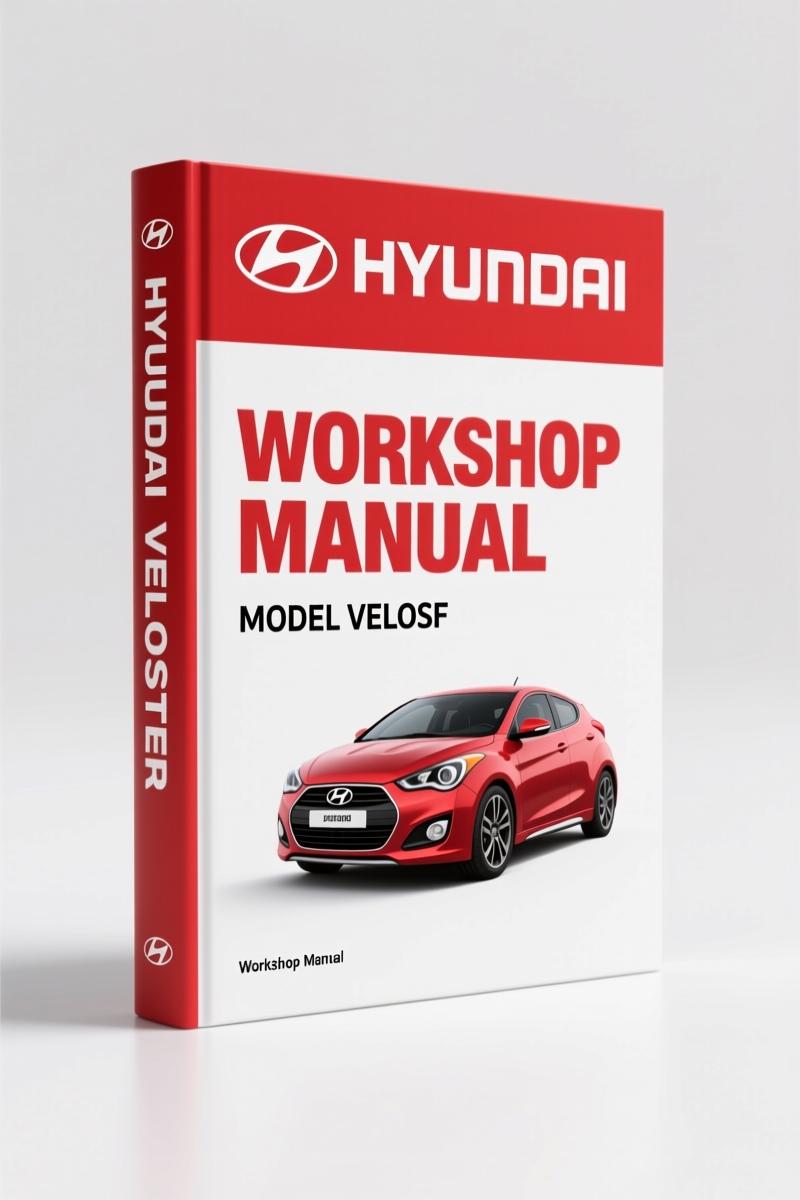
Hyundai Veloster 2012 Workshop Manual – Factory Brake & Chassis Specs
Original price was: $33.00.$25.00Current price is: $25.00.
63-page factory Hyundai Veloster 2012 workshop manual with brake system torque specs, troubleshooting, and fluid capacities.
Description
Hyundai Veloster 2012 Workshop Manual – What the Factory Technicians Use
You get a 2012 Hyundai Veloster in the bay with a brake pedal that sinks to the floor. Aftermarket wiring diagrams and generic torque charts? Not going to cut it. I’ve seen guys strip hub nuts guessing at 88 Nm because they didn’t have the factory spec. That costs a comeback and a pissed-off customer. Here’s why you need the real thing – the factory Hyundai Veloster 2012 Workshop Manual, 63 pages of OEM data that covers exactly what Hyundai’s own techs rely on.
Hyundai Veloster 2012 Workshop Manual – The Data You Can Trust
I’ve torqued more head bolts than most people have had hot meals, and I can tell you one thing: guessing gets you nowhere. This manual opens with service standards for brake pedal height (191.61 mm / 7.54 in) and free play (1.8–4.2 mm / 0.07–0.17 in). Page 2 has those numbers. That’s not a suggestion – it’s the production line spec. You deviate from it? You get a customer complaining the pedal feels off.
Brake Pedal Height and Free Play – Service Standards from Page 2
The manual lays out the complete service standard table. Brake pedal full stroke at 135 mm (5.31 in). Stop lamp switch clearance at 1.0–2.0 mm (0.04–0.08 in). Front brake disc thickness minimum 23 mm (0.91 in). Pad thickness at 10.5 mm (0.41 in). You need to know these before you touch a wrench. Aftermarket guides often round numbers – not this one. It gives you the exact range, and if you’re out of spec, you know what to replace.
Tightening Torques for Every Brake Component
Page 2 also has the tightening torque table. N.m, kgf.m, lb-ft – all three units. Hub nut: 88.3–107.9 Nm (65.1–79.6 lb-ft). Caliper guide rod bolts front and rear: 21.6–31.4 Nm (15.9–23.1 lb-ft). Brake hose to caliper: 24.5–29.4 Nm (18.1–21.7 lb-ft). I’ve seen a kid snap a bleeder screw because he used a torque wrench set to 15 Nm instead of 6.9–12.7 Nm. The spec is there. Use it.
Troubleshooting a Spongy Pedal Without Guessing
Page 3 gives you a problem symptoms table. Symptom: lower pedal or spongy pedal. Suspect areas: fluid leaks, air in system, worn piston seals, rear brake shoe clearance out of adjustment, inoperative master cylinder. Priority numbers tell you the order to check. This is the systematic approach that prevents you from replacing parts that aren’t broken. Follow the table, check fluid first, then look for air, then seals. Don’t skip steps.
Why a Factory Manual Beats an Aftermarket Reprint
Aftermarket manuals often compress data from sources like Automotive Industry Overview and miss critical details like the lubricant spec for caliper guide rods. This manual says: AI-11P grease, 0.8–2.0 g per side. That matters. The brake booster mounting nuts torque is 18.6–23.5 Nm (13.7–17.4 lb-ft). If you use a generic value, you risk a vacuum leak. This is the original OEM print from Hyundai’s technical database. No editor took liberties. For broader context on industry standards, see Automotive Industry Overview.
FAQ – Common Questions About This Manual
- Does this manual include wiring diagrams?
- It covers brake system wiring only. Engine wiring not in this 63-page excerpt.
- What torque value is used for the front caliper guide rod bolts?
- Page 2 lists them at 21.6–31.4 Nm (15.9–23.1 lb-ft). I’ve seen backyard mechanics torque these to 35 lb-ft thinking tighter is better. That binds the guide rod and causes uneven pad wear. The factory spec is there for a reason – stick to it. And don’t forget the AI-11P grease for the guide rod and boot. That’s on the lubricants table, 0.8–2.0 g.
- Can I use this manual for brake bleeding procedures?
- The troubleshooting section on page 3 points to fluid leaks and air in the system as causes of a spongy pedal. The manual expects you to know the bleeding sequence – it doesn’t spell it out step-by-step. You’ll need the service standard specs for pedal stroke and free play to check your work.
- Is this the same as the manual from Hyundai dealership?
- Yes. This is the factory document distributed to Hyundai technicians. No aftermarket rehash.
Related Manuals
- Hyundai R160LC Workshop Manual – Factory 459-Page OEM Shop Guide
- Hyundai 170W 7 Workshop Manual – Factory OEM Transmission Guide
- Hyundai L4GC 2006 Workshop Manual – Factory OEM Shop Guide
You don’t have to guess anymore. Access the Factory Manual and work with the same specs Hyundai builds around.
Additional information
| Brand | Hyundai |
|---|---|
| Language | English |
4 reviews for Hyundai Veloster 2012 Workshop Manual – Factory Brake & Chassis Specs
You may also like…
-
Sale!
Hyundai HD65, HD72, County Training Manual – A/C Diagnostics
Original price was: $65.00.$50.00Current price is: $50.00. -
Sale!
Hyundai HDF15-5, HDF18-5 Service Manual – 227 Pages
Original price was: $61.65.$45.00Current price is: $45.00. -
Sale!
Hyundai HDF50III, HDF70III Service Manual – Factory Repair Specs
Original price was: $70.20.$45.00Current price is: $45.00.
Related products
-
Sale!
2004 Acura TSX Wiring Diagram – 73-Page Factory Electrical Schematics
Original price was: $15.88.$9.99Current price is: $9.99. -
Sale!
Acura NSX 1991 Service Manual – 1420 Pages OEM
Original price was: $102.05.$65.00Current price is: $65.00. -
Sale!

1991 Electrical Schematic – 112-Page OEM Wiring Diagram for International 1000-3000 Series
Original price was: $22.75.$17.50Current price is: $17.50. -
Sale!

2012 Service Manual – Body Builder Electrical Systems 480 Pages
Original price was: $48.28.$34.00Current price is: $34.00.
James L. –
I am very pleased with this manual. The document quality is excellent. Every wiring layout is provided for Hyundai Veloster. I will definitely buy again.
pro_mechanic –
I am extremely satisfied with this manual. The PDF quality is excellent. It guided me to rebuild my Hyundai Veloster transmission. Saves me hundreds of dollars.
David K. –
This is exactly what I was looking for. The pages are clean and easy to navigate. Every wiring layout is included for Hyundai Veloster. Worth every penny.
Robert M. –
Perfect OEM spec sheet. The pages are clean and easy to navigate. It assisted me to rebuild my Hyundai Veloster transmission. Saves me a lot of time.