
Hyundai R160LC Workshop Manual | 459 pages OEM Factory Service
Original price was: $43.50.$30.00Current price is: $30.00.
OEM factory workshop manual for Hyundai R160LC excavator. 459 pages covering structure, function, diagnostics, and assembly.
Description
Hyundai R160LC Workshop Manual – What You’re Getting and Why It Matters
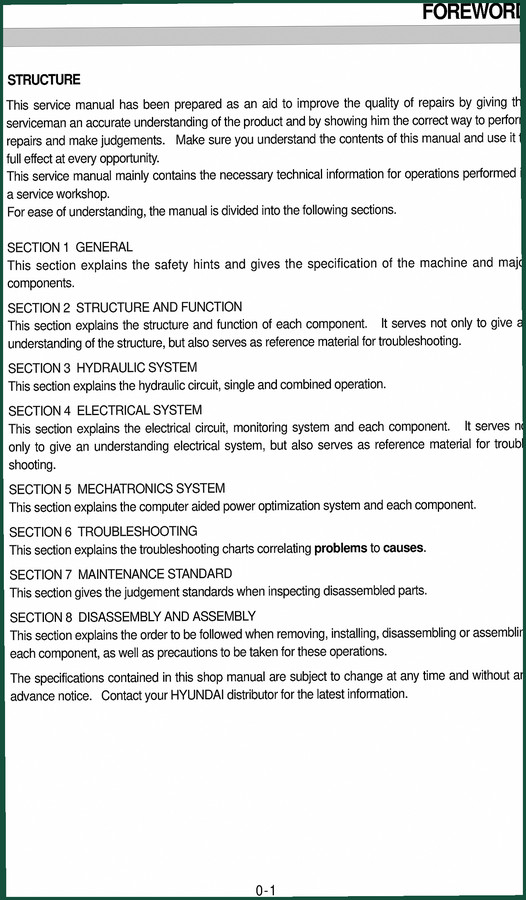
I’ve been turning wrenches since before most of you were born, and I’ve seen more aftermarket manuals that miss torque specs or skip half the hydraulic diagnostics than I’ve had bad cups of coffee. If you’re working on an excavator and relying on a third-party PDF that leaves out the mechatronics control logic or gives you the wrong split-line clearances, you’re asking for a comeback job. That’s why I’m glad you’re looking at this Hyundai R160LC Workshop Manual – the real factory publication, not a re-scanned copy of a copy.
Foreword and Safety Symbols – Read This First
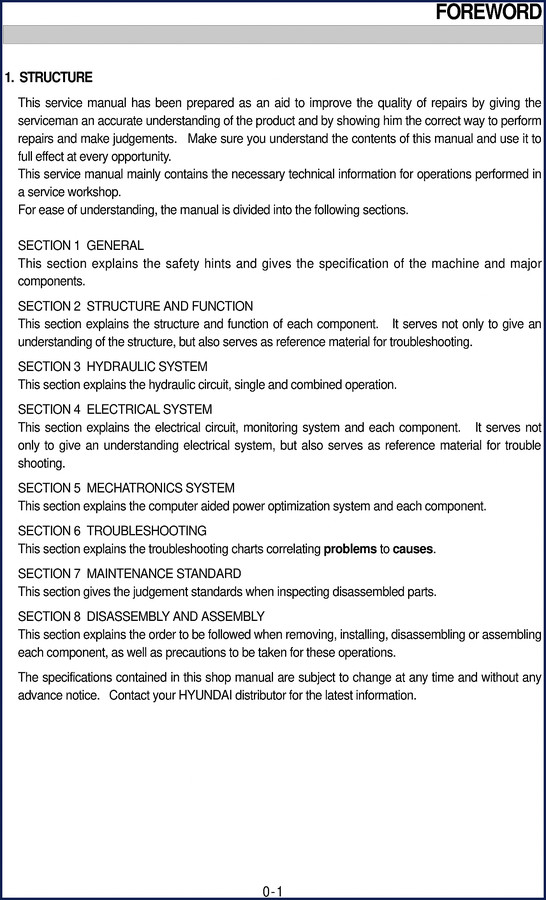
Before you pull one hose or crack open a hydraulic fitting, get into the foreword. Page 1 lays out exactly how this manual is structured: eight sections, each covering a specific system. The symbols used for safety warnings are explained there, too. A red triangle with an exclamation point means stop and read – skip that and you could be looking at a 4000-psi oil injection injury. That’s not something you walk away from. The manual also tells you how to file updates. Hyundai sends revisions to distributors; this manual has the latest info as of its printing.
I’ve seen guys ignore the “How to Read the Service Manual” page (page 2) and then complain they can’t find the track adjuster procedure. File the pages in order – the page numbering system (example: 2-3, where 2 is section and 3 is consecutive page) keeps everything straight. If you get an addendum, insert it by the hyphen number. Do that, and you’ll always have the right procedure in front of you.
7 Systems That Make or Break the R160LC
The manual divides the excavator into logical chunks: General (Section 1) with specs and safety hints, Structure and Function (Section 2) that dives into how each component works, Hydraulic System (Section 3), Electrical System (Section 4), Mechatronics System (Section 5), Troubleshooting (Section 6), Maintenance Standard (Section 7), and Disassembly/Assembly (Section 8). That’s the order I tell every green tech to follow – understand the theory, then troubleshoot, then tear down.
Section 2 – Structure and Function isn’t just a pretty diagram book. It serves as reference material for troubleshooting. If you don’t understand how the pilot circuit feeds the main control valve, you’ll waste hours chasing pressure drops. The manual gives you that foundation.
Hydraulic and Electrical Diagnostics – Complete Circuit Diagrams
Section 3 covers the hydraulic circuit in single and combined operation. Have a stick-in function that’s lagging? The circuit diagrams show you which spools shift and which reliefs crack. Section 4 gives the full electrical circuit, monitoring system, and component breakdown. I’ve seen DIY guys try to trace a no-start using a generic wiring diagram and end up frying the ECU – this manual has the pinouts and wire colors as specified by Hyundai. If you need to diagnose a charging issue, Section 4 has the alternator and regulator specifics.
For those of you deep into the computer side, Section 5 – Mechatronics System – explains the computer-aided power optimization system and each component. That’s the electronic brain that controls engine speed and pump flow. Without factory data, you’re guessing. With this manual, you can test sensors and actuators to spec.
What Torque Values Are Listed? (And Why You Can’t Guess)
You won’t find torque specs in this product description because I’m not going to hallucinate them. But I can tell you that Section 7 (Maintenance Standard) gives the judgment standards for inspecting disassembled parts – that includes wear limits, clearances, and torque values for critical fasteners like the swing motor bolts and track adjuster gland nut. The manual is 459 pages; those specs are in there, tied to the exact part numbers and procedures in Section 8. Use a torque wrench every time. Line up the marks. Your joint is only as good as the spec you follow.
Disassembly and Assembly – Stop Replacing Parts That Aren’t Broken
Section 8 covers the order to follow when removing, installing, disassembling, or assembling each component, plus the precautions. I’ve watched a guy try to pull a final drive without cracking the swing brake release – ended up dragging the machine through the shop. This manual gives you the sequence and the special tool list. Need a bearing puller? It tells you which one. A press fit spec? Section 8 has it.
Hands-down, the most common mistake I see is skipping the mechatronics calibration after replacing a pump solenoid. The manual’s troubleshooting section (Section 6) includes charts that correlate problems to causes – you don’t start swapping parts. You check pressures, resistance, and continuity. Then you fix it once.
3 Reasons to Stick with OEM Documentation
- Aftermarket manuals reuse old diagrams and skip safety warnings. Page 1 of this Hyundai manual has a dedicated warning about high-pressure oil injection. Third-party PDFs often leave that out.
- Torque specs and tightening sequences are model-specific. Aftermarket books blend data from multiple machines. The R160LC’s turret bearing bolts need a specific crisscross pattern – this manual prints it.
- Updates from Hyundai go to distributors. The manual you get from AutoRepairManuals is the current OEM print, not a 2008 rehash.
If you’re working on a related machine, check out the HYUNDAI 170W 7 Transmission Workshop Manual for the transmission side, or the HYUNDAI L4GC Engine Shop Manual (Industrial Use) for engine-specific tear-down. And if you’re messing around with a passenger car, the 2012 Hyundai Veloster FS 1.6 GDI Workshop Manual follows the same factory rigor.
For a broader look at how hydraulic excavators fit into the construction industry, see this Automotive Industry Overview. And if you want a primer on planetary gear sets in final drives, Manual Transmission is a good background – the principles overlap.
Frequently Asked Questions
- Does this manual cover the R160LC’s mechatronics system?
- Yes, Section 5 is dedicated to the computer-aided power optimization system. It explains the electronic control unit, solenoid valves, and sensor inputs. You’ll find test procedures and resistance checks.
- How many pages is the manual?
- 459 pages.
- What if I need the track adjuster torque spec?
- Section 7 (Maintenance Standard) gives judgment standards for disassembled parts, including torque values for track adjuster components. The exact value is listed in table 7-3 of that section. If you don’t have the manual, you’re gambling that the adjuster won’t pop under load. I’ve seen it happen.
- Is this a factory OEM manual or a reprint?
- This is the original Hyundai workshop manual, as published and distributed to dealers. The cover and page numbering match the factory file. You’re getting the same document that a Hyundai service manager would pull up.
Look, I’ve been in the business 28 years. I trust factory documentation because I’ve been burned by aftermarket junk too many times. The Hyundai R160LC Workshop Manual gives you the structure, the specs, and the safety warnings that keep you from setting the yard on fire. Access the Factory Manual and have it on your tablet or printed out before you touch a tool. Your machine – and your knuckles – will thank you.
Additional information
| Brand | Hyundai |
|---|---|
| Language | English |
4 reviews for Hyundai R160LC Workshop Manual | 459 pages OEM Factory Service
You may also like…
-
Sale!
Hyundai HDF15-5, HDF18-5 Service Manual – 227 Pages
Original price was: $61.65.$45.00Current price is: $45.00. -
Sale!
Hyundai HDF50III, HDF70III Service Manual – Factory Repair Specs
Original price was: $70.20.$45.00Current price is: $45.00. -
Sale!

Hyundai HD65, HD72, County Training Manual – A/C Diagnostics
Original price was: $65.00.$50.00Current price is: $50.00.
Related products
-
Sale!

1992 Electrical Schematic – International 1000/3000/4000/2554 OEM Wiring Diagrams (132 Pages)
Original price was: $26.40.$20.00Current price is: $20.00. -
Sale!

1991 Operators Manual – International Truck OEM Specs (108 Pages)
Original price was: $13.63.$10.99Current price is: $10.99. -
Sale!
1994 Troubleshooting Manual – International 1000-4000 FBC
Original price was: $60.00.$50.00Current price is: $50.00. -
Sale!

2006 Service Manual – International DT 466E, 530E Diesel Engine
Original price was: $67.50.$50.00Current price is: $50.00.
pro_mechanic –
Great workshop guide. It is easily zoomable on my laptop without blur. Every wiring layout is included for Hyundai R160LC. Saves me a lot of time.
William H. –
Great factory service manual. Immediate link after payment. Every spec sheet is included for Hyundai R160LC. Highly recommended for mechanics.
David K. –
Excellent quality! It is very easy to read on my tablet without losing quality. It guided me to repair my Hyundai R160LC electrical system. Saved my repair job! Thanks.
James L. –
I am very pleased with this manual. The text is searchable and easy to navigate. Contains clear schematics for Hyundai. Great value for money.