
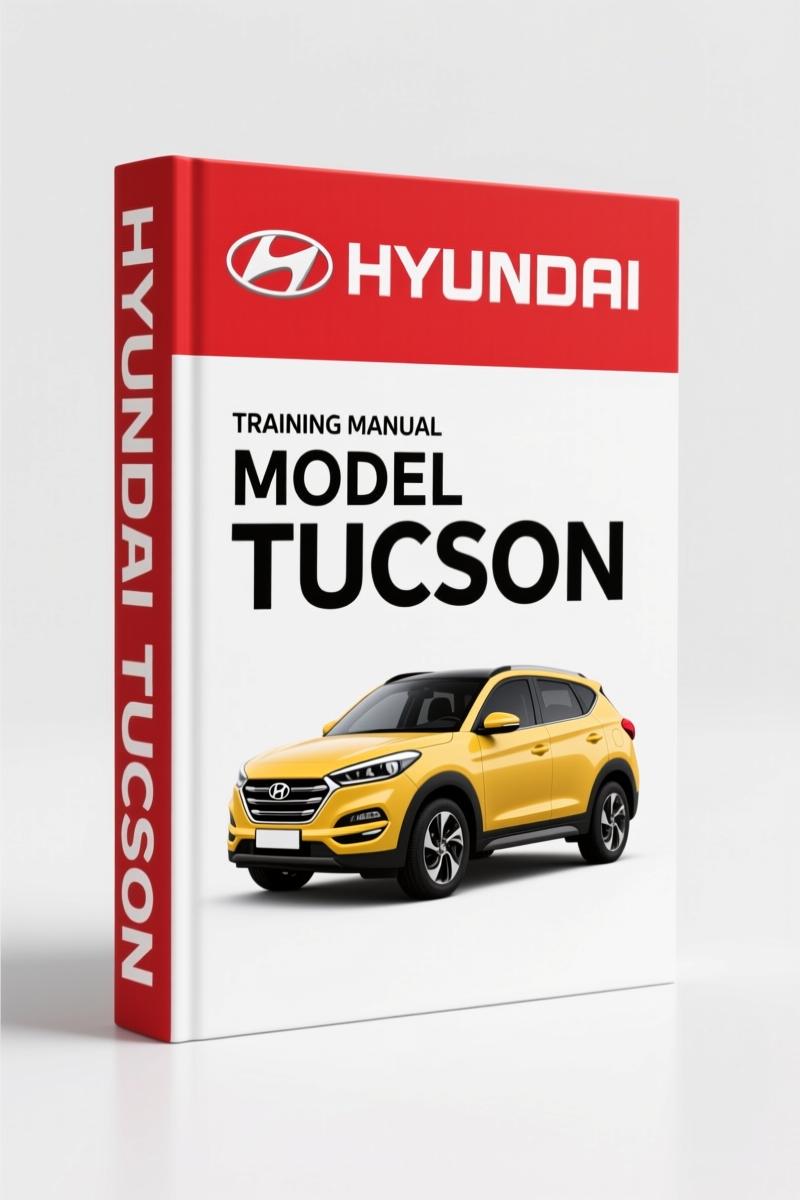
Hyundai TUCSON 2011 Training Manual – CRDi Fuel System Diagnostics
Original price was: $26.20.$20.00Current price is: $20.00.
49-page factory training manual covering CRDi D-2.0 fuel system diagnostics, low-pressure tests, and Euro-3/4 compliance for the 2011 Hyundai TUCSON.
Description
Hyundai TUCSON 2011 Training Manual: Factory Diagnostics for CRDi Diesel
If you have ever wasted a morning chasing a fuel pressure issue on a Hyundai TUCSON 2011 Training Manual CRDi diesel, you know the frustration. Aftermarket specs from some third-party PDF tell you “low pressure should be about X” but never give you the actual test procedure, the diagnostic logic, or the correct hookup for the CR-1000 tool. That is why this 49-page training manual from Hyundai sits on my bench next to the scan tool. It came from the same people who built the engine. It shows you the exact low‑pressure measurement points, the fuel return flow check for each injector, and the symptom table that tells you what a reading of 1.5 kg/cm² means. You do not guess. You measure, compare, and move on.
Fuel System Pressure Diagnosis – Low-Pressure Side
The manual dedicates multiple pages to the low‑pressure circuit on the D‑2.0 CRDi engine. Page 2 and 3 of the document walk you through connecting a pressure gauge to the low‑pressure pipe, starting the engine, and reading the value after five minutes. The table on page 3 lists three ranges: 0–1.5 kg/cm² points to leakage or electrical pump failure, 1.5–3.0 kg/cm² is normal, and 4–6 kg/cm² signals a blocked filter or pipe. That kind of diagnostic branching saves you from swapping parts blindly. The manual also differentiates between Euro‑3 (WGT) and Euro‑4 (VGT) systems, stating that the overflow valve moves to the high‑pressure pump face on later models. If you are working on a 2011 Tucson, you are dealing with Euro‑4 and VGT. The standard low‑pressure value is 4 bar.
Injector Return Flow Measurement – Static and Dynamic Checks
One of the most effective ways to spot a failing injector on a common‑rail diesel is to measure the fuel return volume. The manual lays out two procedures: a dynamic check with the engine running and a static check using the CR-1000 tool. For the dynamic test, you separate the return hose, install the plunger and connector from the special tool, and then run the engine at idle for one second, followed by 30 seconds at 3,000 rpm. You repeat that sequence twice, then read the test cup. The static check uses a high‑pressure gauge and applies pressure without the engine running. These are the exact steps factory technicians use during advanced courses. If you own a Tucson with a rough idle or hard start, this procedure alone can identify the culprit injector inside an hour.
Who Needs This Training Manual?
This is not a general service manual covering every nut and bolt on the vehicle. It is a focused training document for the Common Rail Direct Injection (CRDi) system on the 2011 Hyundai Tucson. If you are a shop owner who wants a technician to understand diesel injection without sending them to a week‑long class, or a DIY owner who already has a good scan tool and a pressure gauge, this manual works. The audience is the person who reads torque specs before tightening and who checks fuel pressure before condemning a pump. Beginners who have never used a CR-1000 tool will need to have the tool on hand and be comfortable with basic fuel system safety—no smoking, no open fuel, proper venting.
Why Factory Training Beats Aftermarket Manuals
I see aftermarket manuals that claim to cover “common-rail systems” but they lift generic diagrams from Wikipedia and guess at the procedure. This manual was printed by Hyundai for their own industrial technical instructors. It includes the instructor’s name (Marco Antonio Interiano) and the course number (A09). The document uses factory part numbers and tool references—like the “CRI 1000 specific tools” required for the static check. When you buy an OEM training manual from AutoRepairManuals, you get the same binder material that a Hyundai technician received in the classroom. No reprint, no third‑party compilation. That matters when you are diagnosing a system that operates at over 1,600 bar. Trust the source that built the engine. For a broader view of the automotive industry and how manufacturers structure training, see Automotive Industry Overview.
7 Procedures You Can Perform Using This 49-Page Manual
- Low‑pressure pipe oil pressure test with electrical pump
- Fuel return quantity measurement (dynamic) using CR-1000
- Fuel return quantity measurement (static) with high‑pressure gauge
- Symptom analysis for pressure readings of 0–6 kg/cm²
- Identification of overflow valve location per Euro-3 vs Euro-4
- Connector and adapter identification for factory tool set
- Judgment criteria for acceptable injector return values
Each procedure includes the step sequence, required tool list, and a judgment table. You do not get generic “check fuel pressure” advice. You get “connect the low‑pressure gauge to pipe connector B, start engine, wait 5 minutes, read value, compare to table.”
FAQ
- Does this manual cover the 2.0L CRDi engine only?
- Yes. The manual is written specifically for the D‑2.0 CRDi engine found in the 2011 Hyundai Tucson. It does not cover the 2.4L gasoline or any other powertrain.
- What pressure specs are listed in the manual?
- Low‑pressure values are given in kg/cm² and bar. For Euro‑4 VGT systems the standard low pressure is 4 bar. The symptom table lists 0–1.5, 1.5–3, and 4–6 kg/cm² ranges. High‑pressure specs are not shown in the OCR excerpt; the static check uses a high‑pressure gauge but the manual likely includes the full range later.
- Can a beginner use this manual without special tools?
- You still need the CR-1000 tool set and a low‑pressure gauge to perform the tests. The manual assumes you have those tools. Without them you can read the theory, but you cannot execute the checks.
- Is this a service manual or a training manual?
- Training manual. It covers diagnostic procedures and system analysis, not disassembly or repair of the engine. Use it alongside a factory service manual for repairs. Related documents include the Hyundai TUCSON 2004 Body Repair Manual and the Hyundai Tucson 2010 Service Manual. For heavy equipment applications, see the Hyundai HL780-9, HL730-9, HL740-9, HL757-9, HL760-9 2012 Training Manual.
Stop throwing parts at a Tucson that cranks but won’t start. Access the Factory Manual, follow the low‑pressure test on page 3, and know in twenty minutes whether the pump, filter, or injectors are the problem. That is the difference between a guessing game and real diagnosis.
Additional information
| Brand | Hyundai |
|---|---|
| Language | English |
4 reviews for Hyundai TUCSON 2011 Training Manual – CRDi Fuel System Diagnostics
You may also like…
-
Sale!
Hyundai HDF15-5, HDF18-5 Service Manual – 227 Pages
Original price was: $61.65.$45.00Current price is: $45.00. -
Sale!
Hyundai HDF50III, HDF70III Service Manual – Factory Repair Specs
Original price was: $70.20.$45.00Current price is: $45.00. -
Sale!
Hyundai HD65, HD72, County Training Manual – A/C Diagnostics
Original price was: $65.00.$50.00Current price is: $50.00.
Related products
-
Sale!

1992 Electrical Schematic – OEM Wiring Diagrams for International 1000-3800
Original price was: $24.48.$18.00Current price is: $18.00. -
Sale!
1992 Electrical Schematic – International 1000/3000/4000/2554 OEM Wiring Diagrams (132 Pages)
Original price was: $26.40.$20.00Current price is: $20.00. -
Sale!
1991 Electrical Schematic – 112-Page OEM Wiring Diagram for International 1000-3000 Series
Original price was: $22.75.$17.50Current price is: $17.50. -
Sale!
2004 Acura TSX Wiring Diagram – 73-Page Factory Electrical Schematics
Original price was: $15.88.$9.99Current price is: $9.99.
Thomas B. –
Perfect factory service manual. It is easily zoomable on my tablet without losing quality. It helped me to troubleshoot my Hyundai TUCSON electrical system. Highly recommended for mechanics.
gearhead88 –
Superb resource! The document quality is excellent. A must-have for any Hyundai TUCSON DIYer doing repairs. I will recommend this shop to others.
Robert M. –
This is exactly what I required. Instant access after payment. Every spec sheet is provided for Hyundai TUCSON. I will definitely buy again.
William H. –
Great workshop guide. The PDF is high resolution. Every torque spec is included for Hyundai TUCSON. Worth every penny.