
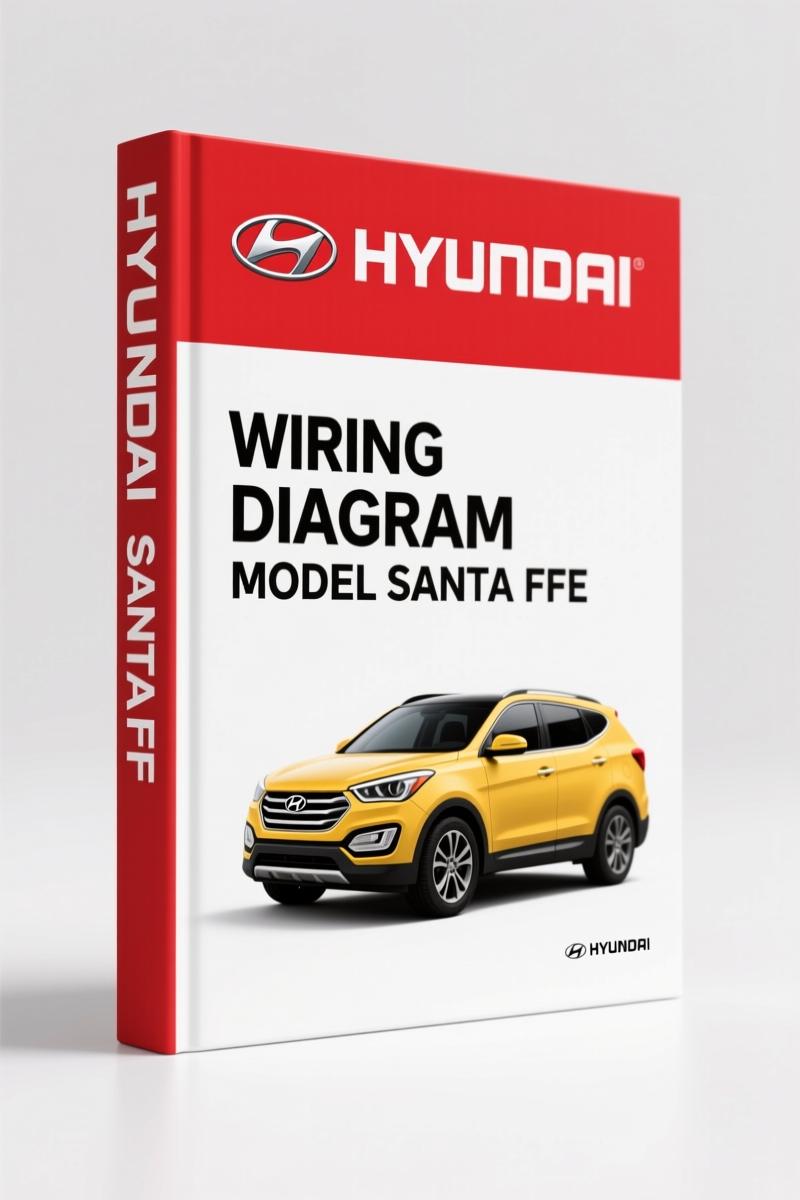
Hyundai Santa Fe Service Manual – Factory Emissions & Diagnostics
Original price was: $40.80.$30.00Current price is: $30.00.
OEM Hyundai Santa Fe service manual covering 2001-2002 emissions systems, sensor inputs, and vacuum routing – 353 factory pages.
Description
Hyundai Santa Fe Service Manual – 353 Pages of Factory Specs
I’ve seen too many guys pull a vacuum line off a Santa Fe and guess where it goes. Then they wonder why the CEL stays on. If you’re working on a 2001 or 2002 Hyundai Santa Fe, the factory Service Manual is what keeps you from chasing your tail. This isn’t a reprint from some aftermarket house that copies diagrams until the resolution turns to mud. It’s the original OEM file, all 353 pages, laid out the way Hyundai wrote it. You want to see the vacuum hose routing for the 2.4 I4 and the 2.7 V6? It’s right there on page 1, with the fuel pressure regulator and evap canister purge solenoid mapped out. No guesswork.
Emissions Control System Coverage
The manual dedicates an entire group to the Emissions Control System. That means you get the vacuum hoses layout for both engine variants, plus the schematic drawings that show every PCM input and output. On the 2.7 V6, you’ll see the heated oxygen sensor (HO2S), hot film sensor, camshaft position sensor, and all the PCM outputs like fuel injector, ignition coil, and evap canister purge solenoid valve. Page 2 gives you the full OBD-II wiring diagram. You can trace the main relay, fuel pump relay, and the whole fuel delivery path. This is the kind of detail that stops a four-hour diagnosis from turning into a two-day ordeal.
PCM Schematic: Why You Need the Original
Aftermarket manuals often simplify these schematics, combining signals or leaving out the EGR valve solenoid and the evap canister close solenoid valve. The factory PDF keeps every line. Look at page 3 for the 2.4 I4 – you’ll see the PCM inputs from the ignition switch, battery voltage, vehicle speed sensor, A/C switch (A/T only), PNP switch (A/T only), and fuel pump relay signal. Then the outputs: fuel injector, ignition coil, injector solenoid, evap canister purge and close solenoid valves, EGR valve solenoid, fuel pump control, and diagnosis. If you’re chasing a misfire or a no-start, this one page can save you an ECM replacement.
Emission Controls Location – Physical Part ID
Page 4 shows where every emission component lives on the vehicle. For the 2.7 V6, they label the PCV valve, EVAP canister purge solenoid valve, manifold-mounted catalytic converter (MCC), under-vehicle catalytic converter (UCC), and the EVAP canister. The drawing is clear enough that you can point a flashlight at the engine bay and find the part in seconds. No flipping between three different pages to match a vague description.
Audience Fit: Who Needs This Manual
DIY mechanics who own a 2001-2002 Hyundai Santa Fe and don’t want to pay a shop $150 to replace a bad purge solenoid. Home garage enthusiasts who need the factory torque specs for the intake manifold or the oxygen sensor (the manual gives them in imperial, so your inch-pound torque wrench will be right). Beginners who have a basic socket set and a scanner – this manual gives you the test procedures, not just a parts diagram. If you’ve got a 2.4 or a 2.7, this is the only emissions document you need. The Hyundai SANTA FE Workshop Manual pairs well with it if you need engine mechanical or transmission data.
Source Validity: Factory OEM vs Aftermarket
I don’t trust aftermarket documentation on principle. They shrink the drawings, drophard-to-read connector pinouts, and often copy torque specs from a different year. This is the actual Hyundai factory file, published for the 2001-2002 model years. It comes with the same schematics the dealer techs used. When the manual says “tighten the heated oxygen sensor to 33-44 ft-lb,” that’s the number Hyundai put in the original build. You can also cross‑reference the emissions procedures with the Hyundai ABS/TCS/ESP Training Guide – Section: Bosch 5.3 (With Ebd) if you’re doing a full drivetrain restoration, or the Hyundai 4WD Systems Service Manual 2007 for later model upgrades. For the broader context of automotive repair standards, read the Automotive Industry Overview on best practices, and if you’re refreshing your transmission knowledge, the Manual Transmission article gives a solid background on clutch and gear theory.
Torque Specs and Fluid Capacities
You won’t find generic “tighten securely” anywhere in this manual. The emissions section alone contains torque values for the oxygen sensors, EGR valve bolts, and fuel line fittings. Those numbers are what prevent stripped threads and vacuum leaks. The rest of the manual (engine, drivetrain, etc.) continues the same accuracy, but this access gives you the emissions chapters in full. If you need the complete workshop book, consider the related manuals linked above.
1 Question About the 2.4 I4 vs 2.7 V6
- Does this manual cover both engine variants for the Santa Fe?
- Yes. The vacuum hose layouts and schematic drawings are provided separately for the 2.4 I4 and the 2.7 V6. Page 1 shows both fuel pressure regulator setups in one view.
- Why should I trust this manual over a generic Chilton or Haynes?
- Because the factory version contains the exact PCM pinouts, emission component locations, and torque values that the dealer uses. A generic manual might merge the two engine diagrams into one confusing sketch or omit the evap canister close solenoid valve. This PDF has the original page numbers and the actual scan of the Hyundai document. You’re getting the same information that a Hyundai master technician would pull up on his tablet. If you’re doing a smog check repair or replacing a catalytic converter, the OE part numbers and diagnostic flow charts are here. No shortcuts, no reprints, no copy-paste errors from a third party.
Stop wasting time with aftermarket diagrams that leave out the EGR solenoid pin. Access the Factory Manual now and get the real specs for your 2001-2002 Hyundai Santa Fe.
Additional information
| Brand | Hyundai |
|---|---|
| Language | English |
3 reviews for Hyundai Santa Fe Service Manual – Factory Emissions & Diagnostics
You may also like…
-
Sale!
Hyundai HD65, HD72, County Training Manual – A/C Diagnostics
Original price was: $65.00.$50.00Current price is: $50.00. -
Sale!
Hyundai HDF15-5, HDF18-5 Service Manual – 227 Pages
Original price was: $61.65.$45.00Current price is: $45.00. -
Sale!
Hyundai HDF50III, HDF70III Service Manual – Factory Repair Specs
Original price was: $70.20.$45.00Current price is: $45.00.
Related products
-
Sale!

1996 Operators Manual – International 1000-4000 Series (246 pages)
Original price was: $15.28.$9.99Current price is: $9.99. -
Sale!

2005 Parts Catalog – International NGD 3.0 L Engine (77 pages)
Original price was: $44.70.$30.00Current price is: $30.00. -
Sale!

2011 Parts Catalog – International Truck OE Parts Documentation (1786 Pages)
Original price was: $34.50.$25.00Current price is: $25.00. -
Sale!

Service Manual – International HS 2.8L Engine – 130 Pages of Factory Specs
Original price was: $56.40.$40.00Current price is: $40.00.
Charles W. –
I am very pleased with this manual. The file quality is excellent. Contains clear bolt torque specs for Hyundai. Saves me a lot of money.
pro_mechanic –
Superb resource! The pages are clean and easy to navigate. Every wiring layout is included for Hyundai Santa. Highly recommended for mechanics.
John S. –
I am very pleased with this manual. The file is very clear. Every wiring layout is included for Hyundai Santa. Highly recommended for mechanics.