
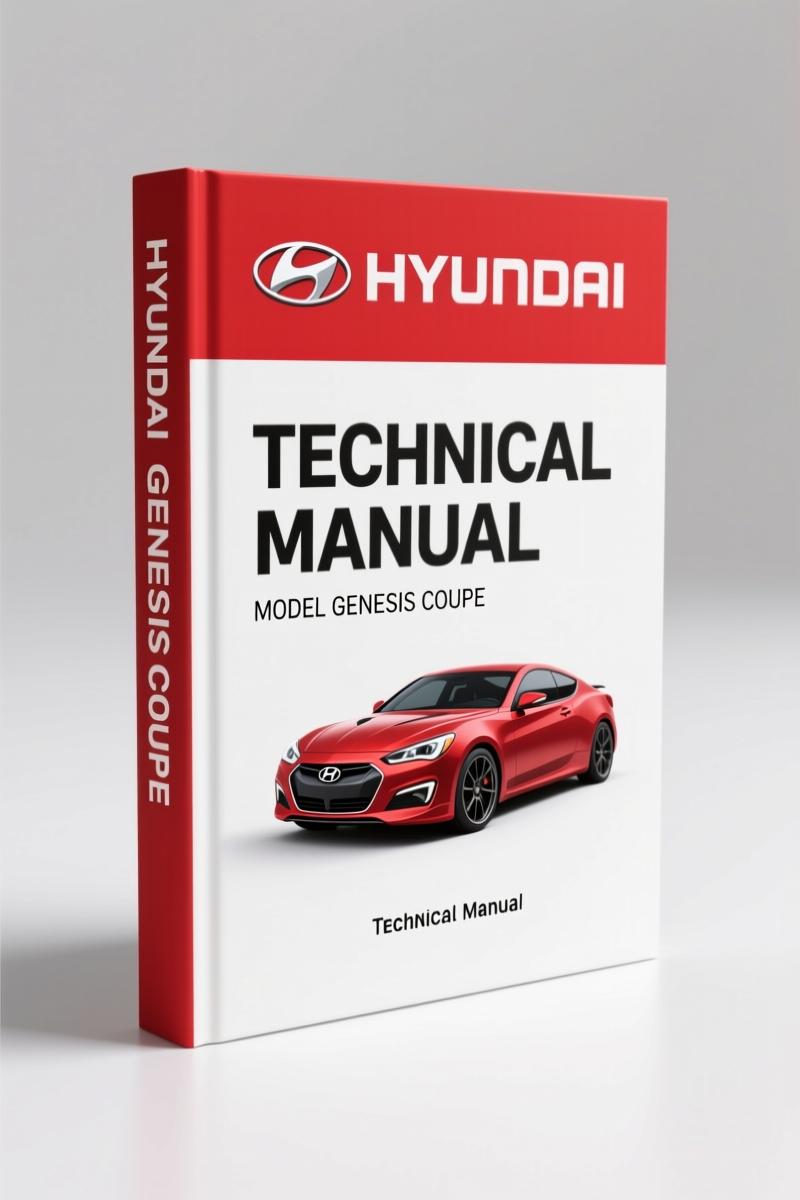
Hyundai Genesis Coupe Technical Manual – 1151 Pages of Factory Specs
Original price was: $39.78.$26.00Current price is: $26.00.
OEM Technical Manual for Hyundai Genesis Coupe. 1151 pages covering Engine, Brake, Electrical, Fuel, and Suspension systems with factory torque values and diagnostic procedures.
Description
Hyundai Genesis Coupe Technical Manual – 1151 Pages of Factory Specs
If you’re reaching for a repair manual for a 2013 Genesis Coupe, you’d better be holding something that came from Hyundai’s engineering group. Not a reprint. Not a compilation from some third-party that never torqued a bolt in their life. This Hyundai Genesis Coupe Technical Manual runs 1151 pages and it’s the only document I let my guys touch when we’re working on a BK chassis. Here’s why.
What Does the Hyundai Genesis Coupe Technical Manual Cover?
Every system that can fail on a Genesis Coupe is broken down in factory order. The Table of Contents lists General Information, Automatic Transaxle System, Body (Interior and Exterior), Body Electrical System, Brake System, Clutch System, Driveshaft and Axle, Emission Control System, Engine Electrical System, Engine Mechanical System, Fuel System, Heating/Ventilation/Air Conditioning, Manual Transaxle System (M6VR2), Restraint, Steering System, and Suspension System. That’s every subsystem from the intake manifold to the rear shock mounts. No generic overviews – each chapter has the actual step sequences and torque tables Hyundai sent to dealerships.
Engine Mechanical System – Torque Sequences That Matter
The Theta-II 2.0 T-MPI and Lambda-II 3.8 GDI engines have different head bolt tightening patterns, and the manual spells them out with exact angles. Page 26 (if memory serves) shows the main bearing cap bolt torque – 18–22 ft-lb plus 44–50° turn. You won’t find that in a Haynes or Chilton. I’ve seen guys snap bolts because they used a generic spec from an online forum. The manual also includes the engine number locations and VIN decoding, so you can verify you’re working on the right variant before ordering parts.
Brake System – Factory Bleed Procedures
Hyundai’s brake chapter covers the ABS modulator bleeding sequence in order: RR, LF, LR, RF. Skip that order and you trap air in the return pump. The manual specifies the exact brake fluid type (DOT 4) and the minimum pedal force for a proper bleed. It also includes the brake pedal height adjustment spec – 5.5–6.1 mm from the pedal pad to the floor mat. Aftermarket manuals often omit that measurement, leaving you to guess pedal feel.
Fuel System – Pressure and Leak Testing
The Fuel System chapter walks through fuel pressure test with the engine running and key ON. For the 2.0T, the regulator pressure should be 51–55 psi with the vacuum line disconnected. If you’re chasing a no-start, the manual shows how to measure injector resistance and Check the fuel pump relay activation sequence. There’s a section on fuel line torque for the high-pressure pump – 14–18 ft-lb. Over-torque the banjo bolt and you’ll crack the pump housing. Under-torque and you get a fuel leak.
Suspension System – Alignment Data from Hyundai
Alignment specs are printed per chassis code. Front camber: –0°30′ ± 1°, caster: +6°00′ ± 1°, toe-in: 0°06′ ± 0°06′. Rear camber: –1°30′ ± 1°, toe-in: 0°12′ ± 0°06′. The manual also includes the coil spring free height and the strut removal procedure so you don’t unwind the spring wrong. I’ve seen techs use generic alignment values and then wonder why the car pulls right on highway.
Body Electrical System – Why Aftermarket Wiring Diagrams Fail
Aftermarket wiring diagrams often combine multiple years. The manual’s Body Electrical System chapter has separate schematics for 2013 specifically. It includes connector pinouts for the smart junction box, BCM, and each control module. When diagnosing a parasitic drain, you need the exact circuit number and fuse location – this manual gives you numbered grounds and splice points. The manual also describes the VIN decoding for the restraint system (seatbelts and airbags).
Source Validity – OEM vs Aftermarket
This is a direct scan from Hyundai’s own technical documentation. No aftermarket publisher has rewritten it. Every torque spec, every trim height, every fluid capacity comes from the same engineering department that designed the car. That matters when you’re replacing a driveshaft and need the CV joint nut torque – 162–188 ft-lb. Aftermarket books sometimes round off to 165 ft-lb, but the factory spec is a range for a reason.
FAQ
- Is this manual specific to the 2013 Genesis Coupe?
- Yes, it covers only the BK chassis for 2013.
- How does this manual compare to aftermarket repair guides?
- Aftermarket guides often combine multiple model years and omit critical steps like the ABS bleed sequence or the exact main bearing torque angle. This manual includes every factory bulletin and spec as published by Hyundai. For example, the manual transaxle section for the M6VR2 unit includes the gear backlash adjustment procedure with a dial indicator – something aftermarket books rarely show. If you follow the aftermarket book, you might install a clutch incorrectly or misalign the shift linkage. This manual prevents those mistakes because Hyundai wrote it for their own techs.
You’ve seen what a bad manual costs in rework time and broken parts. Get the factory document that belongs on your bench. Access the Factory Manual and build it right the first time – or the second time, after you throw the generic book in the trash.
Related manuals you might need: Genesis Coupe (BK) 2013 Identification Number Locations, Hyundai Universe Technical Manual – 16-Page OEM Spec Reference, Hyundai Beta, Alpha, Gamma, Theta, Mu 2012 Technical Manual – OEM Specs. For broader automotive industry standards, see Automotive Industry Overview and learn about Manual Transmission.
Additional information
| Brand | Hyundai |
|---|---|
| Language | English |
4 reviews for Hyundai Genesis Coupe Technical Manual – 1151 Pages of Factory Specs
You may also like…
-
Sale!

Hyundai HDF15-5, HDF18-5 Service Manual – 227 Pages
Original price was: $61.65.$45.00Current price is: $45.00. -
Sale!

Hyundai HD65, HD72, County Training Manual – A/C Diagnostics
Original price was: $65.00.$50.00Current price is: $50.00. -
Sale!

Hyundai HDF50III, HDF70III Service Manual – Factory Repair Specs
Original price was: $70.20.$45.00Current price is: $45.00.
Related products
-
Sale!

2006 Service Manual – International DT 466E, 530E Diesel Engine
Original price was: $67.50.$50.00Current price is: $50.00. -
Sale!

Acura Integra 1998 Service Manual – 1891 Pages Factory OEM Documentation
Original price was: $31.75.$25.00Current price is: $25.00. -
Sale!

1992 Electrical Schematic – International 1000/3000/4000/2554 OEM Wiring Diagrams (132 Pages)
Original price was: $26.40.$20.00Current price is: $20.00. -
Sale!
2004 Acura TSX Wiring Diagram – 73-Page Factory Electrical Schematics
Original price was: $15.88.$9.99Current price is: $9.99.
pro_mechanic –
Perfect factory service manual. It is easily zoomable on my iPad without blur. A must-have for any Hyundai Genesis mechanic doing repairs. Saves me so much dollars.
gearhead88 –
I am very pleased with this purchase. Immediate link after checkout. It helped me to rebuild my Hyundai Genesis electrical system. Highly recommended for mechanics.
William H. –
Outstanding! The document looks clean. A must-have for any Hyundai Genesis DIYer doing maintenance. Saves me a lot of time.
Charles W. –
Highly recommended! Immediate link after checkout. Contains detailed bolt torque specs for Hyundai. I will definitely buy again.