
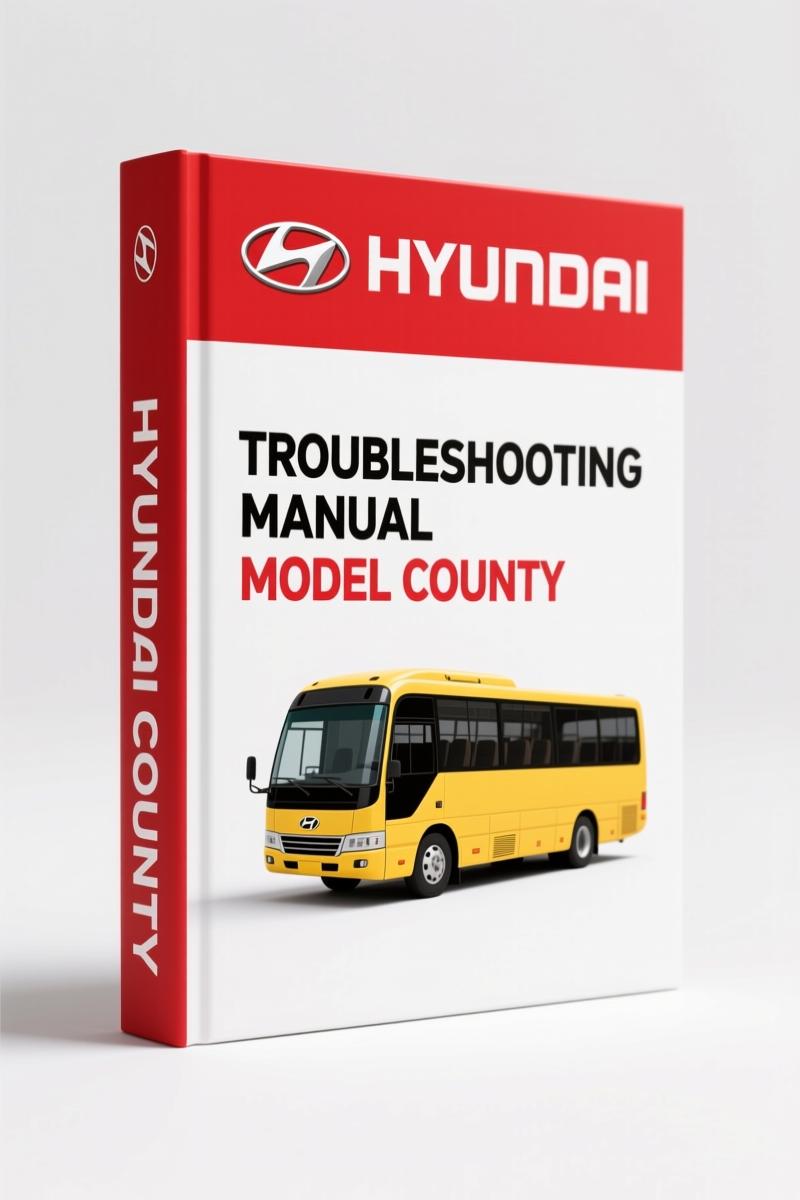
Hyundai County Technical Manual – 27 Pages of Factory Electrical Specs
Original price was: $14.99.$11.99Current price is: $11.99.
Factory electrical system technical manual for Hyundai County (D4DD). 27 pages with alternator, starter, preheating plug specs. No third-party data.
Description
Hyundai County Technical Manual – What You’re Getting
This is the factory Hyundai County Technical Manual for the D4DD engine electrical system. 27 pages, straight from Hyundai. Not a reprint, not a third-party interpretation. If you’re working on a County bus or truck and need to diagnose a no-start, a charging fault, or a preheat failure, this is the document that gets the job done right. I’ve seen too many guys rely on aftermarket wiring diagrams that swap pin 3 and pin 7, then spend an afternoon chasing a ghost. Don’t be that guy.
Let’s walk through what’s inside. The manual breaks the electrical system into four main sections: General, Charging System, Starting System, and Preheating System. Each section includes component descriptions, inspection procedures, and disassembly/reassembly steps. Page 2 gives you the full starting system specification table – starter type, rated output 24V-5.0KW, pinion teeth 9, rotation clockwise from pinion side, and the load test numbers you need to verify after a rebuild. That table alone can save you from bolting in a starter that doesn’t match the ring gear count (114 teeth, center distance 187.2mm). Miss that and the teeth grind in a week.
Charging System: Alternator Disassembly and Inspection
The charging system section (EE-7 through EE-16) gives you step-by-step for the 24V-50A alternator. You get adjustment specs, component breakdown, disassembly order, and inspection criteria. The IC regulator adjusted voltage at 20°C should be 28–29V. If you’re seeing 27.5V on the battery after a full charge, something’s off. The manual tells you exactly how to test the rotor and stator windings. No guesswork. Use the procedure on the disassembly pages to get the alternator apart without cracking the rear housing – that’s a repair I’ve had to redo because someone pried instead of unbolted.
Starting System Specifications – Page 2
Turn to page 2 and you’ll find the starter motor specs laid out in a table. Electronic push-in type, rated 24V-5.0KW, max current 100A, no‑load RPM min 3,300. Magnetic switch operating voltage below 16V. If your starter clicks but doesn’t crank, that switch voltage number tells you the solenoid might be weak. Load test numbers: terminal voltage 9V, max current 1,400A – those are the targets when you bench test a rebuilt unit. I keep a copy of this table in my bay because it saves me from referencing a generic chart that might be off by 10%. Several related manuals will help with adjacent systems: check out the Hyundai County Control System Troubleshooting Manual – Section: Charging System for deeper control module logic, and the Hyundai County Body Electrical System Manual if you’re chasing interior circuit faults. For HVAC electrical, the Hyundai HD65, HD72, County Training Manual – A/C System covers blower and compressor controls.
Preheating System: Glow Plug Inspection (EE-27)
Preheating on a diesel D4DD is critical for cold starts. The manual dedicates a full page (EE-27) to the preheating plug inspection. Specs: rated voltage 23V, resistance 4Ω, temperature increase time 8 ±1.5 seconds to reach operating temp. If a glow plug takes 12 seconds to heat up, it’s dragging down the whole bank. The manual gives you the resistance check and the visual inspection steps. I’ve had a set of plugs pass the 4Ω check but fail under load because of a cracked insulator – the visual inspection catches that. Follow the procedure exactly; skipping the thermal rise test will leave you with a cold‑start complaint next winter.
Troubleshooting Section: Where to Start When It Won’t Crank
The troubleshooting section (EE-5) is laid out in logical flow – battery voltage, starter circuit, alternator output, preheat sequence. It’s not a generic list of “check the battery.” It gives you specific voltage checks at specific terminals. For example, when you measure terminal voltage at the starter during a load test, the spec is 9V with 1,400A draw. If you see 8V under load, the cable or ground is too resistive. The manual tells you to check the magnetic switch operating voltage (below 16V) before condemning the solenoid. That kind of target saves hours.
Why OEM Factory Specs Matter More Than Aftermarket PDFs
I’ve said it before and I’ll keep saying it: aftermarket manuals copy errors. I’ve seen a “universal” Hyundai manual list the alternator output as 28V at all temperatures – this factory manual says 28–29V at 20°C, with a temperature compensation curve that’s implied by the IC regulator adjustment. Use the wrong voltage and you overcharge the MF 90 AH battery (cold cranking ampere 720A at -18°C). Overcharging boils the electrolyte, and then you’re replacing a battery that should have lasted five years. This manual came from Hyundai’s own engineering department – it’s the same one the dealership techs use. You can verify authenticity against Hyundai’s own publications; for a broader perspective on how OEM service information is structured, read this Automotive Industry Overview and understand why manufacturers guard these specs. For another take on the same topic, see Automotive Industry Overview.
Frequently Asked Questions
- Does this manual cover the D4DD engine only?
- Yes, the manual is specifically for the D4DD engine electrical system. It does not cover other County engine variants like the D4GA or D6GA.
- What years/models are included?
- The document does not list a publication year or model year range. It covers the County line equipped with the D4DD engine. Check the VIN or engine tag to confirm your County uses the D4DD.
- Are torque specifications provided for electrical connections?
- No. This manual focuses on electrical diagnostics and component inspection. Torque values for fasteners like alternator mounting bolts or battery terminal nuts are not listed. For those, you’d need the County service manual (chassis/hardware section). This manual provides electrical test specs only.
- Can I use this to rebuild the starter or alternator?
- Yes. It includes disassembly, component inspection, and reassembly procedures for both the starter motor and alternator. The inspection sections (EE-15 for alternator, EE-23 for starter) tell you what to measure and what the acceptable wear limits are. You’ll still need a press and bearing puller, but the step order is correct.
If you’re working on a Hyundai County with a D4DD, this 27‑page technical manual gives you the factory-approved data for the electrical system. Access the factory manual now and get the charging, starting, and preheating specs that match the bus that’s sitting in your bay.
Additional information
| Brand | Hyundai |
|---|---|
| Language | English |
3 reviews for Hyundai County Technical Manual – 27 Pages of Factory Electrical Specs
You may also like…
-
Sale!
Hyundai HD65, HD72, County Training Manual – A/C Diagnostics
Original price was: $65.00.$50.00Current price is: $50.00. -
Sale!
Hyundai HDF50III, HDF70III Service Manual – Factory Repair Specs
Original price was: $70.20.$45.00Current price is: $45.00. -
Sale!
Hyundai HDF15-5, HDF18-5 Service Manual – 227 Pages
Original price was: $61.65.$45.00Current price is: $45.00.
Related products
-
Sale!

Technical Manual – International DT 530 & HT 530 (118 Pages)
Original price was: $37.00.$25.00Current price is: $25.00. -
Sale!

1991 Operators Manual – International Truck OEM Specs (108 Pages)
Original price was: $13.63.$10.99Current price is: $10.99. -
Sale!
Acura NSX 1991 Service Manual – 1420 Pages OEM
Original price was: $102.05.$65.00Current price is: $65.00. -
Sale!

Service Manual – International HS 2.8L Engine – 130 Pages of Factory Specs
Original price was: $56.40.$40.00Current price is: $40.00.
workshop_guy –
Great workshop guide. It is easily zoomable on my laptop without blur. Every torque spec is provided for Hyundai County. Saved my weekend project! Thank you.
William H. –
Excellent factory service manual. The document quality is excellent. Contains precise bolt torque specs for Hyundai. Saves me so much money.
Charles W. –
I am very pleased with this transaction. The scan is high-quality and well indexed. Contains clear wiring diagrams for Hyundai. I will recommend this shop to others.