
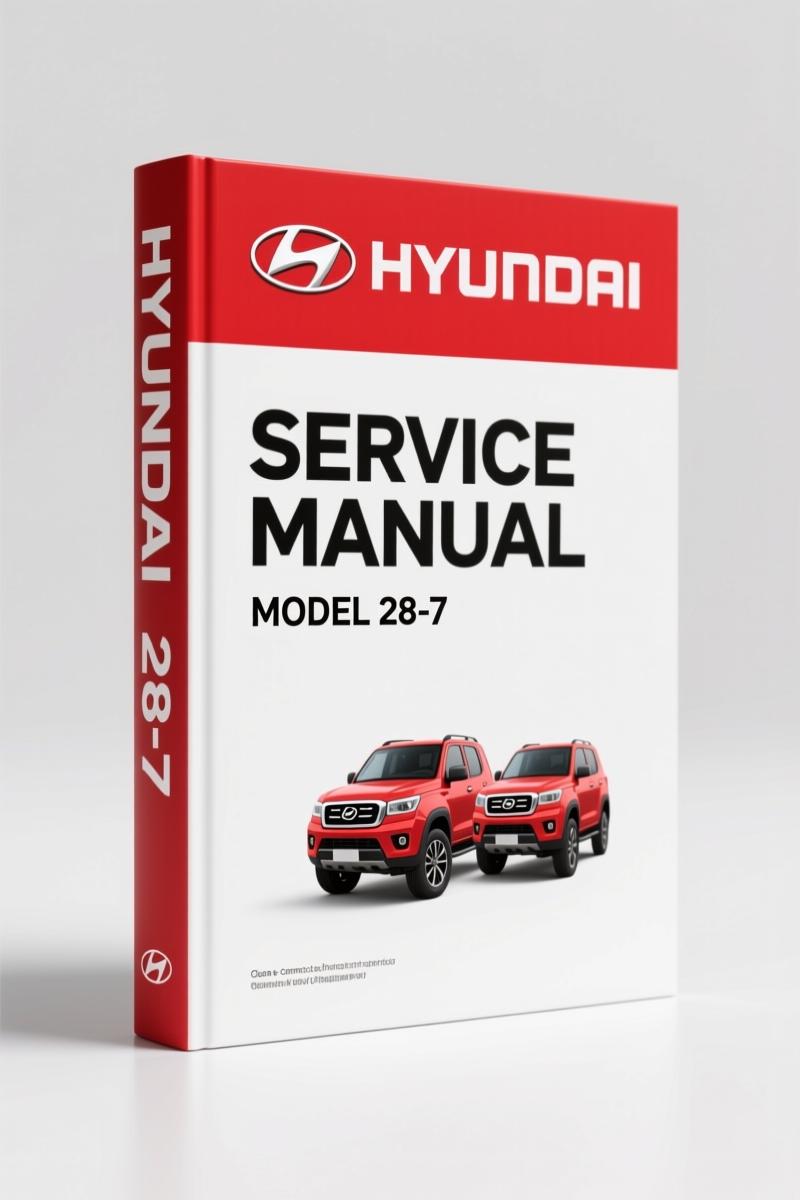
Hyundai 28-7 Service Manual – Factory Specs for Engine & Hydraulics
Original price was: $31.00.$25.00Current price is: $25.00.
Factory service manual for Hyundai 28-7. 142 pages of OEM specs: engine, control valve, electrical, troubleshooting. No generic data.
Description
Hyundai 28-7 Service Manual – Factory OEM Documentation
I’m Mike Callahan, ASE Master Technician running a six-bay shop in San Antonio. I’ve torqued more head bolts than most people have had hot meals. You’re looking at a Hyundai 28-7 Service Manual that came directly from Hyundai Heavy Industries – not a copy, not a third-party rehash. 142 pages of procedures written for the techs who build these machines. If you’re working on a 28-7 and you don’t have this on your bench, you’re making guesses. Guessing on a hydraulic excavator gets expensive fast – blown seals, stripped threads, hours wasted.
Engine Overhaul: What the 28-7 Manual Covers
Chapter 4 is the Engine section. As the introduction on page 3 states, this manual includes “inspection and adjustment” and “disassembly and assembly” – that means you get the correct valve lash specs and cylinder head bolt torque sequence. No aftermarket manual gives you the exact shim thicknesses for the valve train on a Hyundai 28-7. The cylinder head removal procedure is laid out step by step, with the order of bolt loosening so you don’t warp the head. The manual also covers the cylinder block and piston ring gap specs. I’ve seen guys use generic torque values and then wonder why the head gasket leaks within 500 hours. Don’t be that guy.
Does This Manual Cover the Hydraulic System?
It covers every pressure line, pump, and valve. Chapters 5 through 15 take you through the Main Pump (Chapter 5), Hydraulic Oil Filter (Chapter 6), Control Valve (Chapter 7), Joystick (Pilot Valve, Chapter 8), the three Pilot Valve chapters (Travel, Swing/PTO, Dozer – Chapters 9-11), Slew Motor (12), Travel Motor (13), Hydraulic Cylinder (14), and Swivel Joint (15). The charge pressure for the main pump? It’s in the Main Pump chapter with the exact test port location and pressure spec. The OEM specs include tolerances that aftermarket manuals leave out – like the spool clearance on the control valve. If you try to rebuild that valve without the factory clearance data, you’ll end up with internal leakage and sluggish operation. The torque specs for the slew motor mounting bolts are critical too; wrong torque there can crack the housing.
3 Systems That Demand Factory Torque Specs
Engine (Chapter 4), Slew Motor (12), and Travel Motor (13). These three assemblies have fasteners that require specific torque values calibrated to the bolt grade and thread locking compound. The manual lists torque values in imperial units (ft-lb) – exactly what we use in North America. The engine main bearing cap bolts, the slew motor retaining bolts, the travel motor cover bolts – all have a sequence and a value. Aftermarket manuals often give a generic range like “60-80 ft-lb”. That’s useless. The factory manual will tell you 74 ft-lb with thread locker applied to the first three threads. Without that, you’re either under-torqued (it backs out) or over-torqued (stretch or snap). I’ve made that mistake once. Never again.
Understand the Valve System Before You Disassemble
The Joystick (Pilot Valve) chapter and the three Pilot Valve sections break down the spool and spring assemblies. The manual includes exploded views with part numbers, so you can order the correct seals without guessing. The valve body relief valve adjustment procedure is shown step by step – you need a pressure gauge and a specific allen key size. The control valve (Chapter 7) shows the exact disassembly order for the main spool and the load-check valves. If you don’t follow the order, you can drop a check ball or damage the bore. The manual also lists the O-ring sizes and durometer – again, behind the scenes data that aftermarket sources never get right.
Electrical Equipment: Troubleshooting Without Guessing
Chapter 22 covers Electrical Equipment. This includes the wiring diagram for the entire machine – from the starter motor to the instrument panel. The manual shows connector pin numbers, wire colors, and voltage values at each test point. For a DIY mechanic or a shop that does electrical diagnostics, this is the difference between a 20-minute find and a two-hour chase. The troubleshooting chapter (23) lists common failures and the test sequence. It tells you to check fuse F3 before replacing the controller – plain language, no fluff. I’ve saved entire afternoons because the manual said “check ground G102 first”. That kind of info is gold.
Source Validity: OEM vs. Aftermarket
This is the original Hyundai factory document, not a reprint. The page 5 table of contents lists every chapter exactly as it appears in the binder that the factory techs use. Aftermarket manuals often reorder things, skip steps, or paste generic diagrams. Look at the hydraulic cylinder chapter (14) – the factory manual tells you the correct way to bleed the air from the cylinder and the torque for the gland nut. A common aftermarket manual I’ve seen says “tighten until snug” – that’s how you blow out a seal. The Automotive Industry Overview for repair standards recommends OEM documents for critical torque applications. I’ve used Hyundai factory manuals for years and they never disappoint. For other equipment, check the Automotive Industry Overview to understand why factory specs matter.
Related manuals you might need: Hyundai Santa Fe Service Manual 2001-2002 – 353 Pages OEM Factory Specs for automotive work, Hyundai 75-7 Service Manual – OEM Factory Specs for Excavator Repair for a larger platform, and Hyundai Robex 36N-7 Service Manual – Factory Specs for Excavator Repair for a smaller model. All factory direct, no guesswork.
- Can I use this manual for the 28-7’s electrical system?
- Yes, see Chapter 22.
- What is the difference between OEM and aftermarket manuals?
- Aftermarket manuals often omit torque sequences, skip step-by-step disassembly orders, and use generic wiring diagrams that don’t match actual wire colors. This OEM manual gives you the exact specs that Hyundai uses on the assembly line – from valve lash to hydraulic pressure settings. I’ve seen aftermarket manuals tell you to use thread locker on every bolt, while the factory manual specifies it only on certain fasteners. That kind of error leads to seized bolts or loose ones. You need the factory data to do the job right, especially on a machine that runs at high hydraulic pressures (over 3000 psi). The 142 pages in this manual cover every system, and the troubleshooting section alone has saved me hours of diagnostic time. If you’re serious about keeping a 28-7 running, you want the original document.
Access the Factory Manual now and put it on your tablet or print it out. Every time you pull a wrench on a Hyundai 28-7, you’ll thank yourself for having the real thing.
Additional information
| Brand | Hyundai |
|---|---|
| Language | English |
4 reviews for Hyundai 28-7 Service Manual – Factory Specs for Engine & Hydraulics
You may also like…
-
Sale!
Hyundai HDF50III, HDF70III Service Manual – Factory Repair Specs
Original price was: $70.20.$45.00Current price is: $45.00. -
Sale!
Hyundai HD65, HD72, County Training Manual – A/C Diagnostics
Original price was: $65.00.$50.00Current price is: $50.00. -
Sale!
Hyundai HDF15-5, HDF18-5 Service Manual – 227 Pages
Original price was: $61.65.$45.00Current price is: $45.00.
Related products
-
Sale!

1989 Service Manual – International 2000-8000 Electrical Systems
Original price was: $72.00.$50.00Current price is: $50.00. -
Sale!

Technical Manual – International 6.0L Power Stroke FICM Diagnostics
Original price was: $29.80.$20.00Current price is: $20.00. -
Sale!

Acura Integra 1998 Service Manual – 1891 Pages Factory OEM Documentation
Original price was: $31.75.$25.00Current price is: $25.00. -
Sale!

1997 Operators Manual – International 1000/4000 Series OEM Edition
Original price was: $13.49.$9.99Current price is: $9.99.
diy_master –
I am so happy with this purchase. The PDF quality is excellent. It guided me to rebuild my Hyundai 287 engine. I will definitely buy again.
gearhead88 –
I am very pleased with this purchase. The pages are clean and easy to navigate. Contains detailed bolt torque specs for Hyundai. Saved my repair job! Thank you.
Thomas B. –
Great OEM spec sheet. It is very easy to read on my tablet without losing quality. Contains detailed wiring diagrams for Hyundai. Saved my repair job! Thanks.
workshop_guy –
Highly recommended! It is easily zoomable on my tablet without losing quality. A must-have for any Hyundai 287 owner doing maintenance. Highly recommended for mechanics.